Gaming & Culture
How Florida Man Ended Up in GTA 6
Florida Man isn’t a man. He’s a filing system. How a 1909 law, a Wawa alligator and a birthday meme became part of the world GTA 6 satirizes.
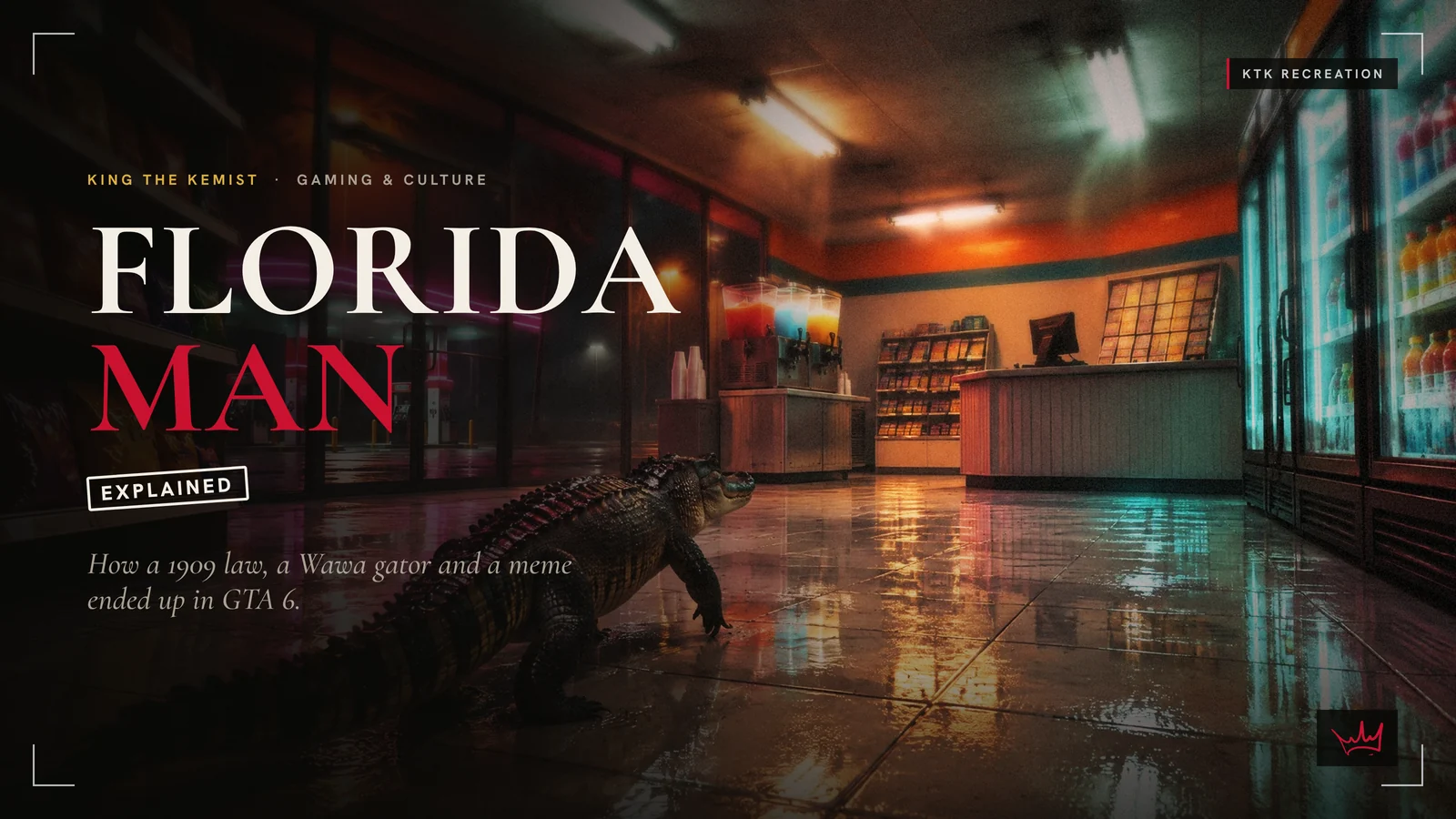
Florida Man isn't a man. He's a filing system.
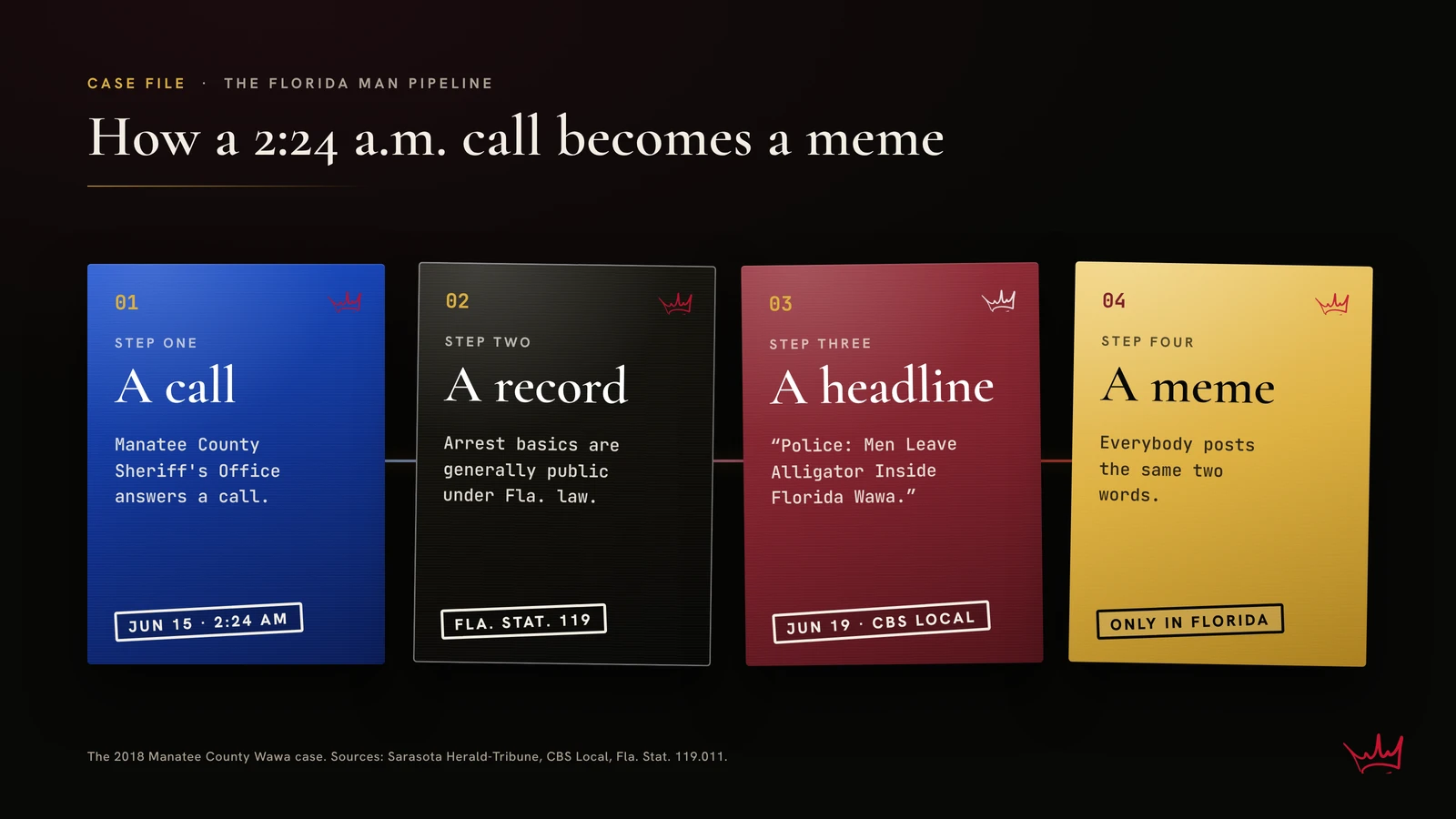
I know that sounds like the start of a conspiracy video. It's the opposite. Once you see how the filing system works, "Florida Man" stops looking like a mystery about one strange state and starts looking like a pipeline anybody could draw on a napkin. A call. A record. A headline. A meme. And at the far end of that pipeline, a video game set in a state called Leonida.
Why is it always Florida Man? Florida’s public-records laws give reporters a way into unusual local stories. Once those stories become headlines, the internet can pick them up and pass them around for years. I’m following one of those stories, a 2018 call about an alligator in a Wawa, to see how that process works and why Rockstar’s fictional Leonida already felt familiar.
In this article
- A gator walks into a Wawa
- So what is Florida Man, really?
- Why is it always Florida Man?
- 23.5 million people and 1.3 million gators
- The Florida Man birthday challenge
- The part that's harder to laugh at
- How GTA 6 built Leonida out of headlines
- Florida Man did the world-building for free
- So, is Florida the craziest state in America?
- FAQ
In the first trailer for Grand Theft Auto VI, an alligator walks into a convenience store. Funny. Very Florida. Very made up. Except, five years before that trailer, deputies in Florida got a call about a real gator inside a real Wawa. The two scenes make a good parallel. One went through the local news, and the other arrived as part of a story Rockstar was telling about a fictional state. Let me open that file first, because it shows the whole machine in one week.
A gator walks into a Wawa
Friday, June 15, 2018, at about 2:24 in the morning, the Manatee County Sheriff's Office answered a call about an alligator inside a Wawa near State Road 70 and Lorraine Road, out by Lakewood Ranch. Deputies contacted the Florida Fish and Wildlife Conservation Commission, and a trapper removed the gator. A sheriff’s office spokesperson told reporters the animal appeared to have been injured. CBS Miami’s June 19 report
Then the sheriff's account reached the press. By Tuesday, June 19, TV station sites across the country were running the same headline: "Police: Men Leave Alligator Inside Florida Wawa." Fox News ran it as two suspects being sought. The news story was now about the search for the people believed to have brought a reptile to a gas station. CBS Miami · Fox News · UPI
By June 19, a wildlife call from one county was news in markets far from Lakewood Ranch. It already had the ingredients for the line everybody knows. Only in Florida.
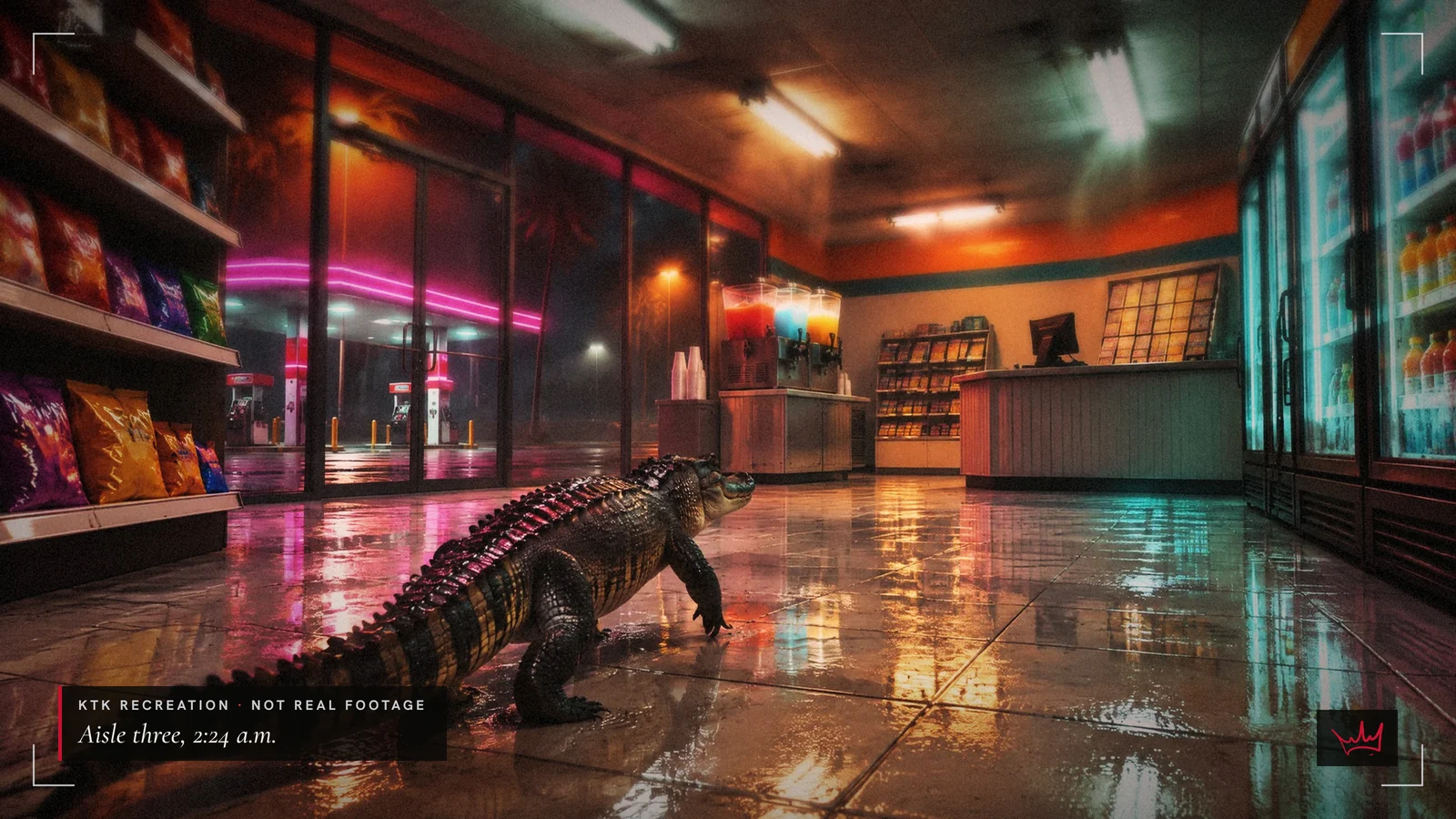
The June 26 follow-up reported that wildlife officials had issued a notice to appear over the alleged illegal taking or possession of an alligator. The person cited was seventeen years old. WKMG / AP · Philadelphia Inquirer
Two things about that. Cited isn't convicted. That's a different file, and I'm not going to pretend I've read it. And the headline said men. The person cited was a teenager. On paper, at least, Florida Man was a Florida teen. By the time that update came out, it didn't matter. The joke had already been told.
That's the pipeline in one week. A call. A record. A headline. A meme. Most people only ever see the last two steps. The interesting part is the first two.
The early story and the later story answer different questions. The first one tells you what a deputy was called to deal with. The second tells you what wildlife officials believed they could charge. The version you tell your friend probably has three words in it: gator, Wawa and Florida. I get it. If I say all three out loud, I've already made you picture the whole thing. I haven't even told you what happened to the alligator yet.
Look how much the shortest version gets to leave out. A store has a location. A call has a time. The report comes with someone's account of what they saw. The animal was apparently hurt. As the story gets passed around, each person decides which details are worth carrying. An alligator under fluorescent lights is easy to carry. The next week's update takes an extra sentence and ruins the rhythm a little. That little loss of rhythm is where you can watch a story become a joke.
So what is Florida Man, really?
If you somehow missed it, "Florida Man" is the internet's name for a genre of news story: a headline that opens with those two words and then describes somebody's very bad decision. Florida Man fights a vending machine. Florida Man brings a gator somewhere a gator shouldn't be. The phrase works because the reader already knows the tone before they hit the verb.
The question everybody eventually asks is why it's always Florida. The lazy answer is that Floridians are crazier than the rest of us. There's no record that proves that, and I'm not going to try. Nobody I'd trust has shown that Florida has more weird nights per person than your state. The better answer is boring on paper and fascinating once you follow it.
It comes down to records, volume, wildlife and the internet. CNN's 2019 explainer pointed at the same pile: public-records laws, a big population, the weather, and gaps in mental-health funding. CNN
Let's take them one at a time.
Ira P. Robbins, writing in the Florida State University Law Review, challenges the usual explanation that Florida's law by itself gives reporters some advantage nobody else has. That's a useful test for the theory. You'd need to compare what other states actually release, and then compare what their newsrooms pick up. The existence of a law and the existence of a meme make a good starting point. There's a lot of work in the steps between them. Robbins, Explaining Florida Man
Why is it always Florida Man?
First, let's be fair to everybody else. Every state in America has its own public-records law. Reporters Committee Open Government Guide
But Florida's version is old, it's specific and it's in the constitution.
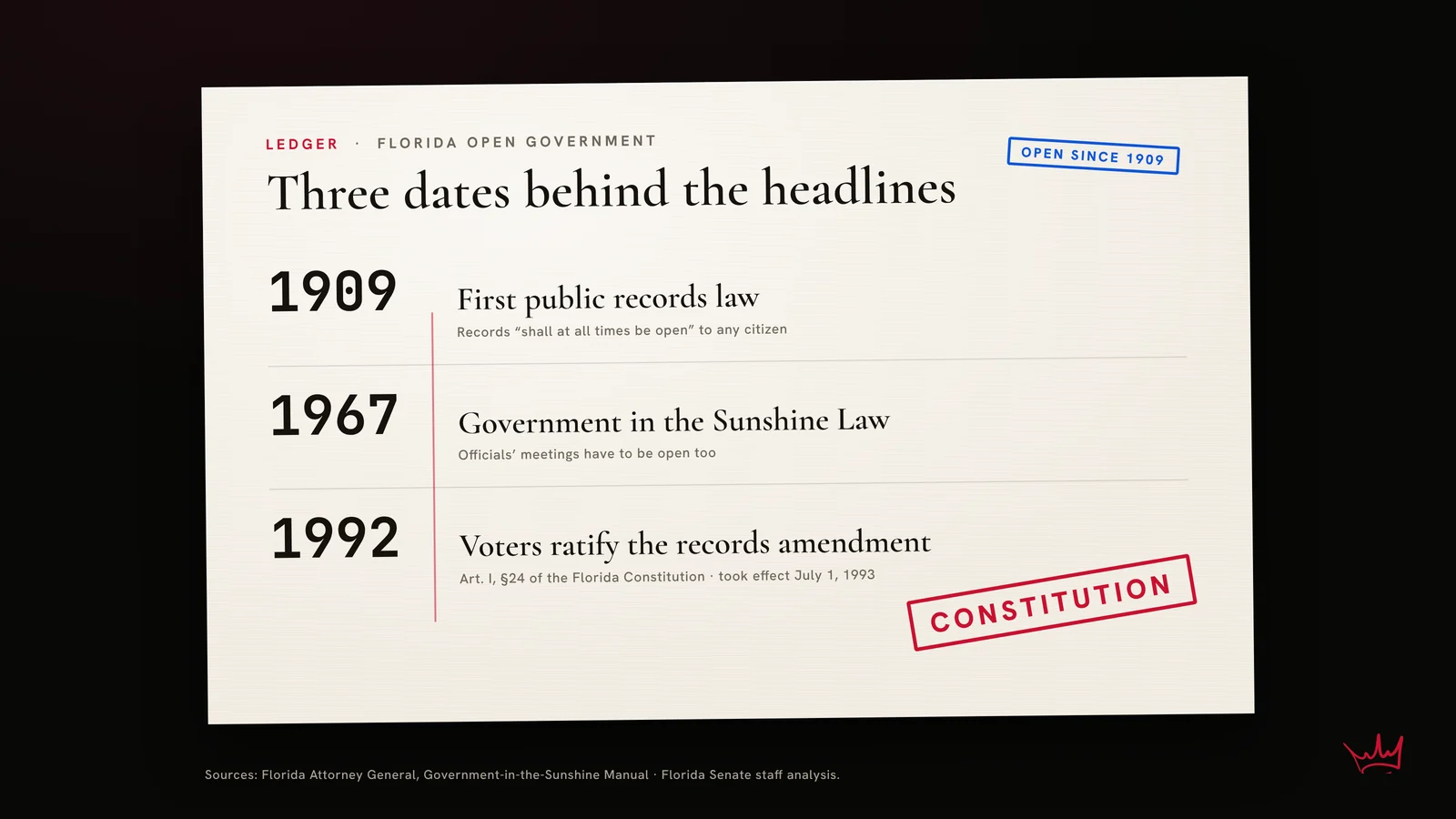
- 1909. Florida passes its first public-records law. The law established public access to government records. The modern public-records statute sits in Chapter 119. Florida Senate staff analysis
- 1967. The Government in the Sunshine Law. The Government in the Sunshine Law set open-meeting rules for covered public boards. Florida Attorney General
- 1992. Florida voters put the right to inspect public records into the state constitution itself, covering all three branches of government. It took effect July 1, 1993. Florida Constitution, Article I, Section 24 · 1992 amendment text
So what does that mean for an arrest? Florida law spells it out. The name of the person arrested, the crime charged, and the time, date and place of the arrest are carved out of what counts as "criminal investigative information." In plain English, those basics are generally public. Fla. Stat. 119.011
Not everything is open. Active criminal intelligence and active investigative information can be held back while a case is being worked. Fla. Stat. 119.071 But the who, what, when and where of an arrest? Generally open.
Now put yourself in a newsroom. You need a story by lunch. In Florida, the basic facts of an arrest are a public record, written down in a format that's built to be read. You often have enough to start asking better questions before the whole case is settled.

A public record can tell you what an agency wrote down at a particular point. A reporter still has to decide what deserves a call back, and an editor still has to decide what belongs in a headline. Imagine two stories that start with the same kind of document. One might turn into a week of reporting about how an agency handles repeat calls. The other is running online by lunchtime because there's an alligator in the picture. Same door into the story. Very different reasons for walking through it.
I like the right to see the paperwork. It means that the institution doesn't get to be the only one telling the story about itself. The same right also gives a writer the chance to decide how much of someone else's worst night the reader really needs. The access and the judgment are separate jobs. A headline can do the second job well even if it makes you laugh.
That's the filing system. Florida isn't the only state with weird nights. It's a state where a right to see certain public records goes back more than a century.
23.5 million people and 1.3 million gators
Paperwork is half of it. The other half is volume.
Florida has about 23.5 million people. The Census Bureau's estimate for July 1, 2025, was 23,462,518, which makes it the third most populous state, behind California and Texas. U.S. Census Bureau · QuickFacts: Florida
That's before you count the tourists, the spring breakers and the snowbirds who come down every winter with a boat they don't know how to drive. More people means more calls. More calls means more reports. More reports means more headlines. That isn't a theory about Florida's character. That's arithmetic.
Then there's the wildlife. Florida's wildlife agency estimates there are about 1.3 million wild alligators in the state, and they've been found in all 67 counties. Not just the Everglades. Golf courses. Retention ponds. Backyard pools. The Wawa. Florida Fish and Wildlife Conservation Commission · FWC alligator brochure
To be fair to the gators, they're not out here hunting people. The same agency says serious bites are rare. FWC You don't need a bite to make the news, though. You need a gator somewhere a gator shouldn't be, and a phone pointed at it.
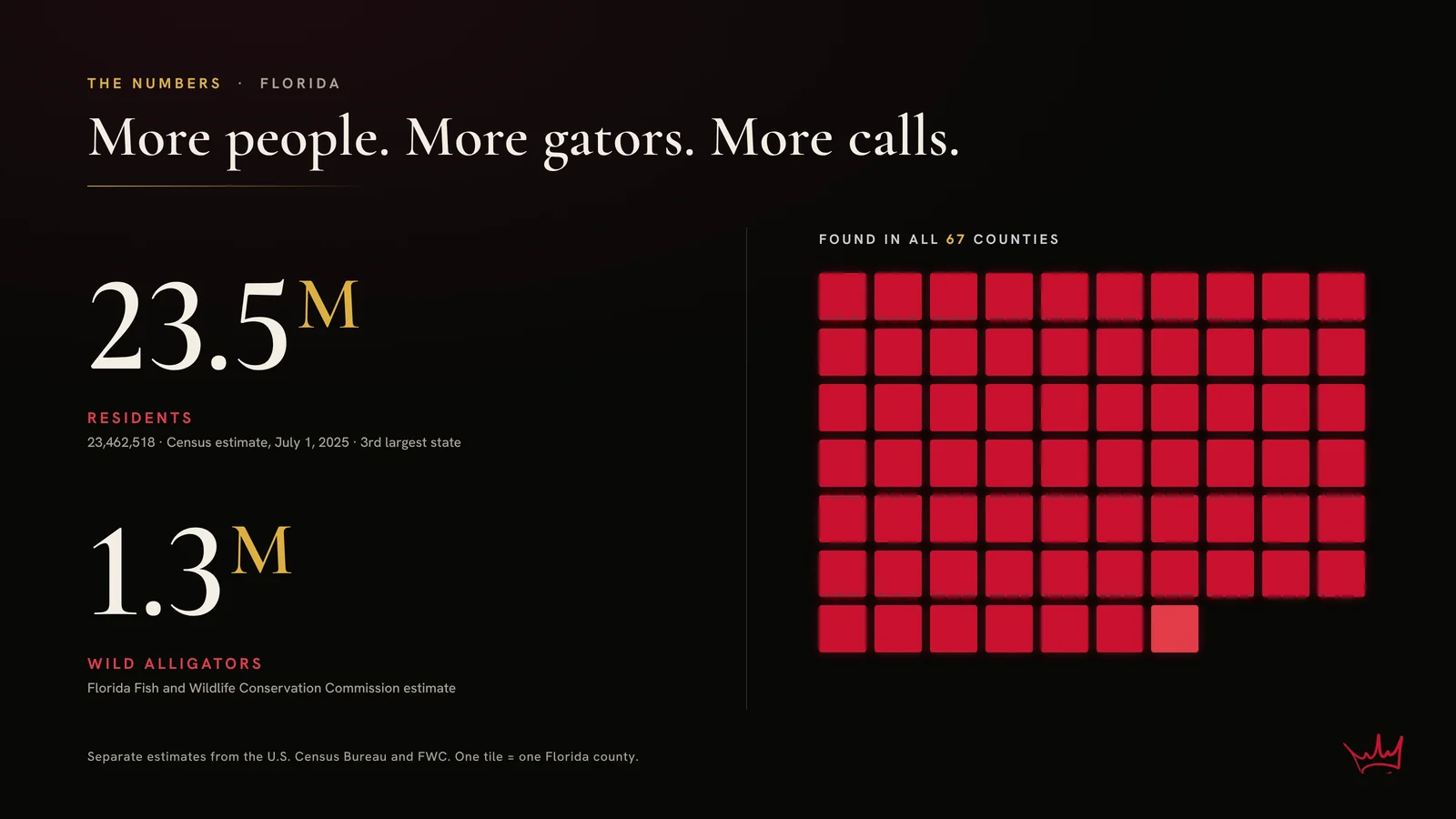
There's a difference between counting animals and counting encounters. The wildlife agency's figure estimates the animals in Florida. It doesn't measure how often a gator shows up around people, much less how often an editor decides to write about one. A gator in suitable habitat has a whole day it can spend without anybody thinking there's news in it. Get the same animal next to a shopping cart and suddenly we're all animal correspondents. That's a story about what people notice as much as it is a story about the number of gators.
Stack it up. Old, open records. Twenty-three million people. Visitors all year. Dinosaurs in the drainage ditch. That's not a state. That's a content farm.
The Florida Man birthday challenge
Somebody had to turn all that into a brand.
In early 2013, a Twitter account called Florida Man showed up. Its bio called him the world's worst superhero, and one of its first posts was about a man arrested after pocket-dialing 911. No radioactive spider. No tragic backstory. Just a man, his pocket and a dispatcher listening to the whole thing. Washington Post Magazine · AP
The account kept going, same two words up front every time. By 2019 it had close to half a million followers. Columbia Journalism Review
Then, in March 2019, it went nuclear. The Florida Man challenge: type "Florida Man" plus your birthday into Google and post whatever comes up. Your aunt did it. Your pastor did it. People shared their results like horoscopes. CNN
That's when "Florida Man" stopped being a headline and became a format. Two words, and the reader already knows the vibe. They're going to click, they're going to share and they're going to tag their friend from Tampa. Newsrooms had every reason to keep feeding it.
The birthday version changed the role of the reader. You could go looking for an installment even when there was no new headline worth talking about. A story from years earlier could become new to you because it contained June 15. Then it could become new to everybody you sent it to. That's a different kind of shelf life from the one the original reporter probably imagined.
It also made the story feel like it had picked you. Search for a date, get a Florida Man, send it to the person who knows exactly why you thought of them. You can be halfway into the joke before you've looked at where the story came from. I think the absurdity does a lot of the work, but so does the little question the format leaves open. What did I get? What did you get?
The part that's harder to laugh at
That same year, the Columbia Journalism Review ran a piece that didn't hold back. It's commentary and reporting, not a formal study, but it's worth sitting with. Its author argued that the genre often turns stories about addiction, mental illness and homelessness into entertainment. Columbia Journalism Review
So let's be grown about this for a second. Sometimes Florida Man is a man having the worst night of his life, and the whole country is reading it like a comic strip. That's also why you won't find a single mugshot or real name in the video or in this article. The point is the system, not the person.
You can still laugh. A man fighting a vending machine is funny. That's physics. Just know what you're laughing at.

How GTA 6 built Leonida out of headlines
In December 2023, Rockstar dropped the first trailer for Grand Theft Auto VI. It drew 90,421,491 YouTube views in its first 24 hours, setting the record for a video game reveal trailer. Guinness World Records
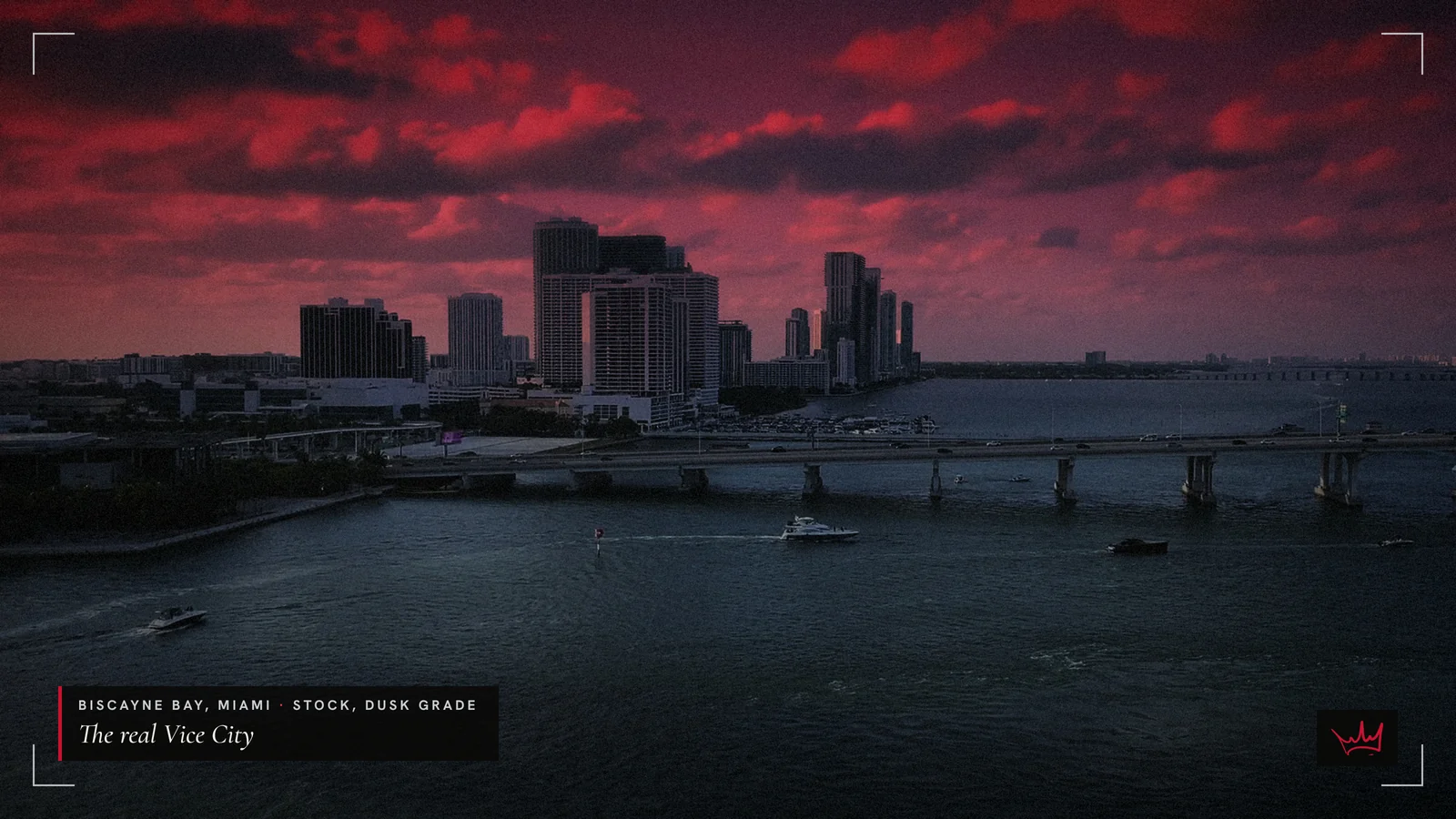
Is GTA 6 set in Florida? Basically, yes. The game takes place in a fictional state called Leonida, which is Rockstar's version of Florida. Its big city is Vice City, Rockstar's Miami. Rockstar’s Only in Leonida
And what got people screaming in the comments wasn't the palm trees. It was the Florida Man energy. Gaming sites spent the next few days matching trailer moments to viral Florida clips: SVG · GameRant · BroBible

| In the trailer | In real life |
|---|---|
| A gator walks into a convenience store | A real gator turned up inside that Manatee County Wawa, June 15, 2018 |
| A gator gets pulled out of a swimming pool | Florida wildlife officials field calls about alligators in places such as pools |
| A man waters his lawn wearing nothing | Gaming sites matched it to a real Florida headline |
| A mugshot with a face full of tattoos | Fans have compared it to a viral Florida booking photo |
| A fake news ticker with a gag headline | The local-news format itself is the joke |
Here's the important part. The first trailer confirms what Rockstar put on screen. The 2018 reporting confirms a similar incident inside a real Wawa. The sources here support that comparison. The leap from resemblance to a specific creative source takes evidence from the people who made it. Anybody who's been online in the last ten years knew exactly what they were looking at.
Rockstar has always roasted real America. Liberty City is New York. Los Santos is LA. Vice City has always been Miami. I wrote about that satire, and about how strange it felt to get the new game in a year that already reads like parody, in The World Feels Like It's Ending… And GTA 6 Just Dropped. This time Rockstar didn't just copy a skyline. They built a fictional version of a state that people were already used to seeing in headlines, shaky phone clips and local-news graphics. The delivery is part of what feels familiar.
Florida Man did the world-building for free
Think about how efficient that is from a game designer's chair.
You don't have to explain the setting. You show a gator in a gas station, and the player's brain goes, oh, I know exactly where I am. More than ten years of headlines, millions of people sharing them and a whole country trained to recognize the vibe in half a second. That's world-building you'd normally spend a whole opening mission on, and it was sitting there, already done, already funny.
And the whole thing starts somewhere small. A phone call at 2:24 in the morning. A record that Florida has been required to keep open, in one form or another, since 1909.
So, is Florida the craziest state in America?
There's no record that proves it.
What Florida has is a long habit of writing things down and letting people read them. A lot of people. A lot of gators. And an internet that turned the paperwork into a punchline. Then Rockstar turned the punchline into a world.
So next time a headline starts with those two words, remember what you're looking at. Not a crazy man. An open file.
Florida Man isn't a man. He's a filing system.
Want to see how the series got from Los Santos to Leonida? Read Why GTA V Still Feels Like Home After 13 Years or pick a station and take the long way with the free GTA free-roam pack.
What's your Florida Man birthday headline? Keep the person’s name and photo out of it.
FAQ
What is Florida Man?
"Florida Man" is an internet nickname for news headlines that start with those two words and describe a strange arrest or incident in Florida. A Twitter account built around it launched in early 2013, and a birthday-search challenge made it a widely shared meme in March 2019.
Why is it always Florida Man?
Records and volume help explain the meme. Florida's public-records law dates to 1909. Voters approved a constitutional right of access in 1992, effective July 1, 1993. The basics of an arrest are generally public, subject to exemptions. Add about 23.5 million residents, year-round visitors and about 1.3 million alligators, and you get a lot of stories that are easy to report. Every state has public-records laws; Florida's are old, broad and well known to reporters.
Is GTA 6 set in Florida? GTA 6 is set in Leonida, a fictional state based on Florida, with Vice City as its version of Miami.
Did Rockstar base GTA 6 on real Florida Man stories?
Gaming sites matched several trailer moments to viral Florida clips, like a gator walking into a convenience store. The public sources cited here establish parallels between published reports and what appears in the trailer. They leave the specific creative sources open.
What is the Florida Man challenge?
In March 2019, people searched "Florida Man" plus their birthday and shared the headline that came up. It went viral and helped turn the phrase into a format.