Money & Making
How to Ask for a Raise (and Actually Get It): Timing, Numbers and Scripts
If your raise is smaller than inflation, you got a pay cut with a nicer name. Here's when to ask, how to find your number, exactly what to say and what to do if they say no. Plus a raise calculator and script builder.

Here's the uncomfortable math nobody puts in the onboarding packet: if your raise is smaller than inflation, you got a pay cut with a nicer name. 😂
Prices were up 3.7% in the 12 months ending September 2026, according to the Bureau of Labor Statistics. The typical company salary budget for 2026 sat around 3.4% to 3.5%. So if you just sat there, did great work and waited for somebody to notice, there's a real chance you went backwards.
Jump to the Raise Calculator ↓
That's why this matters. Asking for a raise isn't greedy, it isn't rude and it isn't some advanced corporate chess move. It's maintenance. Same as changing the oil. And the good news is that it works more often than people think: in a LendingTree survey of full-time workers, 82% of the people who asked for a raise got one.
So let's do this properly. Here's when to ask, how to figure out your number, what to say (word for word), how to handle a "no," and the mistakes that kill the conversation before it starts. Plus there's a raise calculator and script builder further down so you can walk in with real numbers.

Quick answer: how to ask for a raise
If you only read one section, read this one:
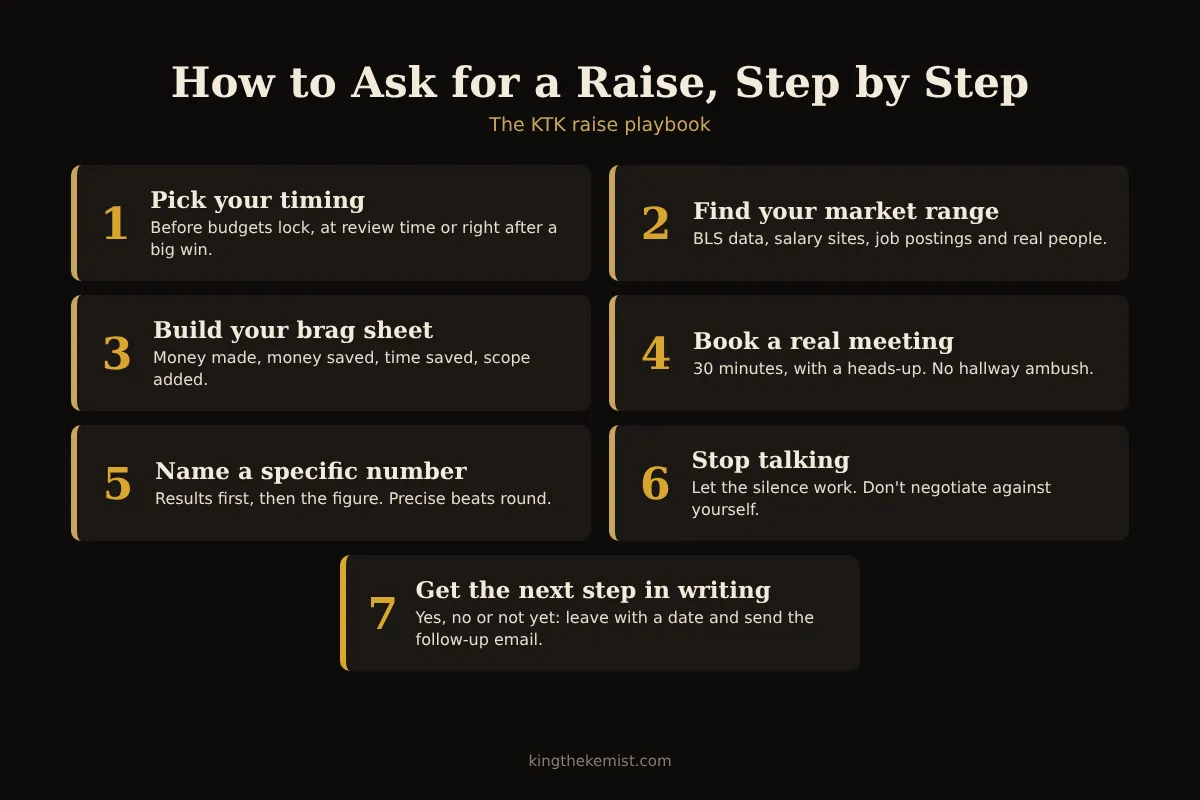
- Pick your timing. Ask before budgets get locked, after a big win, or at your review. Not on a random Friday when your boss is drowning.
- Find your market number. Look up what your role pays in your area. Know your range before you walk in.
- Build your case. Write down what you've delivered, with numbers: money made, money saved, time saved, problems fixed, responsibilities added.
- Book a real meeting. "Can we set up 30 minutes to talk about my compensation?" Not an ambush in the hallway.
- Say a specific number. Lead with your results, then name the figure. Specific beats round.
- Then stop talking. Let them respond. Silence is part of the move.
- Get the next step in writing. Whether it's a yes, a no or a "not yet," leave with a date and a follow-up email.
Now the full breakdown.
Why you have to ask (instead of waiting to be noticed)
I get it. Most of us were raised to believe that if you work hard, keep your head down and don't complain, the reward comes on its own. Sometimes it does. But a lot of the time it doesn't, and it's not because your boss is evil. It's because of how pay actually works inside most companies.
Raise budgets are small and they're spread thin
Every year, companies set a pool of money for raises. Then managers split it up across their team. According to The Conference Board, the median salary increase budget for US companies was 3.5% in 2026 and is projected to stay at 3.5% in 2027. Payscale's 2026–2027 Salary Budget Survey puts the average increase budget for 2026 at 3.4%. Mercer's March 2026 survey found the average merit increase employers actually paid was 3.1%.
That pool is an average. Some people get more, some get less, and some get nothing. The people who make a clear, documented case are the ones who make it easy for a manager to justify giving them the bigger slice.
Inflation doesn't care about your loyalty
Remember that 3.7% inflation number. If you get the "standard" 3% bump while prices go up 3.7%, your paycheck buys less than it did a year ago. You'd have to ask just to stay even.
People who switch jobs often get paid more
The Atlanta Fed's Wage Growth Tracker follows how much people's pay grows over a year. In September 2026, the median pay growth for people who stayed in the same job was 3.4%. For people who changed jobs, it was 4.7%. That gap is one of the biggest reasons people leave. And it's exactly why a smart manager would rather give you a fair raise than replace you.

Asking actually works
Back to that LendingTree survey from October 2024: 82% of full-time workers who asked for a raise got one. About half of those raises (51%) were less than $5,000, so not everybody hit a jackpot. But most people who asked got something, and you can't get something if you never ask.

When to ask for a raise
Timing isn't everything, but bad timing can kill a good case. Here's when your odds are better and when they're worse.
Good times to ask
- Before budgets are set. A lot of companies plan next year's pay months ahead. If you wait until your review, the money may already be spoken for. Ask your manager when budget planning happens and get your request in before it closes.
- At your performance review. This is the expected time to talk pay. Just don't let it be the first time your manager hears about it. Give them a heads-up weeks before.
- Right after a big win. You closed the deal, launched the project, fixed the disaster or covered for somebody for three months. Your value is fresh in everybody's mind.
- When your job got bigger. If you've taken on new responsibilities, managed people, or you're basically doing the job above yours, that's a strong, clean reason.
- When you've learned your market rate is higher. If your research shows you're underpaid, that's a fact you can bring to the table.
Bad times to ask
- During layoffs, hiring freezes or a rough quarter. You can still ask, but your odds are lower. In that case, it can be smarter to ask for a date to revisit, or for something other than base pay.
- Right after you messed up. Let the dust settle. Stack a few wins first.
- When your boss is slammed. Don't pitch your raise in the middle of a fire drill. Book a calm meeting instead.
- As a threat. "Pay me more or I'm out" only works if you're truly ready to leave. Otherwise you just told your boss you're a flight risk.
How to figure out your number
This is where most people blow it. They walk in with "I think I deserve more" and nothing else. "More" is not a number. You need a real figure and a reason for it.
Step 1: Research what your role pays
Look at a few different sources so you're not relying on one site's guess:
- The Bureau of Labor Statistics. The BLS Occupational Employment and Wage Statistics data and the Occupational Outlook Handbook show pay ranges by job and area. It's free and it's the government's data.
- Salary sites. Glassdoor, Payscale, Indeed and LinkedIn all show pay estimates. Treat them as ballpark numbers, not gospel.
- Job postings. More and more postings list a salary range. Look up jobs like yours in your area and see what companies are offering right now.
- Real people. Ask friends in your field, former coworkers or people in industry groups. Some won't share, some will. Every data point helps.
What you want at the end is a range: the low end, the middle and the high end for someone with your title, experience and location.
Step 2: Place yourself in that range
Be honest. Are you new to the role? Probably in the lower or middle part of the range. Have you been crushing it for years, training other people and handling harder work? You belong in the upper part.
Step 3: Pick a specific number
Once you know your range, choose a specific number toward the upper part of what you can justify. Then use that exact number when you ask.
Why specific? There's actual research on this. In a 2013 study in the Journal of Experimental Social Psychology, Malia Mason and her colleagues found that precise opening numbers worked as stronger anchors in negotiations than round ones. People who heard a precise number made smaller counteroffers, because a precise number sounds like you did your homework. So "$71,500" can land better than "around $70k."
Step 4: Know your walk-away point
Decide, before the meeting, the lowest number you'd be happy with and what you'll do if you get less. You don't have to say it out loud. You just need to know it so you don't panic and accept the first thing they say.

How to build your case
Your manager probably has to go to their boss or to HR to get your raise approved. Your job is to hand them the ammunition. Make it easy for them to say yes and easy for them to defend it.
Write your "brag sheet"
Open a doc and list everything you've delivered since your last raise. Use numbers wherever you can:
- Money: sales you closed, revenue you brought in, costs you cut.
- Time: processes you sped up, hours you saved the team.
- Scope: new responsibilities, people you trained or manage, projects you own.
- Wins: launches, saves, client praise, problems you solved that nobody else wanted to touch.
- Skills: certifications, new tools you learned, things you now do that you couldn't do a year ago.
"I worked really hard" isn't evidence. "I took over the vendor contracts in March and cut our software costs by $18,000 a year" is evidence.
Tie it to what the company cares about
Your boss doesn't care that you're tired. Your boss cares about results, the team's goals and not losing good people. Frame everything you did in their language: revenue, savings, customers, deadlines, risk.
Keep it about value, not need
Here's a hard one: your rent going up is real, but it's not your employer's problem. Pay is supposed to be tied to the work and the market. Make the case about what you deliver and what the market pays. That's what gets approved.
What to say: raise scripts you can steal
You don't need to sound like a lawyer. You need to sound prepared and calm. Here are scripts for every step.
To book the meeting
"Hey, can we grab 30 minutes this week or next? I'd like to talk about my role and my compensation."
That's it. No drama. Giving them a heads-up is a courtesy, and it gives them time to check what's possible before you sit down.
To open the conversation
"Thanks for making time. Over the past year I've taken on [new responsibility] and delivered [result with a number]. I've also looked at what this role pays in our market, and I'd like to talk about bringing my salary up to [specific number]."
If they ask "What number did you have in mind?"
Say your number. Don't say "whatever you think is fair." That's handing them the pen.
"Based on my results and what the market pays for this role, I'm asking for [specific number]."
After you say the number
Stop. Let it sit. Don't fill the silence with "but I understand if that's too much" or "or whatever works." Silence is not rejection. It's them thinking.
If they say "Let me think about it"
"Totally fair. When do you think you'll have an answer? I'll send over a quick summary of what we talked about today so you have it if you need to share it."
Then actually send the email. It helps your manager make your case upstairs.
If you're asking over email
Sometimes a manager is remote or prefers writing. Keep it short:
Subject: Time to talk about my compensation
Hi [Name], I'd like to set up a time to talk about my compensation. Over the past year I've [two or three results with numbers]. Based on that and my research on market pay for this role, I'd like to discuss bringing my salary to [number]. Would [day/time] work?
Then have the real conversation live if you can.

The raise calculator and script builder
Plug in your current salary, your target and the latest inflation number. It'll show what your raise is worth after inflation and spit out an opening line you can use.
THE KTK RAISE CALCULATOR
YOUR OPENING LINE
Inflation default: BLS CPI, 12 months ending September 2026. Change it to whatever's current. Numbers are before taxes.
How to handle a "no"
Not every ask is a yes on day one. A "no" isn't the end. It's information.
Ask why
"I appreciate you being straight with me. Can you help me understand what's behind it? Is it the budget, the timing or something about my performance?"
Each answer leads somewhere different:
- Budget: ask when the budget opens up again, and get a date.
- Timing: ask for a specific follow-up date and put it on the calendar.
- Performance: ask exactly what you'd need to show to earn it, and by when.
Get a plan in writing
"Can we agree on what I'd need to do to get there, and come back to this in [three or six] months?"
Then send a follow-up email that spells out what you agreed to. A verbal "we'll see" is easy to forget. An email isn't.
Ask for something else
If base pay really is frozen, other things can still have real value:
- A one-time bonus
- A better title (which helps your next raise or your next job)
- Extra paid time off
- A remote or flexible schedule
- Paid training, certifications or conference tickets
- A guaranteed review date with a specific number attached
Know when it's time to look elsewhere
If you keep hitting "no" with no plan, no date and no reason, that's an answer too. Remember the Atlanta Fed numbers: job switchers have been getting bigger pay jumps than people who stay. Start quietly looking, and let the market tell you what you're worth.

Should you use another job offer to get a raise?
This one's risky, so let's be real about it.
If you get an outside offer, you can bring it to your current employer. Sometimes they match or beat it. But it can also change how they see you. Some managers will start wondering if you're on your way out regardless.
Only use an offer as leverage if you'd genuinely be happy taking it. If you'd stay no matter what, don't bluff. If they call it, you've lost leverage and some trust in one shot.
Raise mistakes that kill the conversation
- Asking with no number. "I deserve more" leaves the number up to them.
- Making it about your bills. Real, but not their call. Keep it about value and market.
- Comparing yourself to a coworker by name. "Jessica makes more than me" puts your boss in an awkward spot and drags Jessica into it. Use market data instead.
- Ambushing your boss. Book a meeting. Give them time to prepare.
- Apologizing for asking. You're not doing anything wrong. Drop the "sorry to bring this up."
- Accepting the first counter on the spot. It's fine to say "Let me think about it overnight."
- Never following up. If they said "next quarter," you bring it back next quarter. With the email.
- Threatening to quit when you won't. Bluffs get called.

What about asking for a raise at a new job?
If you're getting hired somewhere new, that's actually your best moment to negotiate, because your starting salary sets the base every future raise builds on. Same rules apply: research the range, name a specific number, focus on value and get the final offer in writing. A few thousand more at the start compounds every single year after.
Frequently asked questions
How much should I ask for in a raise? It depends on your role, your market and how much your job has grown. Company raise budgets have been running around 3% to 3.5%, and inflation was 3.7% in the year ending September 2026. If you're underpaid compared to the market or you've taken on a much bigger role, it can make sense to ask for more than the standard bump. Let your market research decide the number.
When is the best time to ask for a raise? Before your company sets next year's budget, at your performance review, right after a big win, or when your responsibilities have grown. Avoid layoffs, freezes and the week your boss is buried.
How do I ask for a raise without sounding greedy? Lead with your results, back your number with market data and stay calm. Asking for fair pay for the work you do isn't greedy. It's normal business.
What do I do if my boss says no? Ask why, ask what you'd need to do to earn it, get a follow-up date and put it in writing. If base pay is frozen, ask about a bonus, title, time off or training.
Should I ask for a raise in person or by email? In person or on a video call is usually best, because it's a conversation. Email works for booking the meeting and for the follow-up summary afterward.
How often should I ask for a raise? Usually once a year at most, unless your job changes in a big way, like a promotion or a major new responsibility.

The bottom line
Nobody is coming to hand you your money. Not because they hate you, but because raise budgets are small, managers are busy and the squeaky wheel with receipts gets the grease.
So do the homework. Know your number. Write down your wins. Book the meeting. Say the number and then shut up. 😂 And if they still won't pay you what the market says you're worth, the market is right there waiting.
Go get your bread.
— King
Sources
- Consumer Price Index, U.S. Bureau of Labor Statistics
- US Salary Increase Budgets 2026–2027, The Conference Board
- 2026–2027 Salary Budget Survey, Payscale
- 2026 actual increase budgets (March QuickPulse), Mercer
- Wage Growth Tracker, Federal Reserve Bank of Atlanta
- Pay raises survey (October 2024), LendingTree
- Precise offers are potent anchors, Columbia Business School (Mason, Lee, Wiley and Ames)
- Occupational Employment and Wage Statistics, BLS
- Occupational Outlook Handbook, BLS
Sources checked November 10, 2026.