Pets
Basenji: The Barkless Dog, Explained by Somebody Who's Lived With Them
The yodel, the escape attempts, the cat-like grooming and the health stuff nobody tells you. A real guide to the Basenji from somebody who's had them, with every breed fact checked against the AKC, the Basenji Club of America and BRAT.

A Basenji won't bark at you like other dogs do. You might get one short, single "woof" now and then, but mostly it will yodel at you, stare at you like it's judging your life choices, steal your sock, clean itself like a cat and then try to escape over a fence you thought was tall enough.
And if it picks you, you're done. You're a Basenji person now.
I've had Basenjis. I lost my last one about two years ago, in February, on a full moon. That's the kind of detail you remember. I'm looking at adopting again through a Basenji rescue, which is part of why I wanted to write this. Most of what's online about this breed is either a cute listicle or a breeder's sales page. I wanted to write the version I'd actually give a friend who said, "Yo, I'm thinking about getting a Basenji."
So here's the real rundown: what a Basenji is, why it yodels instead of barking, what living with one is like, the health stuff you need to know, rescue versus breeder, and whether this dog is actually right for you. Every breed fact here is checked against the American Kennel Club, the Basenji Club of America and Basenji Rescue and Transport.

What is a Basenji?
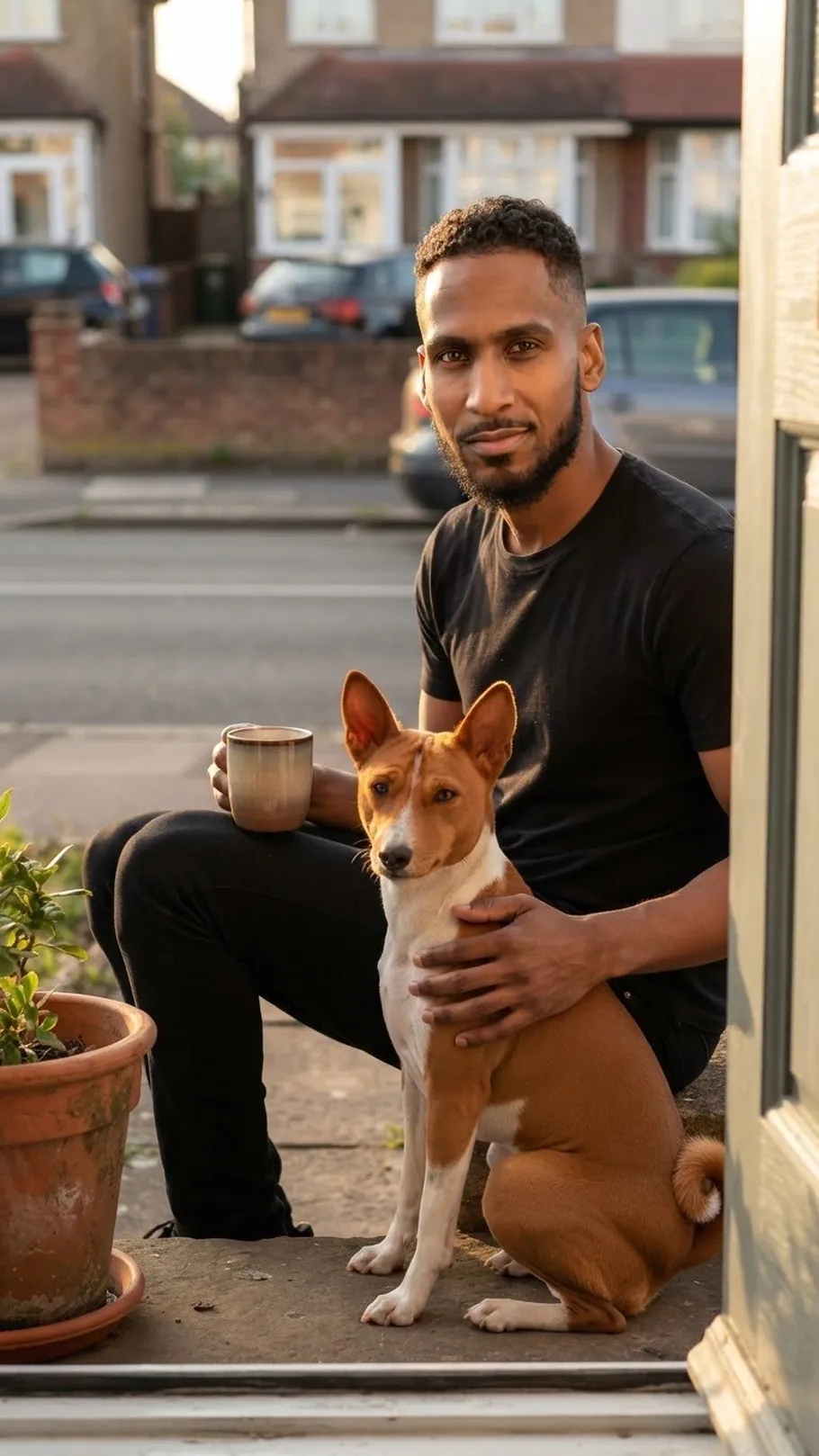
The Basenji is a small, short-coated hunting dog from Central Africa. The American Kennel Club calls it "Africa's 'Barkless Dog'" and describes it as "a compact, sweet-faced hunter of intelligence and poise." It's in the AKC's Hound Group and was recognized by the AKC in 1944.
The quick stats, according to the AKC:
| Male | Female | |
|---|---|---|
| Height | 17 inches | 16 inches |
| Weight | 24 pounds | 22 pounds |
| Life expectancy | 13–14 years | 13–14 years |
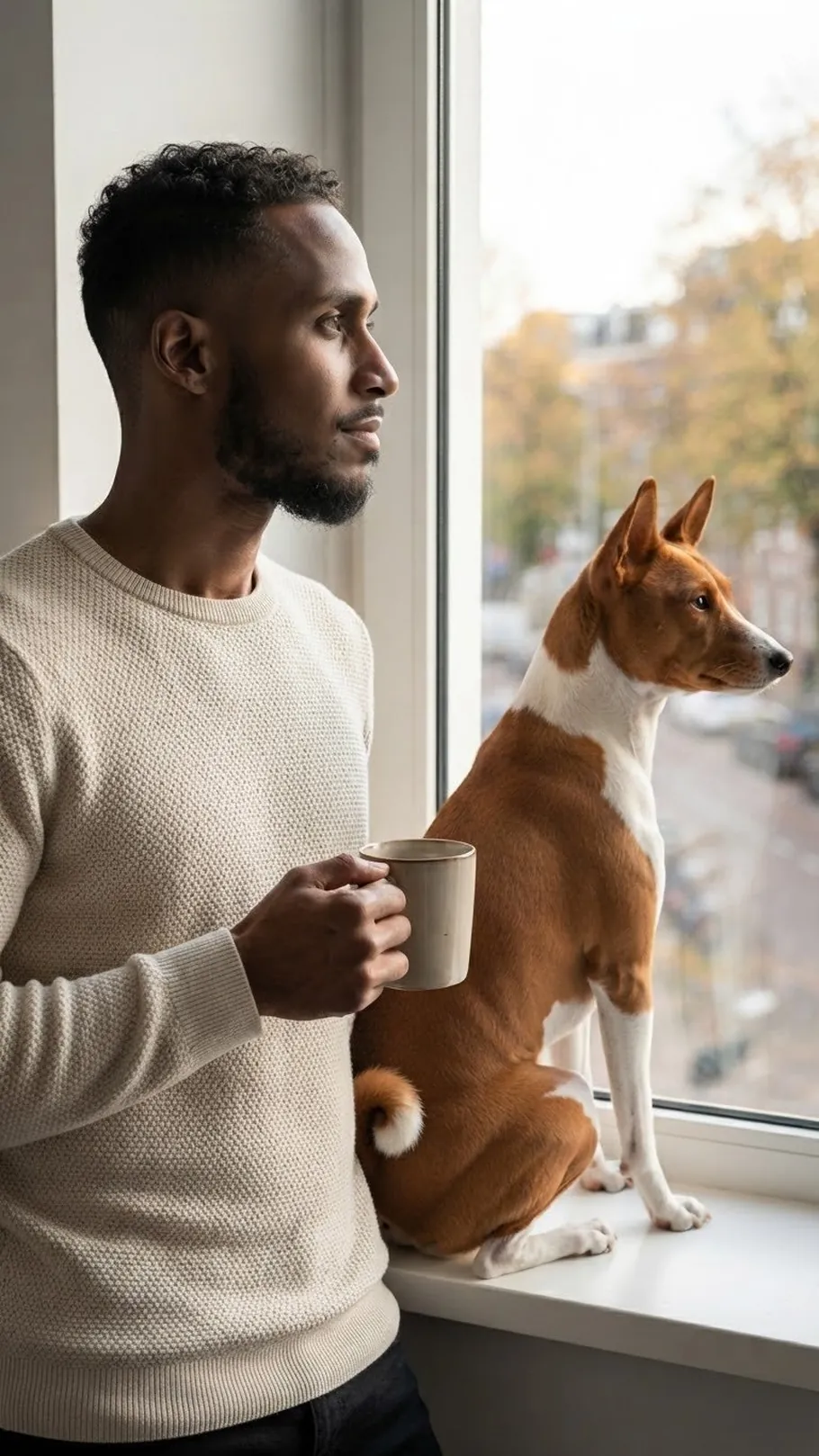
You'll recognize one by the wrinkled forehead that makes them look worried or deep in thought, the upright ears, the tight curled tail and the way they move, light and springy, like they're part deer.
Where Basenjis come from
Basenjis are an old type of dog from the Congo region of Central Africa, where people used them to hunt and to drive game into nets. The AKC repeats the old story that the first Basenjis were brought from the source of the Nile as gifts to the pharaohs of ancient Egypt. Whether you take that literally or not, the point stands: this is an ancient kind of dog, not a modern designer breed, and a lot of its personality comes from that hunting past.
Basenji colors
The breed standard recognizes four main color patterns, all with white markings on the feet, chest and tail tip:
- Red and white. The one most people picture.
- Black and white.
- Tricolor. Black, white and tan.
- Brindle and white. Black stripes on a red background.
The barkless dog: the Basenji yodel
This is the thing everybody asks about first. Do Basenjis bark?
Not like other dogs. The AKC puts it plainly: "they don't bark, but they make their feelings known with an odd sound described as something between a chortle and a yodel." Basenji people call it a barroo, a yodel, a howl or just "the noise."
Don't hear "barkless" and think "silent," though. A Basenji can let out an occasional short bark, and on top of that they can:
- Yodel when they're excited, happy to see you or want something.
- Scream. A Basenji scream is loud and dramatic, and it will make your neighbors think something terrible is happening. Usually it's because the dog is annoyed.
- Growl, whine and grumble. They have opinions, and they share them.
So if you live in an apartment and want a dog that won't bark at every delivery, a Basenji is an interesting option. Just know you're trading barking for a whole different soundtrack.
What living with a Basenji is actually like
They're cat-dogs
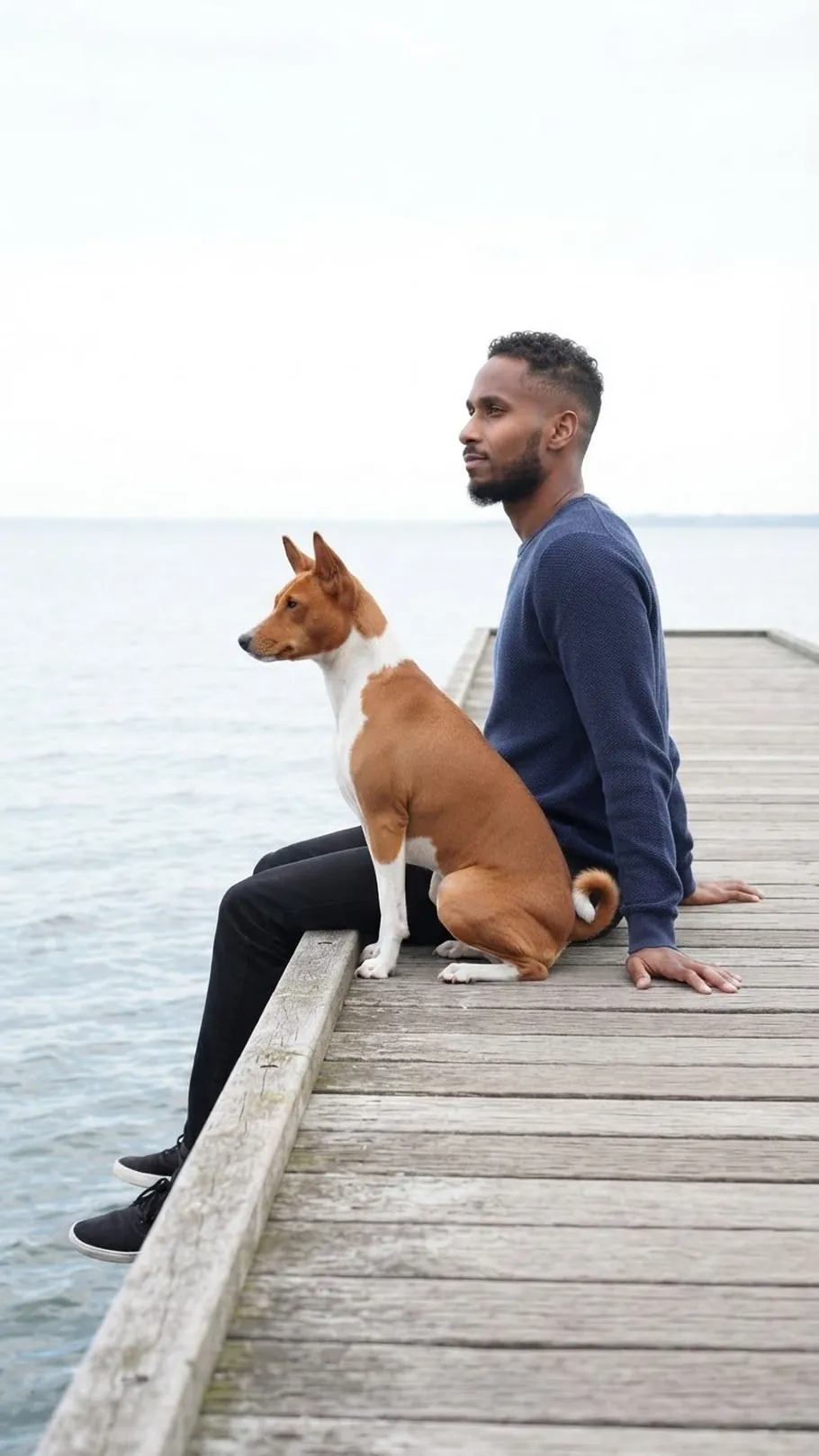
The AKC says Basenjis "are fastidious and will groom themselves like cats." People also describe them as catlike in other ways: they like high spots, they can be aloof, they do what they want and they often hate getting wet. Their short coat sheds lightly, and they're known for having little doggy odor.
They're independent and smart
This is a hound bred to hunt by sight and make its own decisions. The AKC describes the breed as "quite independent and aloof at times," and notes they "lose interest quickly, so training sessions should last no more than five or 10 minutes." Basenjis can absolutely learn, and they're clever. But they don't live to please you like a Labrador does. They're always quietly asking, "What's in it for me?"
Positive training works. Treats work. Repetition with a Basenji who's bored does not.
They will try to escape
Basenji Rescue and Transport, the biggest Basenji rescue in the country, is blunt about this. Basenjis have a high prey drive and "will instantly give chase after anything that moves," from a squirrel to "a piece of tissue paper flying by." BRAT won't even place a dog in a home that uses an electronic or invisible fence, because a Basenji in chase mode will blow right through the shock and then has no reason to come back.
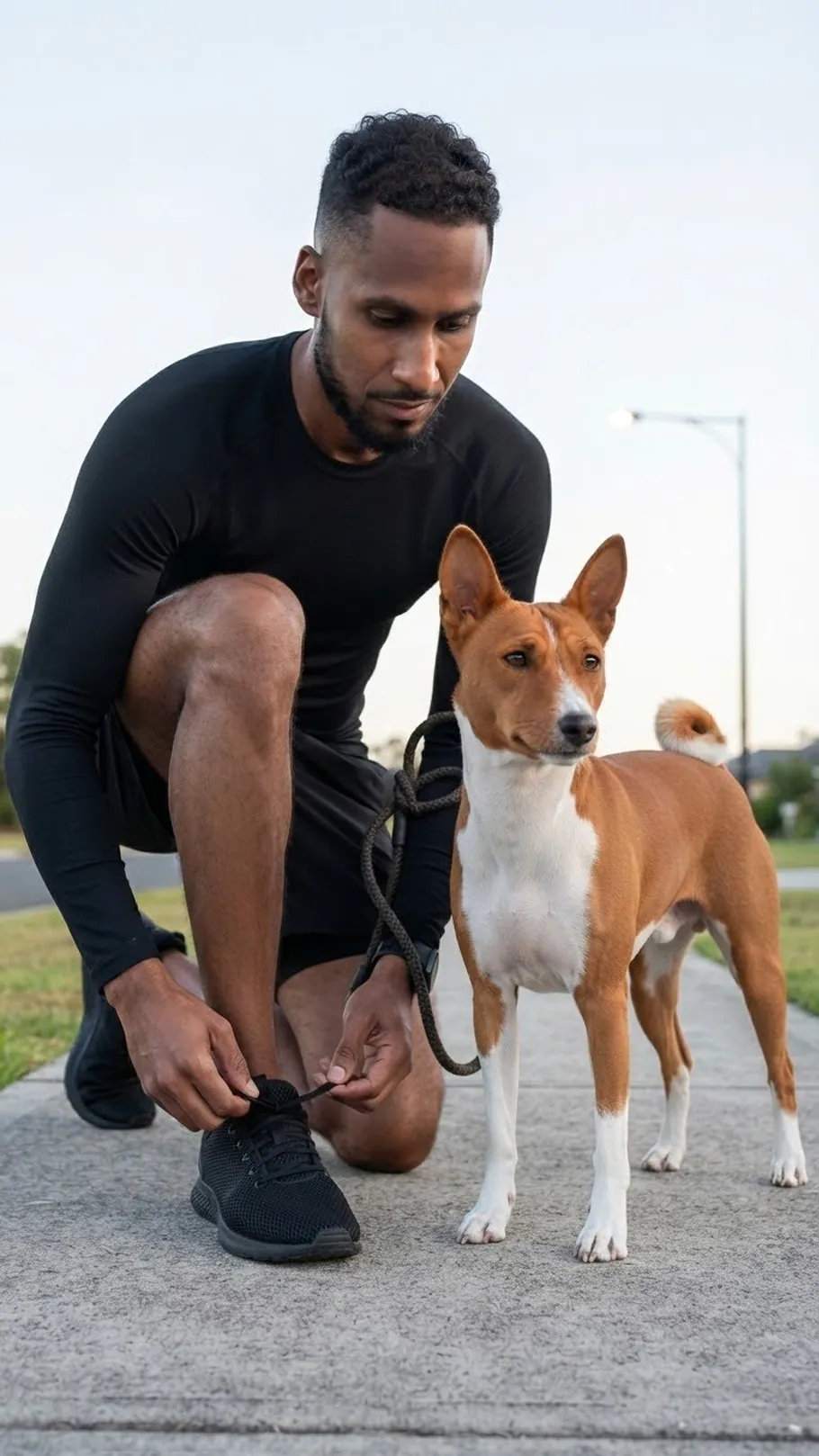
Their recommendation for outdoor containment is a 6-foot privacy fence. And the AKC says a Basenji "should never run loose." Translation: this is a leash-or-fence dog for life. Off-leash hikes and dog-park recall are not the move.
They're energetic, then they're couch potatoes
Basenjis need real exercise every day: walks, play, sprints in a fenced yard, lure coursing if you want to go all in. A tired Basenji is a good Basenji. A bored Basenji eats your couch, your shoes, your remote and possibly your drywall.
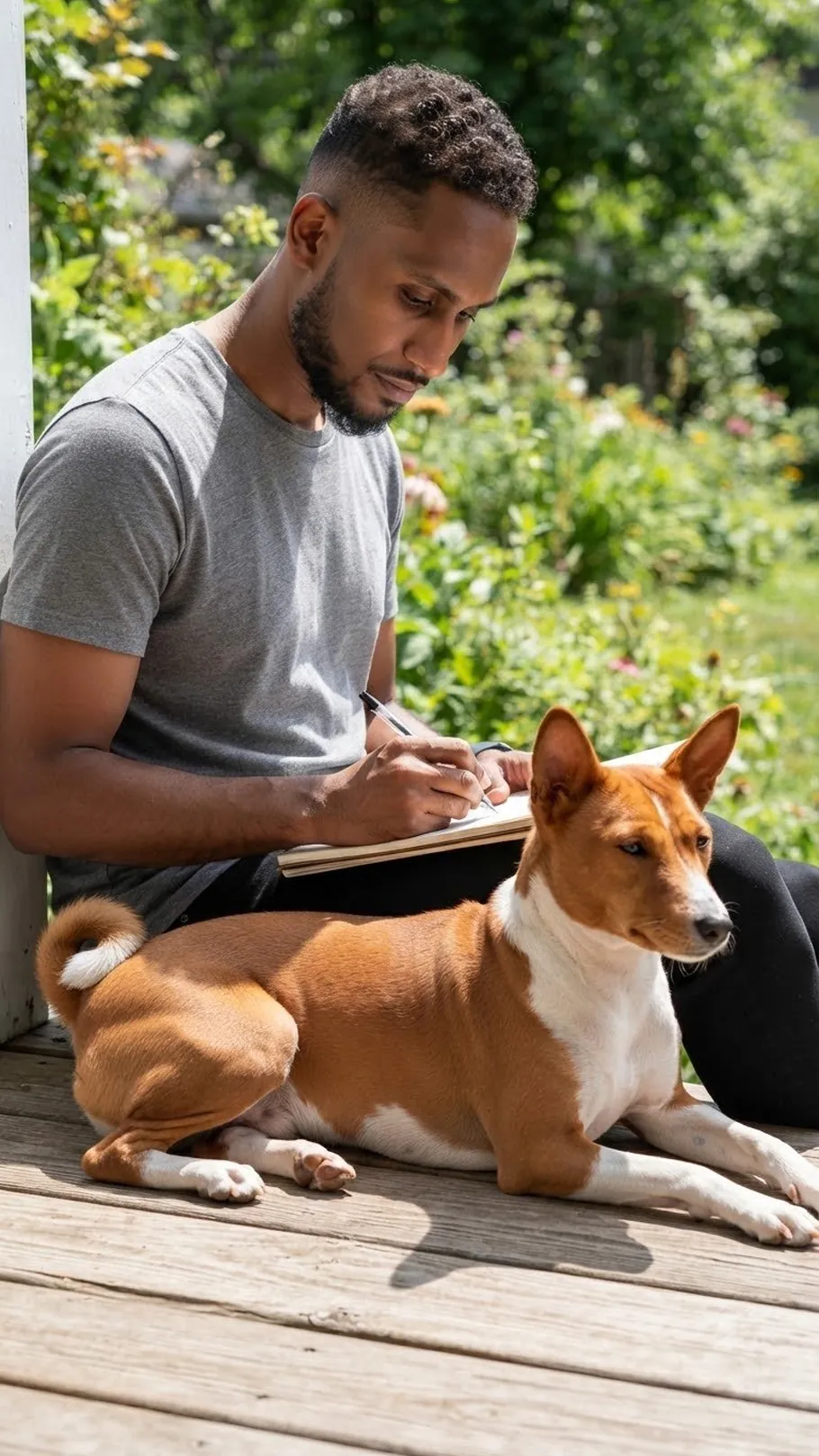
Then, when they're done, they want to be curled up on the warmest thing in the house, which is usually you.
They're loyal to their people, cool with strangers
The AKC describes the Basenji as "alert and careful with strangers, open and calm with friends." That fits the reputation: a Basenji often picks its person, and it's devoted to its inner circle. Strangers get the side-eye until they've earned it.
Basenjis and other pets
Because of their prey drive, Basenjis and small animals can be a bad mix. Some Basenjis live fine with cats they grew up with. Hamsters, rabbits, birds and the neighbor's cat are a different story. Basenjis often do well with another dog for company, especially another Basenji. BRAT even says "most Basenji people believe that two Basenjis are twice as much fun as one."
Basenjis and kids
The AKC says Basenjis are "loving and solicitous with children." Like any dog, how that goes depends on the individual dog, how it was raised and how the kids treat it. BRAT's honest take is that if your home is hectic with small children and lots of activity, you should think hard about whether a Basenji fits right now.
Basenji health: what you need to know
The Basenji Club of America says that "as a collective whole, the basenji is a very healthy breed." But there are a few conditions every Basenji owner should know by name.
Fanconi syndrome
This is the big one. According to the BCOA, Fanconi syndrome is "a condition in which the renal (kidney) tubules do not function properly," and they call it "the most common inherited lethal disease in basenjis." It usually doesn't show up until a dog is an adult.
The good news: since 2011 there's been a direct DNA test. A Basenji tests as Clear (Normal), Carrier or Affected.
- Clear: won't develop inherited Basenji Fanconi and can't pass it on.
- Carrier: probably won't get sick but can pass the gene on.
- Affected: at high risk of developing Fanconi at some point.
If a dog is Affected, the BCOA recommends strip-testing the urine for glucose every two weeks starting around age 1 to 2, for life, and getting your vet the Fanconi information before you need it. Caught early and managed, dogs can do much better.
Progressive retinal atrophy (PRA)
PRA causes progressive vision loss that can lead to blindness. There's a DNA test for one form, PRA-BJ1, which the BCOA says accounts for about half of PRA cases in the breed. The other form has no DNA test yet, which is why the BCOA recommends yearly eye exams by a board-certified veterinary ophthalmologist (ACVO), starting as a puppy. A clear PRA-BJ1 result is good news, not a guarantee.
Hypothyroidism
The BCOA reports hypothyroidism in a small percentage of Basenjis, 5.38% of dogs tested as of December 2016. It's checked with a blood panel at 12 months or older.
Pyruvate kinase deficiency
UC Davis's Veterinary Genetics Laboratory includes a Basenji-specific pyruvate kinase deficiency test in its Basenji health panel, alongside Fanconi and PRA. It's an inherited blood condition.
Bottom line: if you're buying from a breeder, ask to see the parents' DNA results for Fanconi and PRA-BJ1, thyroid results, hip results (OFA or PennHIP) and a current eye exam by a board-certified veterinary ophthalmologist. The eye exam matters because the PRA-BJ1 test only covers about half of PRA cases, so a clear DNA result doesn't replace it. If you're adopting an adult, ask the rescue what's known about the dog's health and testing.

Basenji puppies vs. adopting an adult
Basenji puppies
A Basenji puppy is basically a tiny, fast, curious chaos machine with teeth. BRAT lists "typical Basenji puppy antics" as one of the reasons dogs end up in rescue: people bring the puppy home and aren't ready for it.
If you're going the puppy route:
- Find a breeder who health-tests. Ask for Fanconi and PRA-BJ1 DNA results on both parents, plus thyroid results, hip results (OFA or PennHIP) and a yearly eye exam by a veterinary ophthalmologist (ACVO).
- Meet the parents if you can. Temperament runs in families.
- Be skeptical of cheap, fast and "available now." A good breeder will ask you as many questions as you ask them.
- Start with the Basenji Club of America's resources. The BCOA is the AKC parent club for the breed, and it's the best starting point for finding responsible breeders.
Basenji price
Breeder prices change by region, lineage and demand, so I'm not going to throw out a number that'll be wrong next month. What I'll say is this: the purchase price is the smallest cost. Fencing, training, vet care, crate, food and replacing whatever they chew in year one add up fast. Budget for the dog you'll have for 13 to 14 years, not just the day you bring it home.
Adopting a Basenji from rescue
This is the route I'd point most people to first, and it's the one I'm looking at now.
Basenji Rescue and Transport (BRAT) is a volunteer-run national rescue. Here's how their process works, according to BRAT's own FAQ:
- Fill out the adoption application. It's mandatory.
- A BRAT representative contacts you with questions to find the right match.
- You get emails about available dogs and respond to the ones you're interested in.
- If it's a fit, there's a home visit from a BRAT representative.
- When you're approved, you pay a placement fee and sign an adoption contract. Fees are on a sliding scale by the dog's age and are listed on each dog's page.
- Transport is arranged, often through BRAT's volunteer "Basenji Underground Railroad," where drivers relay the dog to you.
BRAT says the whole thing might take a week or two, but "more typically an applicant waits a month or more for the right dog to come along." If you rent, you may need a letter from your landlord. And remember the fence rule: no electronic fences.
Why are Basenjis in rescue? BRAT lists life changes like illness, job loss, divorce and new babies, plus owners who weren't ready for a smart, strong-willed, independent dog. As they put it: "These dogs are not bad dogs."

Basenji mixes
People search for Basenji mixes a lot: Basenji pit bull mixes, Basenji chihuahua mixes and plenty of shelter dogs labeled "Basenji mix" because of a curly tail or a wrinkled forehead.
Mixes can be great dogs. Just know that a mix can inherit any combination of traits from each parent, including the Basenji prey drive, escape skills and independence. And a shelter's "Basenji mix" label is often a visual guess. If it matters to you, a dog DNA test can tell you more.
Is a Basenji right for you?
Here's the honest checklist. BRAT says that if you answer "yes" to any of these, you should seriously question whether a Basenji is right for you:
- Is your home life hectic right now, with small children and lots of activity?
- Are you away many hours each day for work or travel?
- Do you want a dog that's highly obedient and lives only to please you?
- Do you want a dog that can safely run off-leash?
- Do you want a dog that just lies around the house all the time?
- Do you want a dog that has never met a stranger and loves everyone instantly?
And here's my side of it. A Basenji might be right for you if:
- You like a dog with a personality. Not a follower. A roommate with opinions.
- You're home a good amount or can bring in a dog walker or a second dog.
- You've got a secure, tall fence or you're committed to leash walks every day.
- You're patient. Training a Basenji is a negotiation, not a command.
- You think it's funny when a dog yodels at you for dinner and then pretends it didn't.

What I'd tell a first-time Basenji owner
Here's my short list, the stuff I'd tell a friend.
- Dog-proof your house like you're expecting a toddler with a crowbar. Shoes up, trash locked, cords hidden. Assume anything on the floor is theirs.
- Crate train early. A crate is a safe space, not a punishment, and it'll save your house.
- Keep training short and fun. Five to ten minutes, like the AKC says. End before they get bored.
- Never trust the recall. Not in the park, not "just for a second." Leash or fence, always.
- Exercise them hard. Walks, runs, flirt poles, sprinting in the yard. Then let them sleep on you.
- Know the word Fanconi. Know your dog's test status, and get your vet on the same page early.
- Respect the attitude. A Basenji isn't being bad. It's being a Basenji.
Losing one
I'm not going to make this the sad part of the article, but I'm not going to skip it either.
Thirteen or fourteen years sounds like a long time when you bring home a dog. It isn't. When I had to say goodbye to my last Basenji, it was February, on a full moon, and I still remember that sky.
If you're going through it right now, I'm not going to tell you how to feel. I'll just say this: the love was real, and the fact that it hurts this much is proof of it. And when you're ready, if you're ever ready, there are good dogs in rescue waiting for somebody who already knows how to love a Basenji.
Quick answers
What is a Basenji? A small, short-coated hunting dog from Central Africa, known as "Africa's barkless dog." It's in the AKC Hound Group and was recognized by the AKC in 1944.
Do Basenjis bark? Not like other dogs. The AKC describes their sound as "something between a chortle and a yodel." They can also scream, whine and grumble.
How big do Basenjis get? According to the AKC, males are about 17 inches tall and 24 pounds, and females are about 16 inches and 22 pounds.
How long do Basenjis live? The AKC lists a life expectancy of 13 to 14 years.
Are Basenjis good family dogs? They can be, in the right home. The AKC calls them "loving and solicitous with children," but they're independent, high-energy and high prey drive, and Basenji Rescue and Transport cautions families with hectic homes and small children to think it through.
Are Basenjis hard to train? They're smart but independent. The AKC recommends positive training and sessions of no more than five or ten minutes.
Can Basenjis be off-leash? The AKC says a Basenji "should never run loose" because of its strong hunting instinct.
What health problems do Basenjis have? The main ones are Fanconi syndrome (a kidney disorder) and progressive retinal atrophy (PRA), both with DNA tests, plus hypothyroidism in a small percentage of dogs.
Where can I adopt a Basenji? Basenji Rescue and Transport (BRAT) is a national volunteer rescue. Their process includes an application, a home visit, a placement fee and an adoption contract.
Do Basenjis shed? Lightly. They have a short coat and groom themselves like cats.
The barkless bottom line
A Basenji is not a starter dog. It's not a lazy dog. It's not an off-leash dog. It's a smart, fast, funny, stubborn little hunter with the soul of a cat and the voice of a yodeling cartoon.
If that sounds like a headache, it might be. If it sounds like your kind of dog, welcome to the cult. You'll never want another breed.
More on Basenjis: visit The Kemist's Basenji Corner, read the full Basenji Fanconi syndrome guide or What I Wish Every Basenji Owner Knew.
Sources
- American Kennel Club: Basenji (checked November 10, 2026)
- Basenji Club of America: Basenji Health (checked November 10, 2026)
- UC Davis Veterinary Genetics Laboratory: Basenji Health Panel (checked November 10, 2026)
- Basenji Rescue and Transport: Frequently Asked Questions (checked November 10, 2026)
- Basenji Rescue and Transport: Adopt a Basenji (checked November 10, 2026)
— King