Grown Man Notes
Situationship: What It Is, the Signs and How to Get Out (or Make It Real)
It feels like a relationship, it acts like a relationship, but nobody’s allowed to call it one. 😂 The signs you’re in a situationship, how to have the "what are we" talk and how to get out with your dignity.

You text every day. You hang out every weekend. You've met some of their friends. You know how they take their coffee.
But if somebody asked, "So what are you two?" you'd both look at the floor. 😂
Congratulations. You're in a situationship.
The word got so common that Oxford University Press named it a finalist for its 2023 Word of the Year. (The winner was "rizz," which, honestly, tells you everything about that year.) Oxford defines a situationship as "a romantic or sexual relationship that is not considered to be formal or established."
That's the polite version. The real version is: it feels like a relationship, it acts like a relationship, but nobody's allowed to call it one.
So let's talk about it like grown folks. Here's what a situationship actually is, the signs you're in one, why people end up there, whether it can turn into something real, how to have the "what are we" talk and how to get out with your dignity intact.

What is a situationship?
A situationship is a romantic or sexual connection that has some of the parts of a relationship but no clear label, no clear commitment and no clear future.
It's not quite friends with benefits, because there are feelings involved, or at least one person has them. It's not quite dating, because nobody's sure it's going anywhere. It's not quite a relationship, because nobody said the words.
It lives in the gray area. And the gray area can be comfortable for a while. The problem is that it's usually comfortable for one person a lot longer than the other.
Situationship vs. friends with benefits vs. dating vs. relationship
- Friends with benefits: Feelings usually kept out of it. Labeled as "friends." Usually not exclusive. No future talk.
- Situationship: Feelings, often unspoken. No label. Exclusivity unclear. Future talk avoided.
- Dating (early): Feelings growing. "Seeing each other." Sometimes exclusive. Future talk starting to happen.
- Relationship: Feelings spoken. A clear label. Exclusivity agreed. Future talk happening.
The key difference: friends with benefits is an agreement. A situationship is an avoidance. In FWB, both people know the deal. In a situationship, nobody wants to say the deal out loud.
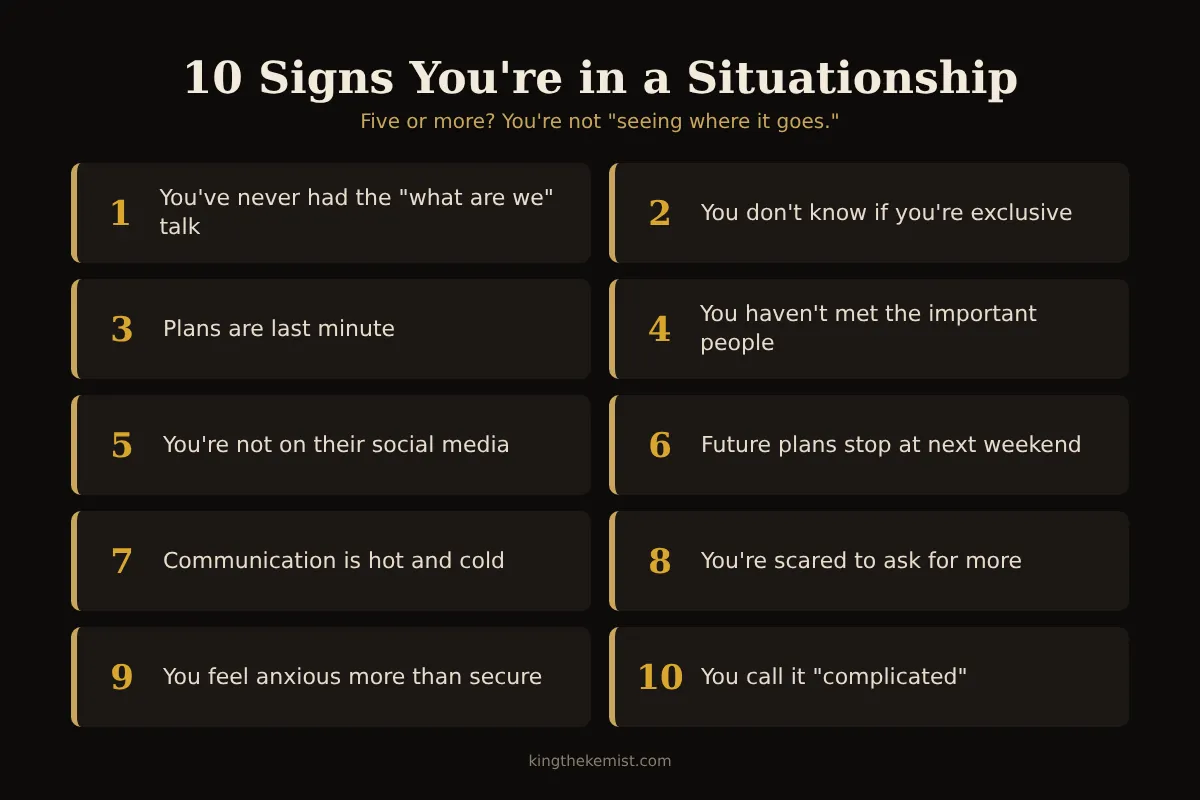
Signs you're in a situationship
If you're reading this, you probably already know. But here are the classic signs.
- You've never had the "what are we" talk. Or you tried and they changed the subject.
- You don't know if you're exclusive. You hope you are. You're not sure.
- Plans are last minute. It's "you up?" or "wanna come through?" instead of "let's do dinner Saturday."
- You haven't met the important people. Maybe a friend or two, but not the inner circle and definitely not the family.
- You're not on their social media. Or you're there, but only in the background.
- Future plans stop at next weekend. Nobody's talking about summer, holidays or next year.
- The communication is inconsistent. Hot one week, quiet the next.
- You're scared to ask for more. You feel like if you bring it up, you'll lose what you have.
- You feel anxious more than you feel secure. You check your phone a lot. You overthink their texts.
- You'd describe it as "complicated." Grown folks know "complicated" usually means "one of us wants more."
If you checked five or more of those, you're not "seeing where it goes." You're in a situationship.
Why people end up in situationships
Nobody wakes up and says, "I'd love a confusing romantic arrangement with no future." 😂 People slide into them. Here's why.
It's easy
There's no pressure. No meeting the parents, no anniversaries, no "where is this going." For a lot of people, especially when life is busy, that ease is the appeal.
Somebody's not over somebody else
Sometimes one person is still healing from a breakup and isn't ready for a real relationship, but also doesn't want to be alone.
Somebody's keeping options open
Dating apps make it feel like there's always somebody else around the corner. Some people don't want to commit because they're afraid of missing out on someone "better."
Somebody's scared
Fear of getting hurt, fear of rejection, fear of losing their freedom. A situationship lets you have closeness without the risk of being fully seen. Psychologists who study attachment describe people who pull away from closeness as having an avoidant style, and people who worry about being abandoned as having an anxious style. A lot of situationships are one of each: one person pulling back and the other person holding on tighter.
Nobody wants to be the one to bring it up
This is the big one. Both people sense it's undefined. Neither wants to look "too invested." So nobody asks, and months go by.
One person wants more, and the other one knows it
Sometimes the person who doesn't want a relationship knows the other person does. They keep it going anyway because they like the attention, the company or the convenience. That's the version that gets ugly.

Situationships at different ages
People talk about situationships like they're just a college thing. They're not.
In your 20s, situationships often come from not knowing what you want yet. You're figuring out your career, your city and yourself, and a label can feel like too much pressure.
In your 30s, they often come from busy lives and past hurt. People have been through real breakups, and some of them are cautious about jumping back in.
In your 40s and beyond, they can come from divorce, kids, careers or just liking your independence. Some people genuinely prefer something less defined at this stage, and that can work if both people are honest about it.
The age changes the reasons. It doesn't change the rule: say what you want and believe what they tell you.
Is a situationship always bad?
No. Let's be fair about it.
A situationship can be fine if both people actually want the same thing. If you're both busy, both not looking for anything serious and both genuinely okay with the gray area, it can be fun and low-pressure.
The problem is that "both people want the same thing" is rare, and it doesn't stay true for long. Feelings grow. Life changes. One person starts wanting more, and suddenly the thing that was easy becomes the thing that keeps you up at night.
The test: if you're at peace with it, it's probably fine. If you're anxious, confused or waiting, it's probably not.
How long do situationships last?
There's no official number, and anybody who gives you one is making it up. Some last a few weeks. Some last years. 😂
What matters more than the length is the direction. Ask yourself:
- Is this getting clearer or staying the same?
- Am I more secure than I was three months ago, or less?
- Are we talking about the future more, or not at all?
If the answer is "staying the same," "less" and "not at all," the length doesn't matter. It's not going anywhere.
Can a situationship turn into a relationship?
Yes, sometimes. Plenty of real relationships started out undefined.
But it almost never happens by waiting. It happens when one person brings it up and the other person says yes. Here are the signs it might actually be heading somewhere:
- They make plans with you ahead of time, not just last minute.
- They introduce you to friends and family on purpose.
- They talk about future things with you in them.
- They're consistent, not hot and cold.
- When you mention exclusivity, they don't panic or change the subject.
And here are the signs it probably isn't:
- They've told you directly they don't want a relationship. (Believe them.)
- They only reach out late at night.
- They get weird when you bring up the future.
- You've asked before and nothing changed.
- You feel like a secret.

How to have the "what are we" talk
This is the conversation everybody dreads. It doesn't have to be dramatic. Here's how to do it like a grown person.
1. Get clear on what you want first
Before you talk to them, talk to yourself. Do you want a relationship with this person? Do you want exclusivity? Do you just want to know where you stand? If you don't know what you want, you can't ask for it.
2. Pick the right moment
Not over text. Not at 2 a.m. Not in the middle of an argument. In person, sober and calm, when you both have time.
3. Keep it simple and direct
You don't need a speech. Try something like:
"I really like what we have, and I've realized I want more than this. I want to be in a relationship with you. Where are you at?"
Or if you just need clarity:
"I've been enjoying this, but I don't really know what we are. I'd like to know where you see this going."
4. Then listen
Don't fill the silence. Don't talk them out of their answer. Let them actually tell you.
5. Believe what they say
If they say "I'm not ready for a relationship," that's the answer. Not "they'll come around." Not "they just need time." Believe people when they tell you who they are and what they want.
6. Decide what you're going to do
If you both want the same thing, great. Define it. If you don't, you get to decide whether you stay or go. Just make that decision with your eyes open.


How to get out of a situationship
Sometimes the answer is clear, and the answer is: this isn't for me. Here's how to leave.
Be honest, even though there's no label
"We were never official" doesn't mean you can just disappear. If you spent real time together, you owe each other a real goodbye. Ghosting is easy. It's also the cheap way out.
Keep it short and kind
"I've realized I want something more defined than what we have, and I don't think we want the same thing. I'm going to step back. I appreciate the time we spent."
No need for a long list of what went wrong.
Don't leave the door half open
"Maybe someday" and "let's stay friends" can keep you stuck. If you need distance, take distance. You can always reconnect later if it makes sense.
Mute, unfollow or archive if you need to
Watching their stories every day won't help you move on. Protect your peace.
Give yourself permission to grieve it
People act like a situationship ending shouldn't hurt because "it wasn't even a relationship." That's nonsense. If you had feelings, it can hurt. Let it.
Pay attention to the pattern
If you keep ending up in situationships, it might be worth asking why. Are you picking people who are unavailable? Are you afraid to ask for what you want? That's not a judgment. It's useful information for next time.

Why a situationship messes with your head
Here's something that explains a lot. When someone is warm one day and distant the next, it can actually hook you harder than if they were consistently nice.
Psychologists call this intermittent reinforcement. It goes back to behavioral research from the mid-1900s by B.F. Skinner and others: rewards that come unpredictably tend to keep a behavior going more stubbornly than rewards that come every time. It's the same reason slot machines are so hard to walk away from.
Now apply that to a situationship. They text you sweet things on Tuesday, go quiet Wednesday and Thursday, then show up Friday like nothing happened. Your brain starts chasing the good days. You check your phone more. You replay conversations. You get a rush when they finally reach out.
That rush isn't proof of love. A lot of the time, it's proof of uncertainty.
That's also why it can feel so hard to leave a situationship that, on paper, isn't even that good. You're not weak or dramatic. You're reacting to a pattern that's built to keep you guessing.
What helps: notice the cycle. When you feel that rush after a quiet stretch, ask yourself, "Am I happy, or am I relieved?" Relief and happiness feel similar, but they aren't the same thing.
How to avoid ending up in another situationship
If you're done with the gray area, here's how to keep from sliding back into it.
- Say what you want early. Not on the first date like a job interview 😂, but within the first few weeks. "I'm dating with the goal of finding a relationship" is a normal, healthy sentence.
- Watch what they do, not what they say. Consistency, plans made ahead of time and being introduced to people in their life tell you more than any sweet text.
- Notice how you feel. If you feel calm and secure, that's a good sign. If you feel anxious and on edge all the time, pay attention.
- Ask sooner. Don't wait six months to find out where it's going. A few weeks of consistent dating is a perfectly fine time to ask.
- Don't play it cool to keep them around. Pretending you don't want what you want just delays the disappointment.
- Be willing to walk away early. The sooner you leave something that doesn't fit, the less it costs you.
None of this guarantees anything. But it makes it a lot harder to wake up a year from now and realize you never actually knew what you were.
If you're the one who doesn't want more
Let's flip it. Maybe you're the one who likes the situationship just as it is. That's allowed. But here's what being a decent person looks like:
- Be upfront. Say clearly that you're not looking for a relationship, early and more than once if needed.
- Don't lead them on. Don't act like a partner when it's convenient and then hide behind "we never said we were together."
- Notice when they want more. If they start hinting, asking or getting hurt, that's your cue to have an honest talk.
- Let them go if they need to. Don't keep somebody around just because you like the attention.
You're not a bad person for not wanting a relationship. You're a bad person if you know they want one and you keep them hanging anyway.
Situationship red flags
- They only text late at night.
- You've never been out together in daylight. 😂
- They get angry or distant when you ask about the relationship.
- They're openly seeing other people while acting like your partner.
- You feel like you can't bring up your needs.
- You've been "taking it slow" for a year.
- You feel worse about yourself than you did before.

Situationship green flags (yes, there are some)
- You both agreed on the deal out loud.
- You both feel free to date other people, or you both agreed not to.
- Communication is consistent and respectful.
- Either person can bring up feelings without it blowing up.
- If one of you wants more, the other one is honest about it.
If you've got those, it's not a mess. It's just an arrangement that works for now.
Frequently asked questions
What is a situationship? A romantic or sexual relationship without a clear label or commitment. Oxford defines it as "a romantic or sexual relationship that is not considered to be formal or established."
How do I know if I'm in a situationship? If you've never defined it, aren't sure if you're exclusive, don't make plans ahead of time and feel anxious about where you stand, you're probably in one.
Can a situationship become a relationship? Yes, but usually only when someone brings it up directly and the other person agrees. Waiting rarely works.
How long does a situationship usually last? There's no set length. What matters is whether it's getting clearer over time or staying stuck.
How do I end a situationship? Be honest, keep it short and kind, don't ghost and don't leave the door half open if you need distance.
Is a situationship a relationship? Not officially. That's the whole point. It has some parts of a relationship but no agreed label or commitment.
Why do men stay in situationships? The same reasons anybody does: it's easy, they're not ready, they're scared or they want options. Gender doesn't decide it. Honesty does.
What do you say in the "what are we" talk? Keep it simple: "I really like what we have and I want more. Where are you at?" Then listen and believe the answer.

The bottom line
A situationship isn't the end of the world. Plenty of people have been in one, and some of them even turned into something real.
But the gray area has a cost. If you're spending your energy guessing, waiting and overthinking, that's energy you could be putting into somebody who's sure about you.
So ask the question. Believe the answer. And then choose yourself, whatever that looks like.
You deserve to know where you stand.
— King
Sources
- Word of the Year 2023 (finalists and definitions), Oxford Languages
Sources checked November 10, 2026.