Creative Chemistry
How to Write an Artist Statement: Examples, a Template and the Artist Statement Lab
"Please include your artist statement." Here’s the simple what-how-why formula, examples for musicians, painters, photographers and writers, a fill-in template and the Artist Statement Lab, a free builder that writes your first draft.
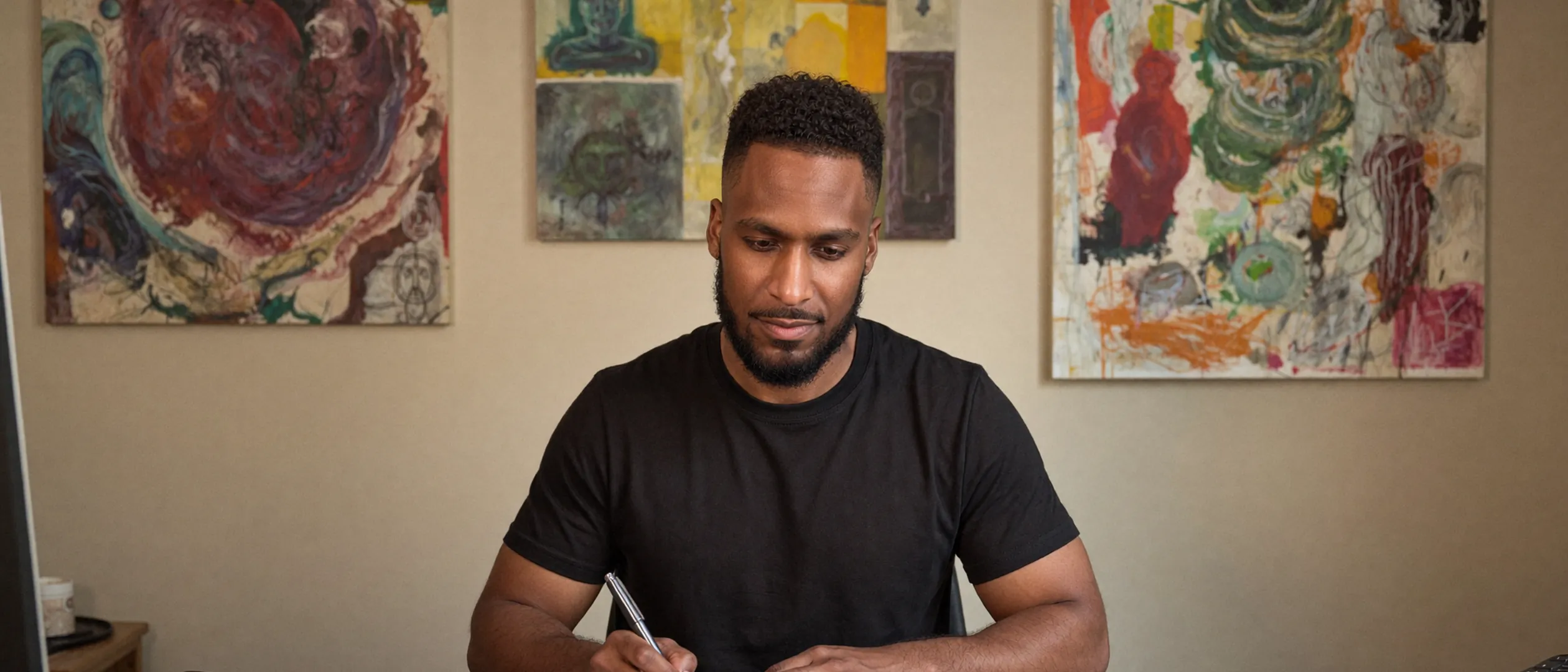
Every artist eventually gets hit with the same question, usually on a form with a tiny text box:
"Please include your artist statement."
And every artist has the same reaction. Panic, then 45 minutes of staring at a blank page, then something like "I create art that explores the human condition." 😂
Jump to the Artist Statement Lab ↓
I get it. Making the art is the easy part. Explaining it in a paragraph feels impossible. But an artist statement isn't a test, and it's not supposed to sound like a museum placard written by a robot. It's just you, telling people what you make, how you make it and why it matters to you.
So here's the Artist Statement Lab: what an artist statement actually is, how it's different from a bio, the simple structure that works for musicians, painters, photographers, writers and everybody in between, real examples, the mistakes to avoid and a free builder that writes your first draft from your answers.
What is an artist statement?
An artist statement is a short piece of writing that explains your work: what you make, how you make it and why you make it.
It's written for people who are about to experience your art, or who are deciding whether to show it, fund it, book it or write about it. Think gallery visitors, grant committees, festival curators, playlist editors, journalists and fans who want to understand you a little better.
A good artist statement does three things:
- Describes the work clearly enough that someone who hasn't seen or heard it gets the idea.
- Explains the thinking behind it: the themes, questions or feelings that drive you.
- Sounds like you. Not like a textbook, not like a press release and definitely not like everybody else.
Artist statement vs. artist bio
People mix these up all the time, so let's clear it up.
| Artist statement | Artist bio | |
|---|---|---|
| Focus | Your work | Your life and career |
| Point of view | Usually first person ("I") | Usually third person ("She…") |
| Answers | What, how and why you make it | Who you are, where you're from, what you've done |
| Includes | Themes, process, ideas | Training, shows, releases, awards |
| Changes when | Your work changes | Your career grows |
Quick example:
- Bio: "Jordan Reyes is a painter based in Chicago. She studied at the School of the Art Institute and has shown work in group exhibitions across the Midwest."
- Statement: "I paint the people in my neighborhood at the scale usually saved for presidents and saints, because I think they deserve to be looked at that closely."
(Jordan is a made-up example, but you get the idea.)
You'll usually need both. They do different jobs.
How long should an artist statement be?
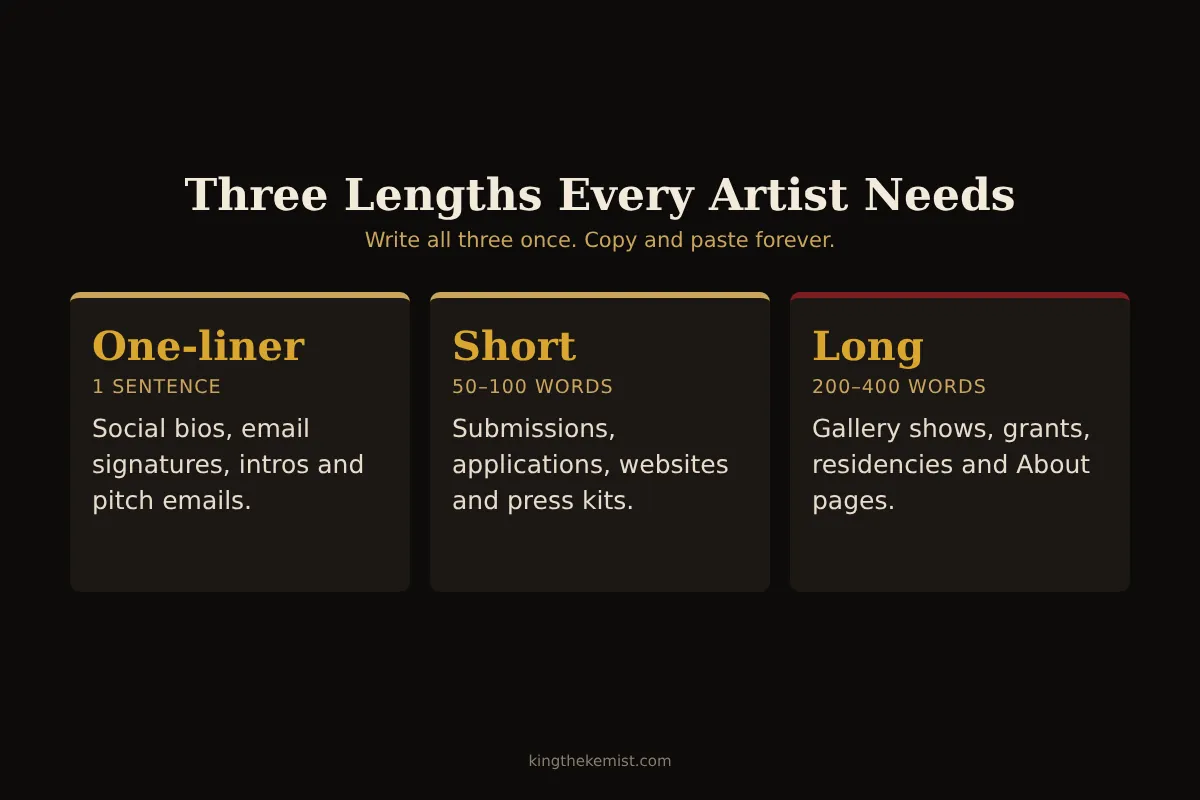
It depends on where it's going. Most artists end up needing three versions:
- One-liner (one sentence): for social bios, email signatures, intros and pitch emails.
- Short statement (50–100 words): for submissions, applications, websites and press kits.
- Long statement (200–400 words): for gallery shows, grants, residencies and the "About" page of a project.
If a specific application gives you a word count, follow it exactly. If it doesn't, the short version is the safest bet. Nobody has ever complained that an artist statement was too clear and too short.
Before you write: 10 questions to ask yourself
If you're stuck, don't start with sentences. Start with answers. Grab a notebook and answer these as fast as you can, without editing.
- What do I make, in the plainest words possible?
- What materials, tools or instruments do I use most?
- What's one habit or ritual in my process that other people might not know about?
- What subjects, people or places keep showing up in my work?
- What questions am I trying to answer, even if I never answer them?
- What feeling do I get when a piece is finished and it's right?
- Who or what has influenced me the most?
- What do people usually say when they first see or hear my work?
- What would I want someone to feel after spending five minutes with it?
- Why do I keep doing this, even when it's hard?
Your answers to 1, 2 and 3 become your "what" and "how." Your answers to 4, 5 and 10 become your "why." Your answer to 9 can be your ending. You just wrote your statement without realizing it. 😂
The simple structure that works
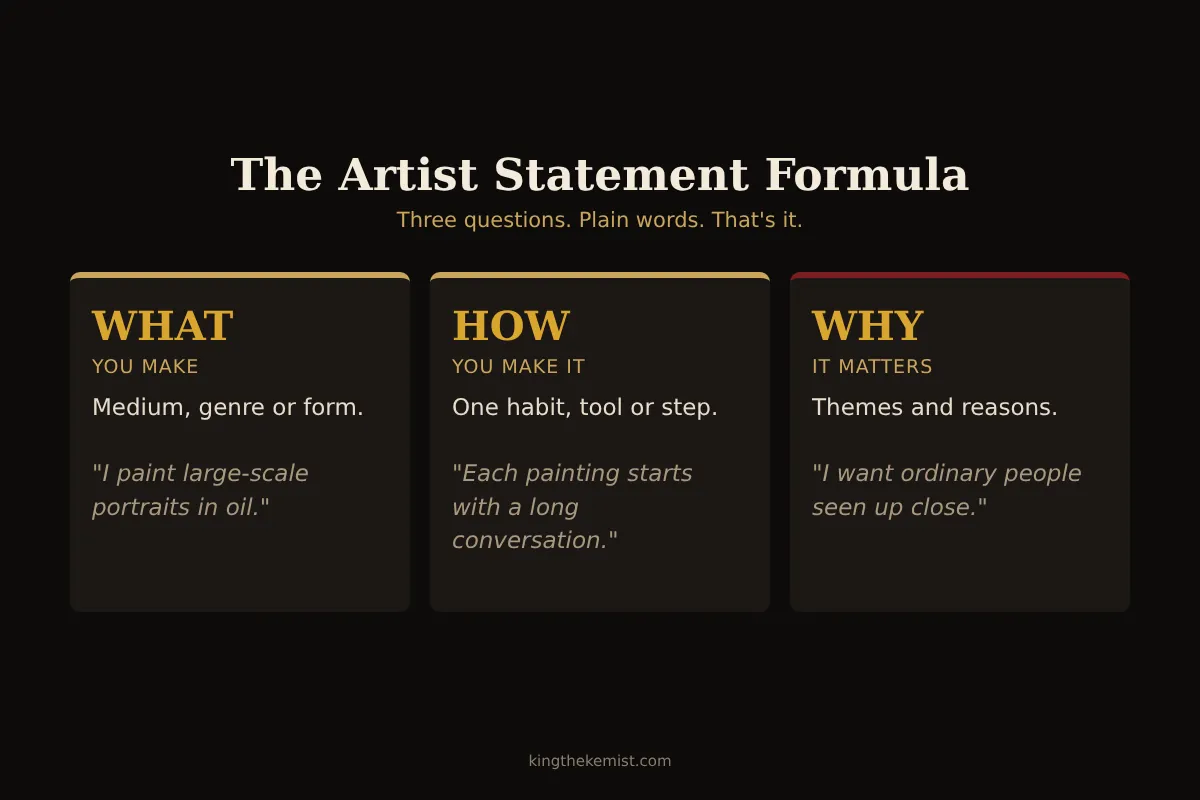
Forget trying to sound deep. Use this structure and fill it in honestly.
1. What you make
Open with the work itself. Be concrete. What medium, what genre, what form?
- "I make soulful hip-hop with live instruments and layered vocals."
- "I paint large-scale portraits in oil on raw canvas."
- "I photograph small towns at night."
2. How you make it
Your process, materials or methods. What's distinctive about the way you work?
- "I write every song starting from a voice memo, usually a melody I hum while driving."
- "I build each painting in thin layers over several weeks."
- "I only shoot with available light, no flash."
3. Why you make it
This is the heart of it. What themes, questions, feelings or experiences drive the work? Why does it matter to you?
- "I'm interested in how people rebuild themselves after losing something."
- "I want to show working people the way they see themselves, not the way they're usually shown."
- "I'm chasing the feeling of being alone in a city and finding it peaceful."
4. What you want people to feel or take away (optional)
Not required, but it can be a strong ending.
- "I hope listeners leave feeling a little less alone in the middle of their mess."
That's it. What, how, why and (maybe) what you hope people feel. Put those together in plain language and you have an artist statement.
Artist statement examples
Here are examples in different disciplines. These are written as models, not as real artists' statements, so you can see the structure working.
Musician (short)
I make soulful hip-hop with live keys, layered vocals and stories pulled from real life. Most of my songs start as voice memos I record late at night, then get built out slowly in the studio. I write about the work of becoming: doubt, discipline, love and the moments where something finally clicks. I want people to hear themselves in it and feel a little more ready for whatever they're facing.
Painter (short)
I paint large-scale portraits of people in my neighborhood, working in thin layers of oil over several weeks. I'm interested in the dignity of ordinary people and the stories that live in their faces. Each painting begins with a long conversation before I ever pick up a brush. I want viewers to slow down and really look at someone they might have walked past.
Photographer (one-liner)
I photograph small towns after dark to show how quiet places hold their own kind of light.
Writer / poet (short)
I write short poems about family, memory and the places we leave behind. My process starts with one image, usually something small like a kitchen table or a coat on a hook, and I build the poem around it. I'm drawn to the moments people don't usually talk about. I hope readers recognize their own families in the details.
Digital artist (short)
I create surreal digital illustrations that mix real photographs with hand-drawn elements. I work in layers, often combining dozens of images into one piece. My work explores dreams, identity and the strange feeling of living half online. I want each piece to feel like a world you could step into.
Filmmaker (short)
I make short documentaries about people who keep old traditions alive in new places. I shoot small and handheld, usually with one other person, so people forget the camera is there. I'm drawn to the quiet work that holds communities together. I want audiences to leave curious about the people they share a city with.
Ceramicist (one-liner)
I make functional stoneware that's meant to be used every day, because I believe beautiful things shouldn't live behind glass.
The Artist Statement Lab: build your first draft
Answer the questions below and the builder will turn your answers into a one-liner, a short statement and an expanded draft you can grow into a full long statement. It's a starting point, not a final version. Read it out loud, change the words that don't sound like you and make it yours.
THE ARTIST STATEMENT LAB
Fill in what you can. Short answers work best. Nothing you type leaves this page.
ONE-LINER
SHORT STATEMENT
EXPANDED DRAFT (GROW THIS INTO YOUR LONG STATEMENT)
This is a first draft. Read it out loud and rewrite anything that doesn't sound like you.
Before and after: fixing a weak artist statement
Here's a typical first draft (made up, but you've seen ones like it):
"My work explores the multifaceted nature of human existence through a variety of media. Drawing on diverse influences, I seek to challenge viewers' perceptions and invite them to engage in a dialogue about identity, memory and the world around us."
What's wrong with it? It's not terrible grammar. It just doesn't say anything. What media? Which influences? Whose identity? It could describe almost any artist alive.
Here's the same artist, rewritten with the what, how and why:
"I make mixed-media collages from old family photos, receipts and handwritten letters I collect at estate sales. I cut, layer and stitch them together by hand, sometimes over several months. I'm interested in what gets left behind when someone dies, the small paper trail that proves a life happened. I want people to think about the stories hiding in their own junk drawers."
Same length. Completely different. Now you can actually picture the work, the process and the reason behind it. That's the whole goal.
A fill-in-the-blank artist statement template
If you'd rather fill in blanks than use the builder, copy this and replace the brackets:
I make [what you make: medium, genre or form]. My process usually starts with [how a piece begins], and I [one distinctive thing about how you work]. I keep coming back to [themes, subjects or questions] because [why it matters to you]. I want people to [what you hope they feel, think or do] when they [see / hear / read] my work.
Here's that template filled in by a made-up spoken word artist:
I make spoken word pieces about growing up between two languages. My process usually starts with a phrase my grandmother used to say, and I write every piece out by hand before I ever perform it. I keep coming back to family and translation because so much of who we are gets lost between words. I want people to call someone they love when they hear my work.
It's simple on purpose. Once you have a version that works, you can make it more personal and more specific.
Artist statement mistakes to avoid
Using big words to sound smart
"My practice interrogates the liminal spaces of contemporary subjectivity." Nobody talks like that, and it doesn't tell anybody anything. If your grandma wouldn't understand it, rewrite it.
Being vague
"I make art about life and emotions." So does everybody. Be specific. Which emotions? Whose life? What kind of art?
Writing your bio instead
Your degree, your hometown and your awards belong in your bio. Your statement is about the work.
Telling people how to feel
"Viewers will be deeply moved." Let them decide. You can say what you hope they feel, but don't promise their reaction.
Making it way too long
If it's longer than the work needs, people stop reading. Cut anything that doesn't explain the what, how or why.
Never updating it
Your work changes. Your statement should change with it. Review it at least once a year, or whenever you start a new body of work or project.
Copying someone else's
It's fine to read examples, including the ones above. It's not fine to copy them. A statement that doesn't sound like you defeats the whole point.
Tips for making your statement sound like you
- Write it like you're explaining your work to a friend. Then clean it up.
- Record yourself talking about your work for two minutes and transcribe the best parts. People are often clearer out loud than on paper.
- Use "I." First person is standard for artist statements and sounds more human.
- Use active verbs. "I paint," "I write," "I build," "I record." Not "Works are created."
- Include one specific detail. A material, a tool, a habit, a place. Details make you real.
- Read it out loud. If you stumble over a sentence, rewrite it.
- Ask somebody who doesn't know your work to read it. If they can describe your work back to you, it's working.
Artist statements for musicians
Musicians often think artist statements are just for visual artists. Not true. You'll need one for:
- Festival and showcase applications
- Grants and arts council funding
- Press kits and EPKs
- Playlist and blog pitches
- Your website and streaming profiles
- Sync licensing and collaboration pitches
For musicians, the "how" is your sound and process: your genre, your production style, your instruments, how you write. The "why" is what your songs are about and why you keep making them.
Tip: don't just list genres. "Hip-hop, R&B, soul, alternative" tells people nothing. "Late-night soul with hip-hop drums and gospel chords" paints a picture.
Artist statements for grants and applications
When an artist statement is part of an application, it's doing a slightly different job. You're not just explaining your work. You're helping someone decide whether to give you money, space or an opportunity.
A few extra tips for applications:
- Read the guidelines twice. Some applications want a general artist statement. Others want a project statement about one specific thing you plan to make. Those aren't the same.
- Match their language without copying it. If a grant is about community impact, make sure your statement clearly connects your work to community. If a residency is about experimentation, talk about what you want to try.
- Be concrete about the project. If you're proposing something new, say what it is, how you'll make it and what it'll look like when it's done.
- Stick to the word count. Going over can get you disqualified. Going way under can look like you didn't try.
- Get a second set of eyes. Ask someone who has won a grant, sat on a panel or just writes well to read it before you submit.
How to use your artist statement
Once you've got your three versions, put them to work:
- Website: long or short version on your About page.
- Social bios: one-liner.
- Press kit / EPK: short version, plus your bio.
- Applications: whichever length they ask for, edited to fit the specific opportunity.
- Email pitches: one-liner in the opening, short version if they ask for more.
- Shows and exhibitions: short or long version on the wall, the program or the event page.
Keep all three versions in one note so you can copy and paste them fast. Future you will thank you.
Frequently asked questions
What should an artist statement include? What you make, how you make it and why you make it. Optionally, what you hope people feel or take away.
How long is an artist statement? Most artists keep a one-sentence version, a short version of 50–100 words and a long version of 200–400 words. Always follow the length an application asks for.
Should an artist statement be in first or third person? Usually first person ("I"). Your bio is usually third person.
What's the difference between an artist statement and a bio? A statement is about your work: the what, how and why. A bio is about you: your background, training and accomplishments.
Do musicians need an artist statement? Yes, especially for grants, festivals, press kits and pitches.
How often should I update my artist statement? At least once a year, and whenever your work changes in a meaningful way.
Can I use AI to write my artist statement? You can use tools to get a first draft, including the builder on this page, but rewrite it in your own words. The whole point of a statement is that it sounds like you.

The bottom line
An artist statement isn't supposed to be a masterpiece. It's supposed to be clear.
Tell people what you make. Tell them how you make it. Tell them why it matters to you. Say it the way you'd say it to somebody you respect, then cut every word that doesn't need to be there.
The art does the heavy lifting. The statement just opens the door.
— King