Creative Chemistry
How to Write a Song: A Step-by-Step Guide From Idea to Finished Track
Songwriting isn’t magic. It’s a craft, and the magic shows up more often when you know it. 😂 Song structure, hooks, writing the chorus first, lyrics that hit, melody, chords and the exercises that get you unstuck.

Everybody has a song in them. Most people just don't know where to start, so it stays stuck as a melody they hum in the shower or a line they typed into their Notes app at 2 a.m. 😂
Here's the truth about songwriting: it's not magic. It's a craft. The magic shows up more often when you know the craft.
You don't need to read music. You don't need to play five instruments. You don't need expensive gear. You need an idea, a structure and the willingness to write a bad first draft so you can get to a good second one.
So here's the full breakdown: how songs are built, a step-by-step way to write your first one, how to write lyrics that hit, how to find a melody and chords, the exercises that get you unstuck and what to do once the song is finished.

Quick answer: how to write a song
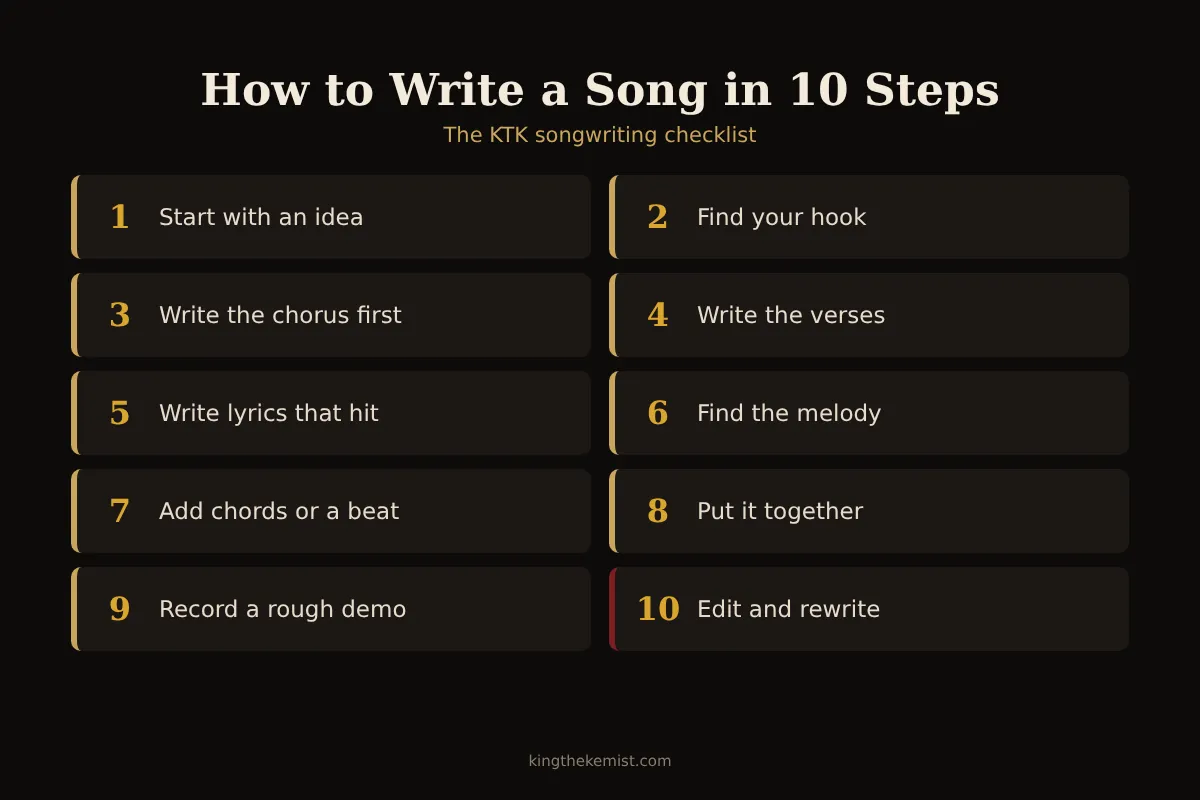
- Start with an idea. A feeling, a story, a title or a line you can't stop thinking about.
- Find your hook. The one line people will remember. It's usually the title.
- Write the chorus first. It's the heart of the song. Build everything else around it.
- Write the verses. They tell the story and set up the chorus.
- Add a melody and chords. Hum it, play it or build it over a beat.
- Shape the structure. Verse, chorus, verse, chorus, bridge, chorus is a classic for a reason.
- Record a rough demo. A phone voice memo is fine.
- Edit. Cut weak lines, tighten the rhymes and make every word earn its spot.
Now let's go deeper.
How songs are built: the parts of a song
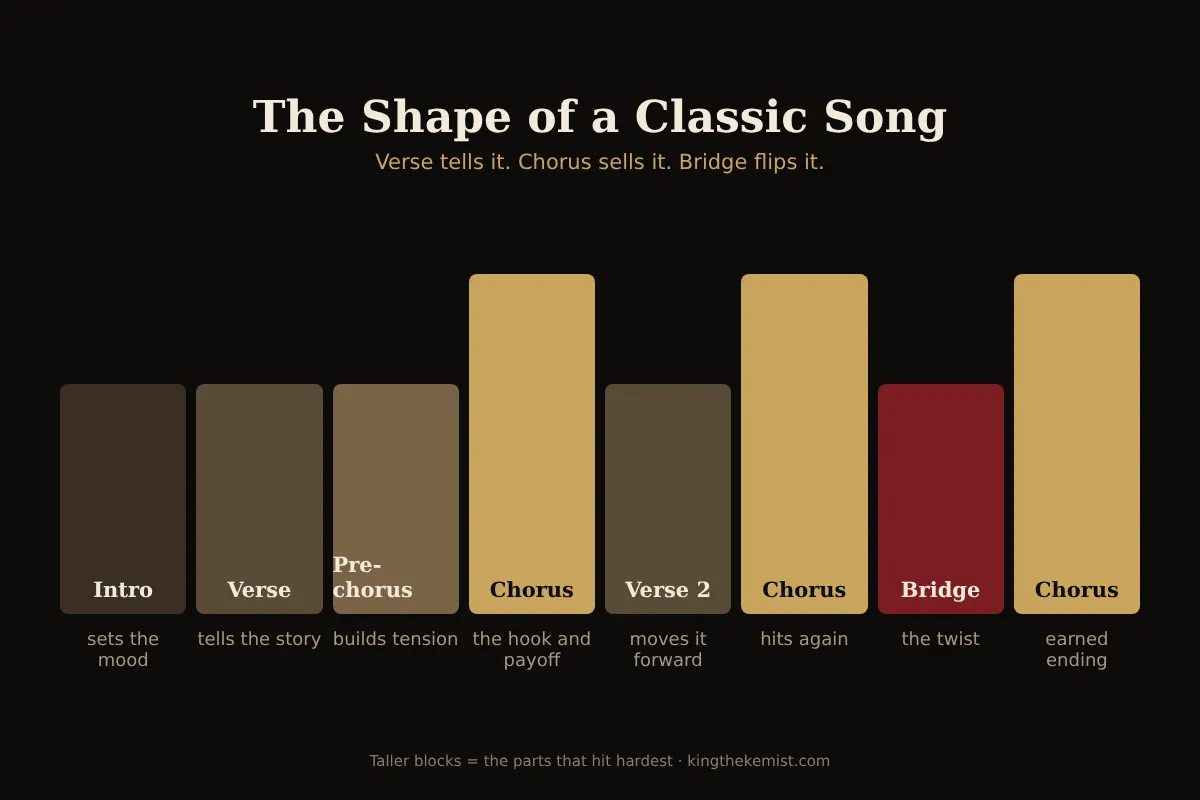
Before you write, it helps to know the pieces. Most popular songs are built from some combination of these.
| Part | What it does | Feels like |
|---|---|---|
| Intro | Sets the mood | The door opening |
| Verse | Tells the story, gives details | The conversation |
| Pre-chorus | Builds tension toward the chorus | The ramp |
| Chorus | Delivers the main message and hook | The payoff |
| Post-chorus | Repeats a hook or vocal chant | The echo |
| Bridge | Brings something new: a twist, a shift, a contrast | The plot twist |
| Outro | Wraps it up | The door closing |
Common song structures
- Verse – Chorus – Verse – Chorus – Bridge – Chorus. The classic pop and R&B shape.
- Verse – Pre-chorus – Chorus (repeat) – Bridge – Chorus. Adds a build before each chorus.
- Hook – Verse – Hook – Verse – Hook. Common in hip-hop: the hook carries the song and the verses do the talking.
- Verse – Verse – Bridge – Verse (AABA). Older standards and some singer-songwriter styles.
You don't have to follow any of these. But knowing them gives you a map, and it's easier to break the rules once you know what they are.
Step 1: Start with an idea
Every song starts with a seed. It might be:
- A feeling. Heartbreak, gratitude, anger, nostalgia, hype.
- A story. Something that happened to you or someone you know.
- A title. A phrase that sounds like a song, like "Leave the Light On" or "Second Chances."
- A line. Something you overheard, said or thought that stuck with you.
- A sound. A beat, a chord, a melody, a groove.
Keep a running list. Your phone's notes app and voice memos are two of the best songwriting tools ever made. When an idea hits, capture it immediately. Ideas are slippery. If you don't catch them, they leave.
Make the idea specific
"A song about love" is too big. "A song about the first time you realize someone is never coming back" is a song. The more specific the idea, the easier it is to write and the more people will actually feel it.
Step 2: Find your hook
The hook is the part people sing back to you. It's usually in the chorus, and it's often the title of the song.
A good hook is:
- Short. A few words, not a paragraph.
- Memorable. Easy to repeat, easy to sing.
- Emotional or surprising. It lands a feeling or a twist.
- Repeated. Hooks work because they come back.
Try writing ten possible hooks for your idea before choosing one. The first one you write is rarely the best.

Step 3: Write the chorus first
A lot of songwriters write the chorus before anything else, and for good reason. The chorus is the center of the song. Once you know what the chorus says, you know what the verses need to set up.
A strong chorus:
- States the main idea of the song clearly
- Contains the hook, usually at the beginning or end
- Uses simpler, broader language than the verses
- Has a melody that lifts or hits harder than the verse
Tip: read your chorus out loud with no melody. If it doesn't sum up the song, keep working on it.
A worked example: from one idea to a chorus
Let's walk through it with a made-up idea so you can see the process.
The idea: a guy who finally stops answering texts from someone who keeps coming back only when they're bored.
Possible hooks (brainstorm ten, keep the best): "Read at 2 a.m." · "Not This Time" · "You Only Call When It Rains" · "Left on Read" · "Same Number, New Me"
Pick one: "Same Number, New Me." It's short, it has a twist and it tells the whole story in four words.
First-draft chorus:
You still got my number, yeah, it's still the same
But the man who used to answer don't go by that name
You can call it, you can text it, you can try and see
Same number, new me
Now check it: does it state the main idea? Yes. Is the hook in it? Yes, at the end, where it lands hardest. Is it simple enough to sing back after one listen? Pretty much.
From here, Verse 1 could show the old pattern (the late-night texts, the excuses), and Verse 2 could show the moment he decided to stop. The bridge could be the one time he almost answers. That's a full song map built from one specific idea.
Step 4: Write the verses
The verses are where you tell the story. If the chorus is the headline, the verses are the article.
- Verse 1 usually sets the scene: who, where, what's happening.
- Verse 2 moves the story forward: what changed, what got worse, what you learned.
Each verse should lead naturally into the chorus, so when the chorus hits, it means something new.
Show, don't tell
This is the most important lyric rule there is. Instead of saying how you feel, show the details that make the listener feel it.
- Telling: "I was so sad after you left."
- Showing: "Your coffee cup's still sitting in the sink."
The second line is sadder, and it never uses the word "sad."

Step 5: Write lyrics that hit
Use real details
Names of streets, specific objects, times of day, brand names, smells, songs on the radio. Details make a song feel real and personal, and weirdly, the more specific you get, the more relatable it becomes.
Write like people talk
The best lyrics sound like something a real person would say. Read your lines out loud. If you'd never say it in conversation, consider rewriting it.
Rhyme with purpose
Rhymes help songs stick, but forced rhymes kill them. Don't change what you mean just to rhyme.
- Perfect rhymes: love / above, night / light.
- Slant (near) rhymes: home / alone, mind / time.
Slant rhymes give you a lot more freedom and often sound more natural.
Avoid clichés (or flip them)
"Heart of gold," "tears like rain," "you're my everything." We've heard them a million times. If you use a cliché, flip it into something new.
Make every line earn its spot
If a line is just filling space, cut it. Songs are short. Every word should either move the story, build the feeling or set up the hook.
Step 6: Find the melody
You don't need to be a trained singer or musician to write a melody.
- Hum over a beat or chords. Record yourself humming random melodies for a few minutes. Listen back and pick the parts that stick.
- Speak the lyrics, then exaggerate. Say a line out loud and notice its natural rhythm and rise and fall. Stretch that into a melody.
- Contrast the sections. Make the chorus melody higher, longer or punchier than the verse so it feels like a lift.
- Repeat what works. Melodies are memorable because they repeat. Don't be afraid to use the same melodic phrase more than once.

Step 7: Add chords or a beat
If you play guitar or piano, a few basic chords go a long way. One of the most famous chord progressions in pop music is I–V–vi–IV, which in the key of C is:
C – G – Am – F
Hundreds of hit songs use that progression or something close to it. It's not cheating. It's a foundation.
Other simple progressions to try:
- vi–IV–I–V (Am – F – C – G): a little moodier.
- I–IV–V (C – F – G): classic, bright and bluesy.
- ii–V–I (Dm – G – C): smooth, common in jazz and R&B.
If you don't play an instrument, you can write over a beat or instrumental. A lot of hip-hop and R&B songs are written exactly that way: the beat comes first, then the melody and lyrics.
Step 8: Put the song together
Now arrange your pieces. A simple starting point:
- Intro (optional, keep it short)
- Verse 1
- Chorus
- Verse 2
- Chorus
- Bridge
- Chorus (maybe twice, maybe with a change)
- Outro (optional)
Write the bridge
The bridge is your chance to add something new before the last chorus. It might be:
- A change in perspective
- A twist in the story
- A moment of honesty the rest of the song has been avoiding
- A new melody or chord change
The bridge makes the final chorus feel earned.
Step 9: Record a rough demo
Before you polish anything, record a simple version. Your phone's voice memo app is enough. Just you singing or rapping over a guitar, a piano or the beat.
Then listen back the next day with fresh ears. You'll instantly hear what works and what doesn't. Lines that felt great at midnight sometimes don't hold up in the morning. 😂
Step 10: Edit and rewrite
The first draft is supposed to be messy. The song lives in the rewrite.
Ask yourself:
- Does the chorus clearly say what the song is about?
- Is there a line that sounds forced just to rhyme?
- Is the hook strong enough that someone could sing it back after one listen?
- Does the second verse add something new, or just repeat the first?
- Is the song longer than it needs to be?
Cut, tighten and try alternatives. Sometimes changing one word changes the whole song.

Songwriting tips by genre
The basics apply everywhere, but each genre has its own habits.
- Hip-hop: the hook carries the song and the verses carry the weight. Verses are often 16 bars. Wordplay, flow and specific details matter a lot. Many writers start with the beat.
- R&B: melody and feeling come first. Lyrics are often intimate and conversational, and the vocal delivery does a lot of the storytelling. Smooth chord progressions like ii–V–I show up a lot.
- Pop: big, simple choruses, short sections and hooks that repeat. Pop songs often get to the chorus fast, sometimes within the first 30 to 45 seconds.
- Country: storytelling is king. Clear narratives, specific details and a twist in the last chorus are classic moves.
- Rock and alternative: energy and attitude matter as much as polish. Guitar riffs can be the hook.
- Gospel and worship: repetition and congregation-friendly melodies, with lyrics built around a central message people can sing together.
Whatever genre you write in, listen to the songs you love and study why they work. Map their structure, count their bars and notice where the hook hits.
Songwriting exercises to get unstuck
Writer's block is real. These exercises help.
- Object writing. Pick an object in the room and write about it for ten minutes using all five senses. Then pull the best lines into a song.
- Title first. Write ten song titles. Pick one and write the chorus in 15 minutes.
- Write a letter. Write a letter to someone you never said something to. Turn the best sentences into lyrics.
- Steal a structure. Take a song you love, map its structure and write a new song with the same shape (not the same words or melody).
- Change the point of view. Write the same story from the other person's perspective.
- Set a timer. Give yourself 30 minutes to finish a full rough draft. Deadlines kill perfectionism.
- Write every day. Even four bad lines a day. The habit matters more than the quality.
Common songwriting mistakes
- Waiting for inspiration. Professionals write on schedule. Inspiration shows up when you're already working.
- Being too vague. "I feel so lost" doesn't paint a picture. Details do.
- Forcing rhymes. Meaning matters more than rhyme.
- No clear hook. If nobody remembers it, it's hard to love it.
- Burying the chorus. If it takes too long to get to the chorus, people might skip before they get there.
- Never finishing. A finished average song teaches you more than ten unfinished great ones.
- Not editing. Most first drafts need work. That's normal.

What to do after you finish a song
Protect it
Under U.S. law, your song is protected by copyright as soon as it's fixed in a tangible form, like a recording or written lyrics. The U.S. Copyright Office explains that registration isn't required for protection, but registering your work gives you important legal benefits, including being able to file a lawsuit for infringement for U.S. works. Many songwriters register their songs once they're ready to release them.
Get credit and royalties
If your song gets released, look into a performing rights organization like ASCAP or BMI in the U.S. They collect performance royalties for songwriters when songs are played publicly.
Get feedback
Play it for people you trust, especially other songwriters. Ask specific questions: "Does the chorus land?" "Did the second verse lose you?"
Write the next one
The best way to get better at songwriting is to write a lot of songs. Your 50th song will be better than your 5th. Keep going.
Frequently asked questions
How do I start writing a song for the first time? Start with a specific idea or a title, write the chorus first, then build the verses around it. Record a rough demo on your phone and edit from there.
Do I need to know music theory to write a song? No. It helps, but plenty of songwriters write by ear, by humming or over beats. You can learn theory as you go.
What comes first, lyrics or melody? Either. Some writers start with words, some with a melody, some with a beat. Try both and see what works for you.
How long should a song be? Most popular songs are around two and a half to four minutes, but there's no rule. Write the song it needs to be.
How do I make a catchy chorus? Keep it short and simple, put the hook in it, repeat it and give it a melody that lifts above the verse.
How do I protect my song? In the U.S., your song is protected by copyright once it's fixed in a tangible form. Registering with the U.S. Copyright Office gives you extra legal benefits.
How many songs should I write? As many as you can. Quantity builds quality.

The bottom line
Writing a song isn't about waiting for lightning to strike. It's about having a process you can come back to.
Catch the idea. Find the hook. Write the chorus. Tell the story in the verses. Hum it, record it, cut what doesn't work and finish it.
Then write another one. That's the whole secret.
Go make something.
— King
Sources
- Copyright in General (FAQ), U.S. Copyright Office
- ASCAP
- BMI
Sources checked November 10, 2026.