Money & Making
Everything Wants $9.99 a Month Now: How Subscriptions Drain You (and How to Fight Back)
Your music, your movies, your cloud storage, your meditation app. Everything wants $9.99 a month now. 😂 What it really costs, how to find every subscription you pay for and how to cut the ones you forgot, plus a free tracker.

I need somebody to explain to me when everything turned into $9.99 a month. 😂
Your music. Your movies. Your cloud storage. Your meditation app. Your password manager. Your photo editor. Your "premium" weather app. The app that tells you when to drink water. At some point, a car company even tried to charge people a subscription to turn on the heated seats that were already in the car. The seats. Were already. In the car.
Everything wants $9.99. And every single one of them says the same thing: "It's less than a cup of coffee!"
Bro. You're not buying one cup of coffee. You're buying fifteen cups of coffee every month, from fifteen different companies, and you forgot you ordered half of them.
So this is a rant. But it's a useful rant. By the end, you're going to know why subscriptions sneak up on you, what $9.99 actually costs over time, how to find every subscription you're paying for and how to cut the ones that aren't earning their spot. And there's a free tool to help you do it.

The $9.99 trick
Let's talk about why $9.99 works so well.
First, it's not $10. Our brains see the 9 and round down. $9.99 feels like "nine-something," not "ten." That penny is doing a lot of work. 😂
Second, it's monthly. Nobody would pay $119.88 upfront for most of these apps. But $9.99 a month? That's nothing. That's a sandwich. You barely feel it.
Third, it's automatic. You sign up once and then you never have to decide again. It just keeps going. Forever. Until you notice.
And that's the real trick. A subscription doesn't need you to say yes every month. It just needs you to never say no.
What $9.99 a month actually costs
Here's the math nobody puts on the signup page.
| Monthly | Per year | 10 years |
|---|---|---|
| $9.99 | $119.88 | $1,198.80 |
| $14.99 | $179.88 | $1,798.80 |
| $19.99 | $239.88 | $2,398.80 |
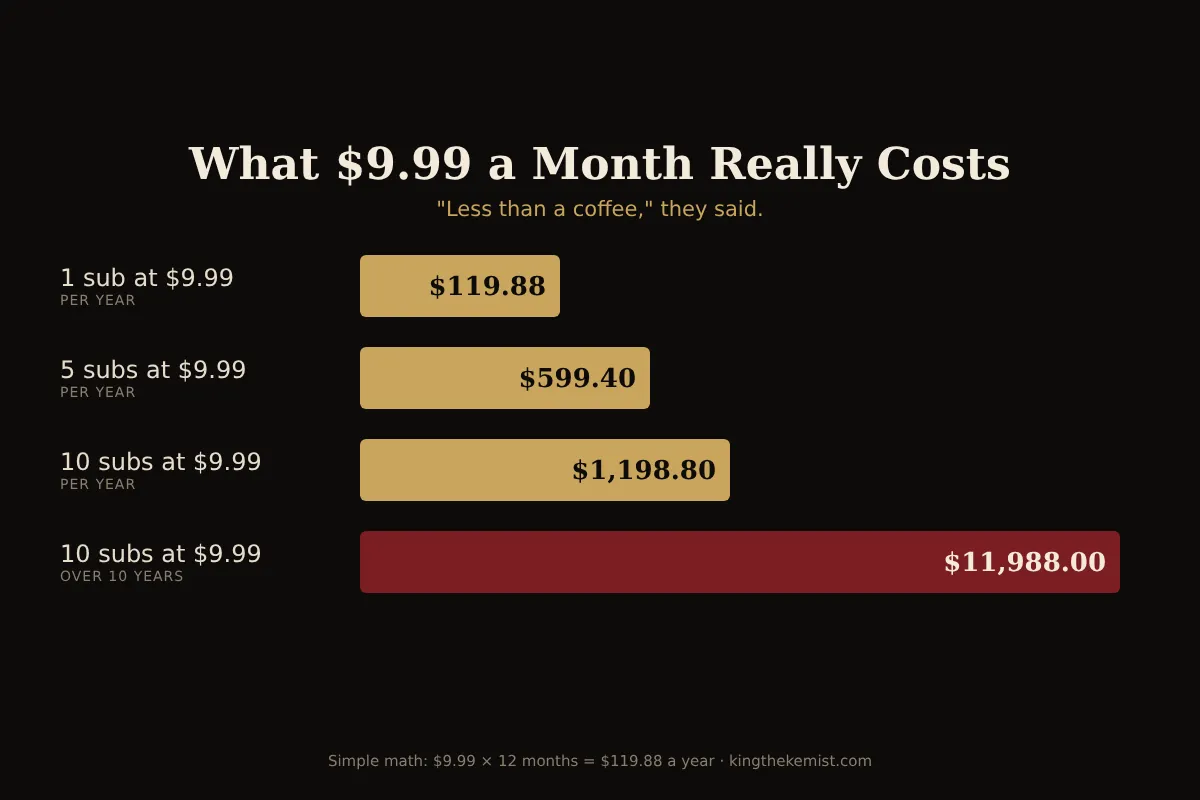
Now stack them. Five subscriptions at $9.99 is almost $600 a year. Ten of them is almost $1,200 a year. Over ten years, ten "less than a coffee" subscriptions add up to almost $12,000.
That's a used car. That's a trip. That's a real emergency fund. That's money that went out the door one little "it's only $9.99" at a time.
You probably pay more than you think
This is the part that got me.
In 2022, C+R Research surveyed 1,000 U.S. consumers about their subscriptions. People guessed they were spending $86 a month. When they actually added it up, the average was $219 a month. That's more than two and a half times what they thought.
It gets better. Or worse. 42% said they had forgotten about a subscription they were still paying for. 74% said it was easy to forget about recurring charges. And 72% had their subscriptions set to auto-pay.
So most of us aren't making bad decisions on purpose. We're just not making decisions at all. The money leaves on its own.

How they get you
I'm not saying every subscription is a scam. Some are worth every penny. But a lot of companies have gotten really good at making it easy to start and annoying to stop. Here's the playbook.
The free trial
"Try it free for 7 days!" Then they need your card. Then day 8 comes, you forgot, and now you're a paying customer. Some trials even quietly turn into an annual plan.
The intro price
"$1.99 for your first three months!" Then it jumps to full price, and you don't notice because it's still "small."
The price creep
You signed up at $7.99. Then it was $9.99. Then it was $11.99. Then there was a new "premium" tier and suddenly the plan you had got worse unless you upgrade.
The ads tier
"Now with a cheaper plan with ads!" Which really means the old price now buys you less, and the no-ads version costs more.
The cancellation maze
Sign up in two clicks. Cancel through six screens, three "are you sure?" pop-ups, a survey, a discount offer and a "talk to a live agent" button. 😂
The government has noticed, by the way. In October 2024, the Federal Trade Commission finalized a "click-to-cancel" rule meant to make canceling as easy as signing up. In July 2025, a federal appeals court threw it out on procedural grounds, and in 2026 the FTC started the rulemaking process over again. Meanwhile, an older federal law called ROSCA (the Restore Online Shoppers' Confidence Act, from 2010) still requires online sellers to clearly disclose subscription terms, get your consent and give you a simple way to stop recurring charges. So the fight over how easy it should be to cancel is still going.
The "everything is a subscription now" move
Software you used to buy once now costs monthly. Features that used to be included now sit behind "Plus" or "Pro." Even hardware sometimes comes with features you have to keep paying for to unlock.

The subscriptions people forget the most
When you do your audit, look extra hard for these. They're the sneaky ones.
- Phone apps. Photo editors, fitness apps, language apps, games and "pro" versions of tools you downloaded once.
- Cloud storage. It starts small. Then your phone fills up and you upgrade without thinking twice.
- Extended warranties and protection plans. Phones, laptops, appliances. Some of these renew monthly or yearly.
- Gym and fitness memberships. Including the one across town you haven't been to since February. 😂
- News and magazine subscriptions. Especially the ones that started as a $1 trial.
- Delivery memberships. Free delivery feels great until you realize you're paying for it every month whether you order or not.
- Kids' apps and games. In-app subscriptions on a shared device can slip right past you.
- Software you used for one project. Design tools, video editors, website builders and AI tools you tried for a week.
- Domain names and hosting. If you ever started a website, check for auto-renewals on domains and plans.
The subscription audit: find every single one
Okay, enough complaining. Let's fix it. This takes about an hour, and it can save you hundreds a year.
Step 1: Pull your statements
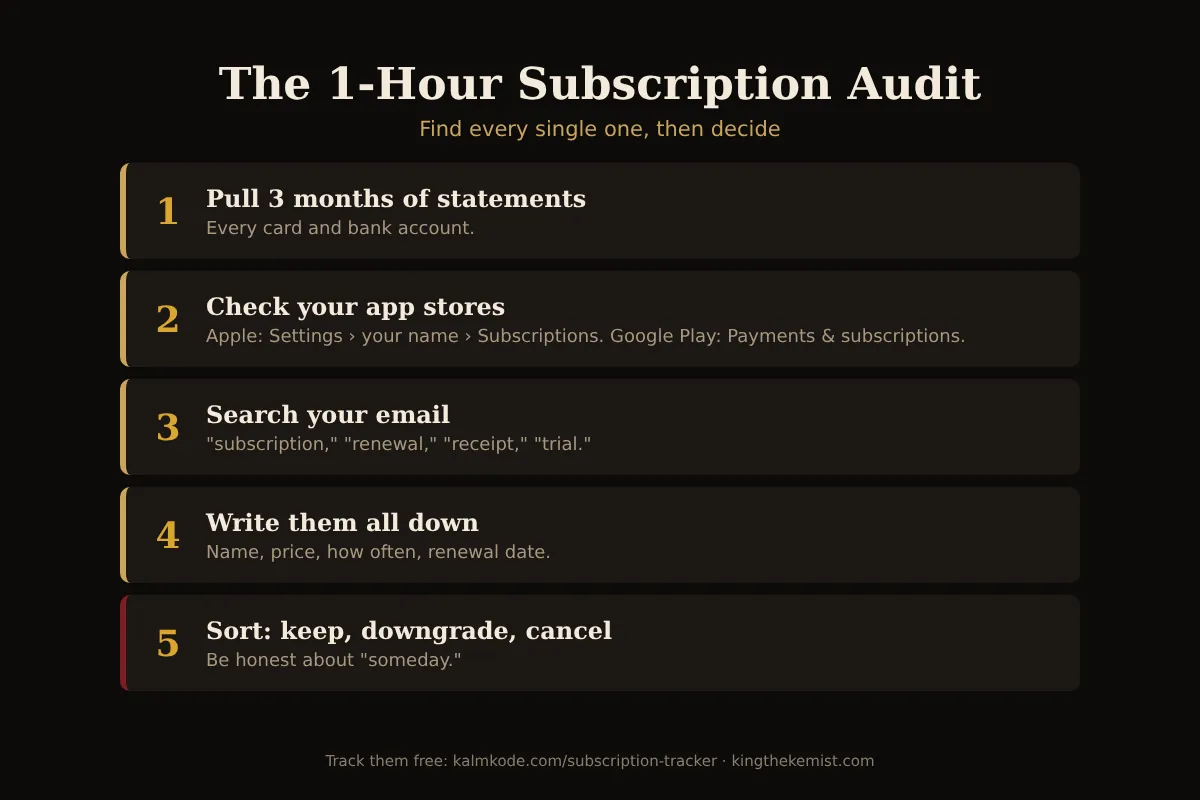
Grab the last three months of statements from every card and bank account you use. Three months, because some things only charge quarterly, and you want to catch them.
Step 2: Check your app stores
A lot of subscriptions don't show the company's name on your bank statement. They show up as Apple or Google.
- iPhone or iPad: go to Settings, tap your name, then Subscriptions.
- Android: open the Google Play Store, tap your profile picture, then Payments & subscriptions, then Subscriptions.
Step 3: Search your email
Search your inbox for words like "subscription," "renewal," "your plan," "receipt," "trial" and "membership." You'll be shocked what pops up.
Step 4: Write them all down
Every single one. Name, price, how often it charges and when it renews.
This is where the free tool comes in. My Kalm Kode Free Subscription Tracker lets you list everything you pay for and shows you what it costs every month and every year. Seeing the yearly total in one place is usually the wake-up call. 😂
Step 5: Sort them into three piles
- Keep: you use it every week and it's worth it.
- Downgrade: you use it, but you don't need the premium tier.
- Cancel: you forgot it existed, you use it once a month or you only kept it out of habit.
Be honest. "I might use it someday" is how you end up paying for six streaming services.

How to cut subscriptions without missing out
Rotate your streaming
You don't need every streaming service at once. Subscribe to one, binge what you want, cancel it, then switch to another one next month. You'll still watch everything you care about, just not all at the same time.
Pay yearly for what you actually use
If you know you'll keep something all year, the annual plan is often cheaper than paying monthly. Just make sure you'll really use it, and set a reminder before it renews.
Use family and bundle plans the right way
A lot of services offer family plans or bundles. Splitting a family plan with the people in your household can bring the cost down a lot. Just follow the service's rules on who can share.
Check what you already get for free
Your phone carrier, credit card, internet provider or job might already include some subscriptions or discounts. Check before you pay twice.
Use the free version
A lot of apps have a free tier that's plenty for most people. Try going free for a month and see if you even miss the premium features.
Check your trial's cancel rules first
Signing up for a free trial? Check whether canceling ends trial access immediately (some offers do). If it does, set a reminder before the cancellation deadline. If it doesn't, cancel right away and you won't get charged if you forget.
Set calendar reminders
For every trial and every annual renewal, put a reminder on your calendar a few days before it charges. Future you will thank you.

My subscription ground rules
These are the simple rules I'd hand anybody who's tired of the drip.
- No free trial without a reminder. If you can't be bothered to set a reminder, you don't really want the trial.
- One in, one out. Adding a new streaming service? Cancel one.
- Audit twice a year. Put it on the calendar. January and July work great.
- If it's on auto-pay, it's on the list. Everything recurring goes in your tracker, no exceptions.
- Annual plans only for proven winners. Use it monthly for a few months first. If you're still using it, then lock in the yearly price.
- Price goes up? Re-decide. Every price increase is a chance to ask, "Would I still sign up today?"
- Free is a feature. Try the free version before paying. Pay only when the free version actually holds you back.
- Cancel the day you stop using it. Not "next month." Today.
Which subscriptions are actually worth it?
I'm not anti-subscription. I'm anti-paying-for-stuff-I-don't-use. Here's a simple test for every one you keep:
- Do I use it at least once a week?
- Would I sign up for it today at this price?
- Does it save me time, money or stress?
- Would I notice if it disappeared tomorrow?
If you answer yes to most of those, keep it. If you answer no to most of them, it's gone.
The usually worth it list
- Tools you use for work or your business every week
- Cloud backup for photos and files you can't afford to lose
- A password manager (seriously)
- One or two entertainment services you actually use
- Anything that directly saves you more money than it costs
The usually not worth it list
- Apps you opened once
- Duplicate services that do the same thing
- "Premium" tiers you upgraded to for one feature
- Free trials you forgot to cancel
- Memberships to places you don't go anymore 😂

What to do when a company makes canceling hard
You click "cancel" and suddenly you're in a maze. Here's how to get out.
- Look for the cancel option in your account settings first. It's often under "Plan," "Membership," "Billing" or "Manage subscription."
- If you subscribed through Apple or Google, cancel through the app store, not the company's website.
- Ignore the discount offers unless you actually want to stay. "50% off for three months" is designed to keep you paying.
- Screenshot everything. The cancel confirmation, the date, the email.
- Check your next statement to make sure the charges actually stopped.
- If they keep charging you, contact your bank or card company. They can often help you dispute charges you didn't authorize or that kept going after you canceled.
If you run a business or freelance
Business subscriptions are the same problem with bigger numbers. Software seats, design tools, scheduling apps, email marketing platforms, AI tools, storage, hosting, domains and plug-ins. They add up fast, and because they're "for the business," nobody questions them.
A few extra moves for business owners:
- Keep business subscriptions on one card so they're easy to find and track.
- Check user seats. Are you paying for team members who left?
- Look for overlap. Two tools that both do scheduling? Three places you store files? Pick one.
- Review before tax time. It's easier to spot waste when you're already going through expenses.
The same rule applies: if a tool doesn't save you more time or money than it costs, it doesn't get to stay.
Talking about subscriptions with the people you live with
If you share money with a partner, roommates or family, subscriptions can get messy. Two people paying for the same streaming service. A kid's game charging the family card. A partner who didn't know about your "premium" app.
Have a quick, no-blame conversation. Pull up the list together, decide what you're keeping and who's paying for what. Shared tracking makes it a lot easier to avoid double-paying and surprise charges.
The real cost isn't just money
Here's the part that's bigger than the math.
Every subscription is a tiny decision you outsourced. Every one is a little drip of money leaving without you looking. And when you add them all up, it's not just $219 a month. It's the feeling of not really knowing where your money goes.
That feeling is expensive too.
When you clean up your subscriptions, you don't just save money. You get back a little control. You know exactly what you're paying for and why. And that's a good feeling.

Frequently asked questions
How much does the average person spend on subscriptions? In a 2022 C+R Research survey of 1,000 U.S. consumers, people guessed they spent $86 a month, but the actual average was $219 a month.
How do I find all my subscriptions? Check three months of bank and card statements, check your app store subscriptions (Apple Settings or Google Play), and search your email for words like "subscription," "renewal" and "receipt."
What's the easiest way to track subscriptions? Write them all down in one place with their price and renewal date. The free Kalm Kode Subscription Tracker shows your monthly and yearly totals.
How do I cancel a subscription on my iPhone? Go to Settings, tap your name, then Subscriptions, choose the subscription and tap Cancel Subscription.
How do I cancel a subscription on Android? Open the Google Play Store, tap your profile picture, go to Payments & subscriptions, then Subscriptions, choose the one you want and tap Cancel.
Is the FTC click-to-cancel rule in effect? The FTC finalized it in 2024, but a federal appeals court vacated it in July 2025. The FTC began a new rulemaking process in 2026. An older federal law, ROSCA, still requires clear disclosures, consent and a simple way to stop recurring charges for online subscriptions.
Is $9.99 a month a lot? On its own, no. But $9.99 a month is $119.88 a year, and ten of them add up to almost $1,200 a year.
Is it better to pay for subscriptions monthly or yearly? Yearly is often cheaper, but only if you'll actually use the service all year. Try it monthly first, then switch to annual for the ones you know you'll keep, and set a reminder before it renews.
What is subscription fatigue? It's the feeling of being overwhelmed by how many subscriptions you have and how much they cost together. In the C+R survey, 22% of people said they felt overwhelmed by the number of subscription services they had.
Can my bank help me stop a subscription? Many banks and card issuers let you dispute unauthorized charges or charges that continued after you canceled. Some cards and banking apps also let you block a specific merchant. Check with your bank to see what they offer.
The bottom line
Everything wants $9.99. Fine. But not everything deserves it.
Pull your statements. Check your app stores. Write every subscription down. Keep what you love, cut what you forgot and stop letting "it's less than a coffee" drain your account one drip at a time.
Your money should go where you send it, not where it wanders off to.
Now go cancel that meditation app you used twice. 😂
— King
Sources
- Subscription Service Statistics and Costs, C+R Research, 2022 survey of 1,000 U.S. consumers
- Eighth Circuit vacates FTC click-to-cancel rule, Cooley, July 2025
- Apple Music promotional offer terms (example of a trial that ends when canceled), Apple
Sources checked November 10, 2026.