Pets
Adopting a Rescue Basenji: The Questions to Ask (and the Ones They'll Ask You)
Adopting a rescue Basenji? What BRAT's process looks like, the questions to ask about a dog, the ones they'll ask you and how to get your home ready.

By King The Kemist · Sources reviewed November 12, 2026. Editorial source review, not veterinary review.
Basenji rescue adoption starts with an honest match between a particular dog and the life you can offer. And if you've started looking at Basenji Rescue and Transport's listings, you've probably noticed something: this isn't a "pick a dog and take it home Saturday" process.
That's on purpose. Basenjis are smart, strong-willed and clever escape artists. I've had two, Rocco and Ghost, and I learned the hard way that you have to stay about 20 steps ahead of them. Rescues know that too, which is why they ask so many questions.
This guide walks through how Basenji rescue adoption generally works, using Basenji Rescue and Transport (BRAT) as the main example, since it publishes its process in detail. It covers the questions to ask about a specific dog, the questions the rescue will ask you, what it costs, how to get your home ready and what the first weeks look like. BRAT's current Adoption Process page supplies the timing and placement sequence; its FAQ adds context. Confirm the current listing and coordinator's instructions for the individual dog. I'm not affiliated with BRAT; I'm a Basenji person who wants more of these dogs in good homes.
Quick answer: With BRAT, you read about the adoption process, fill out an application and get contacted by a representative for your state, who may ask questions to find a good match. You'll get emails about new dogs; when one fits, you contact that dog's coordinator. If the coordinator wants to move forward, a home visit is scheduled. When you're approved, you pay a placement fee, which varies by the dog's age, and sign an adoption contract. Transport may be arranged through volunteer relays called the Basenji Underground Railroad. BRAT's current process page says it might take a month, or several months or more, to find the right dog. Placement is not first-come, first-served. BRAT won't place a dog in a home that uses electronic fencing and recommends a 6-foot privacy fence. Ask every rescue about the dog's Fanconi status, history with cats, kids and other dogs, escape history and medical needs.
Why Basenjis End Up in Rescue
It helps to understand why these dogs need new homes. BRAT's FAQ lists several common reasons:
- Life changes: illness, a family member who needs care, job loss, long work hours, travel, marriage, a new baby, divorce or money trouble.
- Mismatched expectations: BRAT says the breed's looks "can appeal to people who are not really suited to having a Basenji." Some people assume "barkless" means silent, or that Basenjis are good apartment dogs that don't need exercise, or expect an obedient dog.
- Rescued from bad situations: dogs removed from abuse or neglect, saved from shelters or puppy mills, or seized from collectors.
- Behavior problems: BRAT says Basenjis "are smart, strong-willed, independent, creative dogs" that "require intelligent handling," and "if left to their own devices, they may learn behaviors that are unacceptable."
- Health problems and age: some come in because an owner couldn't manage a health condition, and some simply because they're old.
BRAT's bottom line on relinquished dogs: "These dogs are not bad dogs." They may be undertrained or under-socialized, and they can do well with someone willing to spend time, be consistent and train. BRAT's FAQ says it "does not knowingly accept or place dogs that bite." That is its stated policy, not a guarantee of a dog's future behavior. Ask directly about known bites, snapping, guarding, triggers and the foster home's observations.
Is a Basenji Right for You?

BRAT asks you to be honest with yourself before applying. It says "yes" answers to questions like these should make you question whether a Basenji is right for you:
- Is your home life hectic right now, with small children and lots of activity?
- Are you caring for a dependent family member?
- Are you away many hours a day for work, or traveling often?
- Do you want a dog that's highly obedient and lives only to please you?
- Do you want a dog that can safely run off leash?
- Do you want a dog that just lies around the house?
- Do you want a dog that instantly loves everyone, including small children?
And on the other side, BRAT says a Basenji "might be just the right dog for you" if you want an intelligent dog that will challenge you and "may even outsmart you on occasion," a dog that's "cheerfully disobedient," and you're "willing to laugh at yourself when your dog puts one over on you."
That's the honest version. I'd add: if you like a dog with a sense of humor and you don't mind being outwitted now and then, you'll love it.
How the Process Works With BRAT
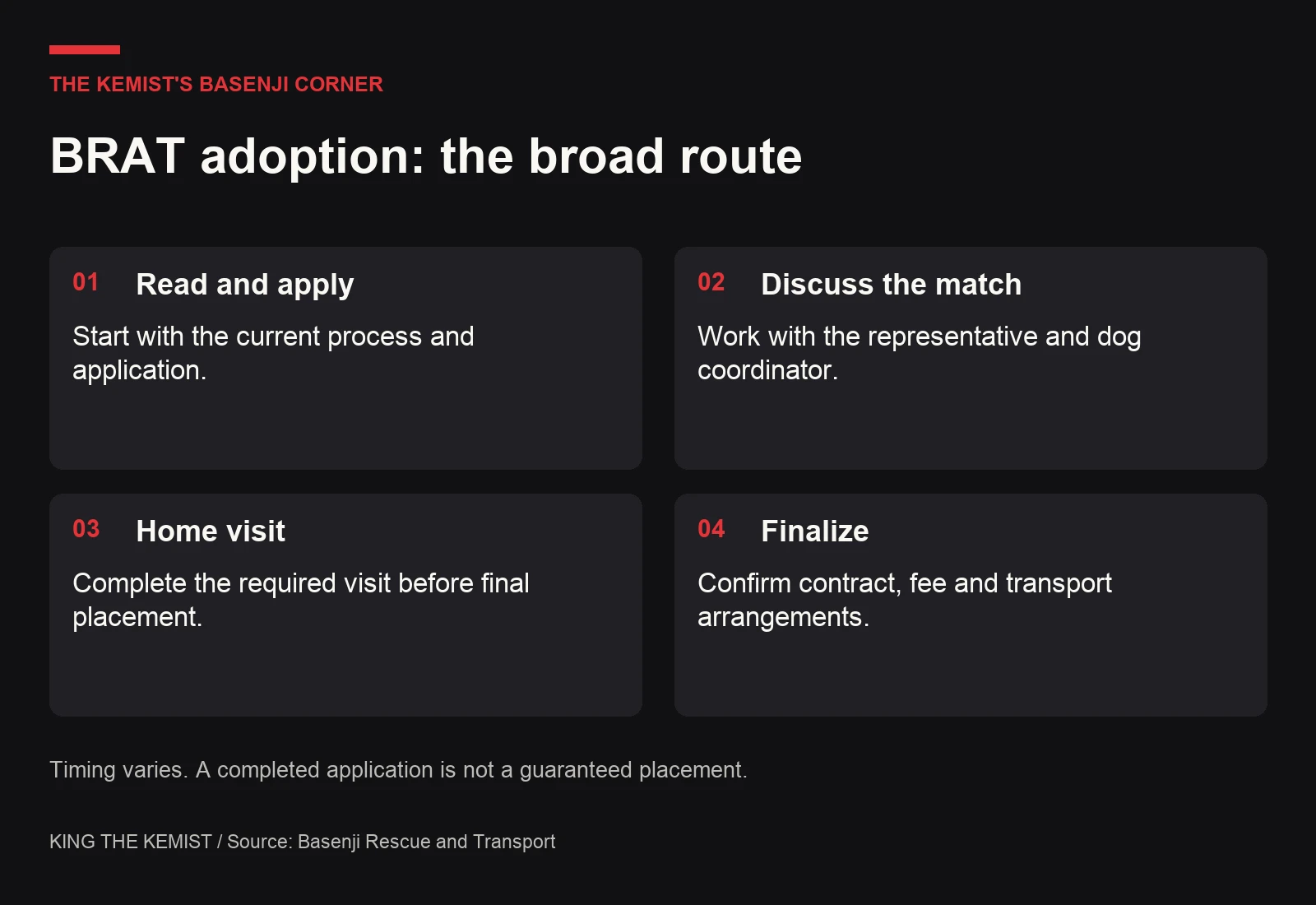
Here is BRAT's process, using its current Adoption Process page for timing and its FAQ for additional context. The coordinator for a specific dog can clarify current arrangements.
1. Read and apply
BRAT says the first thing to do is read about its adoption process, then complete its adoption application.
2. Hear from your state representative
After you apply, BRAT says, "you will be contacted by a BRAT representative," usually the one assigned to your state. They'll welcome you, confirm your email and may ask questions about your application. If you rent, BRAT says you may be asked for a letter from your landlord approving a dog.
Respond promptly. BRAT warns that "failure to respond will be interpreted as a lack of interest and will result in your application being removed" from its active database.
3. Watch for dogs
Once you've applied, BRAT says you'll start getting emails describing new Basenjis. You only need to respond if you're interested. You can also browse its listings. BRAT says to read profiles carefully, especially notes about whether a dog does well with cats or children.
4. Contact the dog's coordinator
When you see a dog that might fit, email that dog's coordinator using the link in its listing. BRAT's current process page says a coordinator's response might take a few days. Coordinators are volunteers, so do not treat this as a guaranteed response deadline. Expect follow-up questions. BRAT says coordinators "are not trying to be nosey or give you a hard time" and "just want a positive outcome."
5. Home visit
BRAT says a home visit is required before a final placement decision. If the coordinator wants to pursue the placement, the visit is scheduled. A BRAT representative visits your home to talk further, "hoping to ensure a positive outcome for both you and the Basenji." In some cases you may be able to visit the dog, which BRAT says is particularly useful for first-time Basenji owners and people with other dogs, and "critical if the Basenji is shy or has difficulty accepting new people."
6. Fee, contract and transport
When you're approved, BRAT says you pay a placement fee and sign an adoption contract. The fee varies by the dog's age and is listed on each dog's page. BRAT says fees "help defray costs of medical care and feeding," that fees are "flexible for pairs and special-needs dogs," and that a higher fee may apply when a dog has had extraordinary medical costs.
For transport, BRAT may coordinate a Basenji Underground Railroad (BUR) run, where volunteers drive the dog to you relay-style. Its older FAQ also discusses air transport at the adopter's expense. Confirm transport availability, current airline rules and total costs with the coordinator for that dog; do not assume an older FAQ establishes today's airline policies or guarantees a flight.
How long it takes
BRAT's current Adoption Process page says finding the right dog might take a month or several months or more. It is not first-come, first-served. The wait depends on the dogs available and the match, so a completed application does not reserve a dog or set a placement date.
Getting ready for the home visit
A home visit can feel like an inspection. It's really a conversation. BRAT describes it as "further discussion, hoping to ensure a positive outcome for both you and the Basenji." A few ways to make it go well:
- Walk your own fence line first. Look for gaps, loose boards, low spots and anything a dog could climb.
- Check your gates and latches, and think about how visitors, kids and delivery drivers use them.
- Think through your door routine. Who comes and goes, and how will you keep a fast dog from slipping out?
- Know where the dog will sleep, eat and spend time alone.
- Have your questions ready. The visit is your chance to ask about the dog too.
- Include your household. Everyone who lives with the dog should be part of the conversation if they can.
- Be honest. If something isn't ready yet, say so and ask for advice. Rescue volunteers have seen it all and would rather help you fix it than find out later.
Questions the Rescue Will Ask You

BRAT's FAQ lists examples. Think about your answers before anyone calls:
- What are your expectations? Do you want a dog that's promptly obedient and content to lie by your side?
- Would you adopt a Basenji that might chew your sofa or climb your fence? One with iffy house manners? One that needs medication for hypothyroidism or is on a dietary protocol for Fanconi syndrome?
- How much effort will you put into helping the dog settle in?
- What do you believe about training and crating? Do you think dogs should be allowed to run free?
- Do you support crating? If not, why?
- What training methods will you use?
- Do you rent or own? Does your landlord allow dogs? Is your yard fenced?
- Who lives in your home, and how do they feel about dogs?
- Do you have children, or do children visit often?
- Do you have other dogs? What breeds and ages? Are they spayed or neutered? Any behavior issues? Do you have cats?
- What's your lifestyle like?
Answer honestly. A good match is the goal, and a mismatch is how dogs end up back in rescue.
Questions to Ask About the Dog
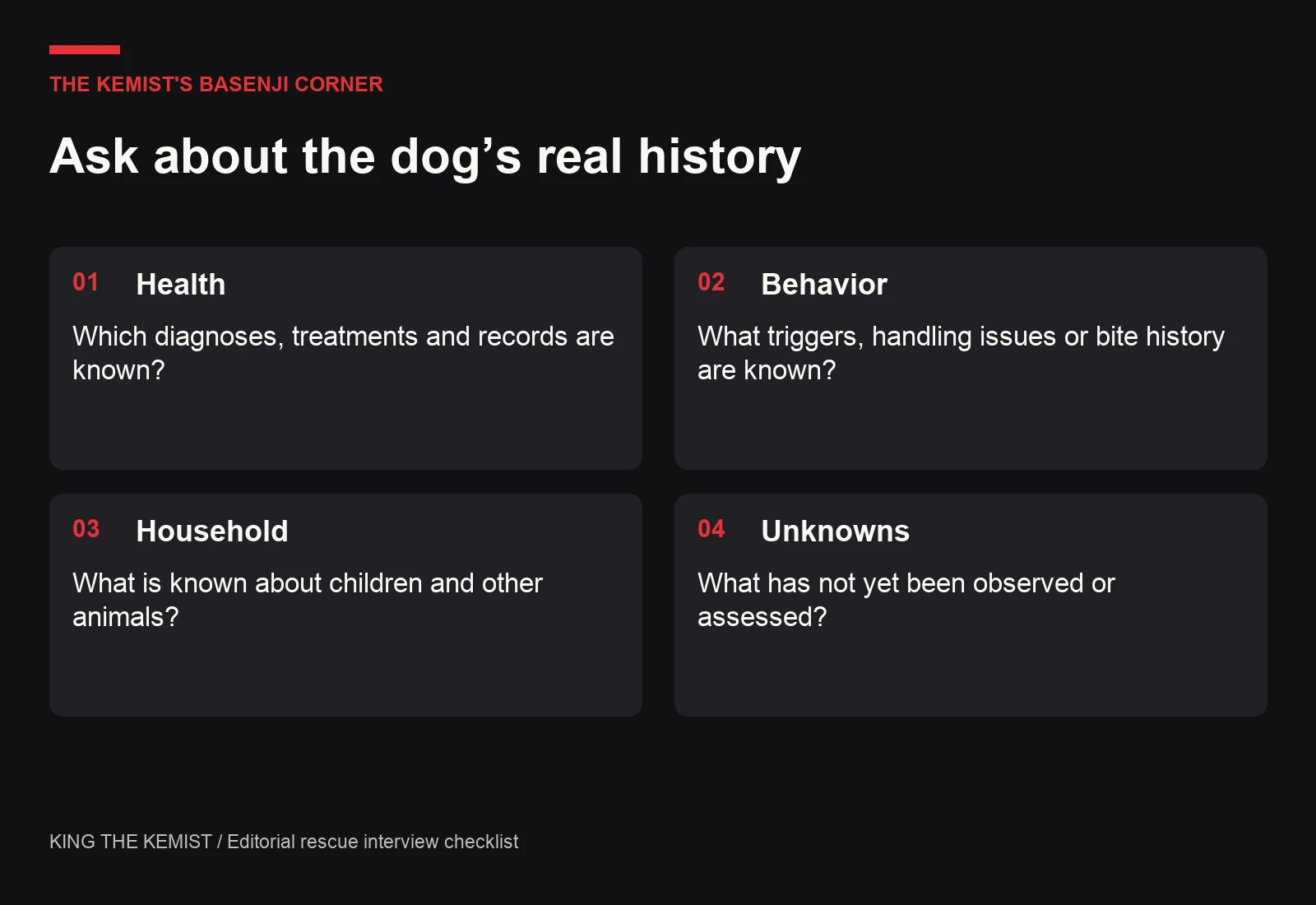
The rescue wants a good match. So should you. Here's what I'd ask a coordinator about any dog:
Health
- What's this dog's Fanconi DNA status? If it's unknown, has it been tested or can it be?
- Has the dog had recent blood work or a urine test?
- Is the dog on any medication, like thyroid medication, or a special diet?
- Any history of digestive, urinary, eye or skin problems?
- Is the dog spayed or neutered? (BRAT says it doesn't place intact dogs.)
- Can I get copies of all its vet records?
BRAT raises money specifically for Fanconi DNA testing, and I'd always ask. My Fanconi guide explains why, and Basenji Health Tests, Explained covers the rest.
Behavior
- How does the dog do with strangers? With kids? With cats? With other dogs, male and female?
- Has it ever escaped a yard, crate or house? How?
- How does it handle being left alone? Any destructive behavior or signs of stress?
- Is it crate trained? House trained?
- How does it do on a leash, in the car and at the vet?
- Does it guard food, toys or spaces?
- What does it love? What scares it? Has it ever bitten or snapped, and what happened immediately before and after?
Daily life
- What's its routine in foster care: walks, meals, sleep?
- How much exercise does it get, and what happens when it doesn't get enough?
- What food is it eating now?
- What would the foster home want the next family to know?
Escape history matters a lot with this breed. I got Ghost a big crate so she'd have extra room. She broke through it to come find me when I left the house. If a dog panics or injures itself trying to escape a crate, work with your vet or a qualified behavior professional on a safe plan; a stronger crate alone is not the answer. If a coordinator tells you a dog is a climber or a door-dasher, believe them and plan for it.
After you meet a dog, ask yourself
Meeting a dog in person, or even on a video call with the foster, tells you a lot. Afterward, ask yourself:
- Does this dog's energy level match my daily life, honestly?
- Can I handle the specific challenges the coordinator described?
- Does everyone in my home feel good about this dog?
- Am I choosing this dog for who it is, or because of how it looks?
- If the first month is hard, do I have the time and patience to work through it?
If the answers are yes, tell the coordinator. If they're not, it's OK to wait for the right dog. BRAT's process is built around the right match, not the fastest one.
Prepare the People Too

The dog isn't the only one adjusting. Before your Basenji arrives:
- Agree on house rules, like whether the dog is allowed on furniture and where it sleeps, so everyone is consistent. A Basenji will notice if the rules change depending on who's home.
- Assign jobs: feeding, walks, yard checks and who's responsible for doors and gates.
- Talk to kids about giving the dog space, especially while it's eating or resting, and about letting the dog come to them.
- Tell visitors to keep doors closed and not to let the dog out.
Same-Sex Pairs and Other Dogs
If you already have a dog, BRAT's FAQ has a specific warning: "same-sex aggression can often be a problem with Basenjis," and "in general, and especially when dealing with adult dogs, opposite sex placements are easier and safer."
Thinking about two Basenjis? BRAT says "most Basenji people believe that two Basenjis are twice as much fun as one." It suggests adopting an already-bonded pair, or, if you're not sure, adopting one now and waiting six months to a year before adding a second. It warns that adding a dog too soon can cause behavior issues, especially for a Basenji that's had a hard life.
Don't Overlook Older Basenjis
BRAT makes a strong case for seniors. It says it "places many dogs over the age of eight," that "most older dogs adjust wonderfully to their new homes" and that it's "a myth that the older dog takes longer to bond." It says an older Basenji is less demanding, needs less exercise to blow off steam and can be a great first Basenji. It also notes Basenjis "seem to live longer than many other breeds."
If you've lost a Basenji and you're tempted to go young to avoid another loss soon, BRAT has a gentle point: "one Basenji can never replace another," and time can dull memories of how demanding a young Basenji really is.
Getting Your Home Ready

Fence and containment
BRAT won't place a Basenji in a home that uses electronic fencing, inside or outside. It says Basenjis "will instantly give chase after anything that moves" and will ignore the beep, vibration or shock, and that "once out, they will not be motivated to go back into their yard." BRAT recommends a 6-foot privacy fence outdoors and, indoors, "positive training, closed doors, crates, exercise pens, and baby gates." If you don't have a secure fence, BRAT says you'll need to be dedicated to regular leashed walks.
Basenji-proof the house
I came home once to my blinds demolished. That's a Basenji. Before your dog arrives:
- Get down on your knees and look for cords, shoes, trash and anything chewable.
- Move or protect blinds, curtains and anything at window height.
- Check every gate latch and door. Assume all of them will be tested.
- Set up a safe, comfortable space with a crate or pen, water and a bed.
- Have puzzle toys and chews ready.
Find your vet first
Set up a vet before the dog arrives. My guide to finding a vet who gets your Basenji walks through it.
The First Weeks

Expect an adjustment period. New home, new people, new rules. Go slow.
- Keep it calm and routine. Same walk times, same meal times.
- Leash every time outside the fence. Even in the yard at first, until you know the dog.
- Start alone time small and build up.
- Let the dog come to people on its own terms. The AKC says a Basenji "prefers to make the first overtures."
- Stay in touch with the coordinator. BRAT says it provides adopters with a printable Post Adoptive Care guide covering common adjustment problems, and that it's "there to help the adopter at any time during the life of the dog."
While You Wait
Waiting a month or several months can feel long when you're excited. Use the time well:
- Read BRAT's Reality Stories. BRAT's FAQ points adopters to them and calls them "an eye-opener."
- Fix the fence and Basenji-proof the house now, not the week the dog arrives.
- Find your vet and your nearest emergency vet.
- Line up a trainer who uses positive methods, since the AKC says Basenjis learn best "in an encouraging and rewarding atmosphere."
- Gather supplies so you're not shopping on day one.
- Keep checking listings and responding promptly to your state rep and coordinators.
What It Costs

Beyond the placement fee, budget for:
- A vet visit soon after adoption, plus any tests your vet recommends
- Fanconi DNA testing, if the status isn't known
- A sturdy crate or pen, bowls, a well-fitted collar or harness and leash
- ID tags and a microchip check
- Enrichment toys and chews
- Training classes; the AKC says early training is "a necessity" for this breed
- Fence repairs or upgrades if needed
- Air transport, if your dog flies
Can't Adopt? You Can Still Help
Not everyone is ready to adopt. BRAT's site lists other ways to help: general donations, a fund for Fanconi DNA testing, its yearly calendar fundraiser and volunteering. Transport volunteers drive Basenji Underground Railroad legs. Fostering, if your rescue offers it, gives a dog a home while it waits.
This guide is part of Basenji Corner. New to the breed? Start with Basenji: The Barkless Dog, Explained and What I Wish Every Basenji Owner Knew.
About the Author
King The Kemist has lived with two Basenjis, Rocco and Ghost. Basenji Corner combines his owner experiences with attributed breed-club and veterinary resources. These educational guides are not veterinary diagnoses or individualized treatment plans.
Frequently asked questions
How long does it take to adopt a Basenji from BRAT?
BRAT's current Adoption Process page says it might take a month or several months or more. Matching is not first-come, first-served, and no individual timeline is guaranteed.
How much does it cost to adopt from BRAT?
BRAT says fees are on a sliding scale based on the dog's age and listed on each dog's page, with flexibility for pairs and special-needs dogs.
Does BRAT do home visits?
Yes. BRAT says that if a coordinator decides to pursue a placement, a home visit is scheduled.
Will BRAT place a dog with an invisible fence?
No. BRAT says it won't place a Basenji in a home that uses electronic fencing, and recommends a 6-foot privacy fence.
Should I get a second Basenji of the same sex?
BRAT says same-sex aggression can often be a problem with Basenjis, and that opposite-sex placements are generally easier and safer, especially with adults.
Is BRAT adoption first-come, first-served?
No. BRAT's current process emphasizes matching the dog and household rather than application order. A completed application does not reserve a particular dog.
How quickly will a BRAT coordinator reply?
BRAT says it might take a few days. Coordinators are volunteers, so use the contact instructions in the current listing and do not assume a guaranteed response deadline.
What medical records should I ask a rescue for?
Ask for available veterinary records, medications and diet instructions, Fanconi DNA status and any relevant test reports. Take what is available to your veterinarian and make a plan for missing information.
Sources
- BRAT Frequently Asked Questions (Basenji Rescue and Transport)
- Basenji Rescue and Transport (donation options)
- Basenji (American Kennel Club)
- Basenji Health (Basenji Club of America)