Pets
Basenji vs Shiba Inu: Which One Fits Your Life?
Basenji vs Shiba Inu, from a two-time Basenji owner: size, temperament, shedding, training, health tests and which breed fits which kind of home.
By King The Kemist · Sources reviewed November 12, 2026. Editorial source review, not veterinary review.
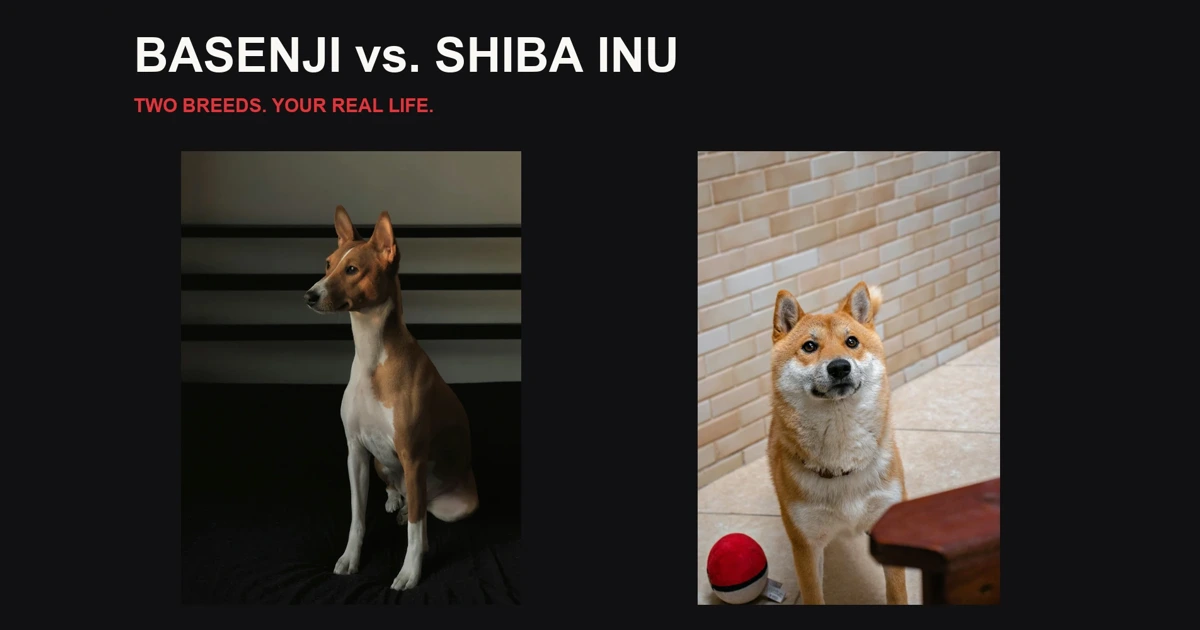
Basenji vs Shiba Inu is a comparison worth making before you choose a dog, not after you bring one home. Both are small-to-medium, fox-faced, curly-tailed dogs with clean habits, big personalities and a reputation for doing what they want. From across a park, you could mix them up.
I've had two Basenjis: Rocco, a red and white boy, and Ghost, my tricolor girl. I've never owned a Shiba Inu, so I'm not going to pretend I know what living with one is like. For the Shiba side, I'm sticking to what the American Kennel Club says. For the Basenji side, you get the AKC, the Basenji Club of America and what Rocco and Ghost taught me.
This isn't about which breed is better. They're both great dogs for the right person. It's about which one fits your life.
Quick answer: Both are independent, clever, clean, catlike breeds that should never be trusted off leash. The Basenji is a hound from Africa, about 16 to 17 inches tall and 22 to 24 pounds, known as the "barkless dog" because it yodels instead of barking; it has a short coat that's very easy to groom, high energy and a strong chase instinct. The Shiba Inu is a Japanese breed in the AKC's Non-Sporting Group, about 13.5 to 16.5 inches and 17 to 23 pounds, with a double coat that the AKC says sheds "a lot." The AKC lists a life expectancy of 13 to 14 years for Basenjis and 13 to 16 years for Shibas. If you want a short coat and can handle a high-energy escape artist, look at the Basenji. If you are drawn to a Shiba, plan for its double coat, daily exercise and independent personality rather than assuming it is an easier option. Either way, meet adults of the breed before you decide.
At a Glance
| Basenji | Shiba Inu | |
|---|---|---|
| Origin | Africa | Japan |
| AKC group | Hound Group | Non-Sporting Group |
| AKC description | "independent / smart / poised" | "alert / active / attentive" |
| Height | 17 in (male), 16 in (female) | 14.5–16.5 in (male), 13.5–15.5 in (female) |
| Weight | 24 lb (male), 22 lb (female) | 23 lb (male), 17 lb (female) |
| Life expectancy | 13–14 years | 13–16 years |
| AKC recognition | 1944 | 1992 |
| Coat care | Weekly once-over with a soft brush or hound glove | Heavy seasonal shedding; brush more during sheds |
| Off leash | "Should never run loose" | "Can never, ever be considered reliable off lead" outside a confined area |
| Breed club health tests (per AKC) | Hips, eyes, thyroid, PRA DNA, Fanconi DNA | Patellas, hips, eyes |
All figures and quotes in this table are from the AKC's breed pages.
Where They Come From
Basenji
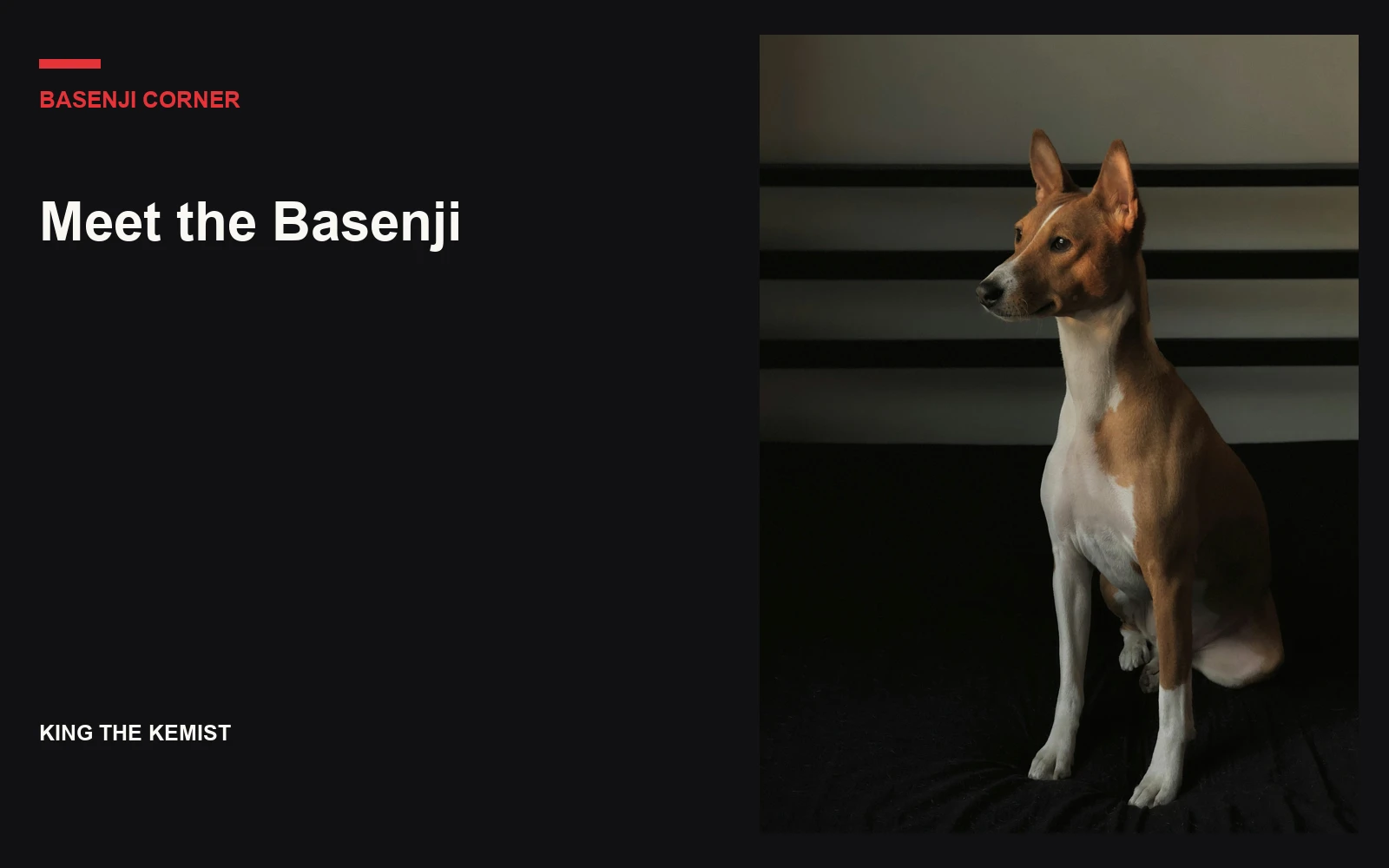
The AKC calls the Basenji "Africa's 'Barkless Dog'" and says the first specimens "were brought from the source of the Nile as presents to the Pharaohs of ancient Egypt." It also says Basenjis "are contenders for the title of oldest AKC breed." The AKC recognized the breed in 1944, and it sits in the Hound Group.
They're hunters at heart. The AKC describes the Basenji as a "compact, sweet-faced hunter of intelligence and poise." That hunting background explains a lot about living with one, especially the chase instinct.
Shiba Inu
The AKC calls the Shiba "an ancient Japanese breed" and says Shibas "are considered the oldest and smallest of Japan's dogs." It says the breed was originally used to hunt and that the Shiba is "the number-one companion dog in Japan." The first documented Shiba in the US arrived with a military family in 1954, and the AKC recognized the breed in 1992. It's in the AKC's Non-Sporting Group.
Size and Build

On paper, they're close. Basenjis run a little taller and a little heavier on average. The AKC lists a Basenji male at 17 inches and 24 pounds and a female at 16 inches and 22 pounds. It lists a Shiba male at 14.5 to 16.5 inches and 23 pounds and a female at 13.5 to 15.5 inches and 17 pounds.
In person, the Basenji is built lean and leggy, like the hound it is. The AKC calls them "small, graceful hounds." The Shiba is more compact and sturdy; the AKC describes it as "little but well-muscled." Both are easy to pick up and both fit in an apartment, as long as their exercise needs are met.
Temperament
This is where people lump them together, and where the differences matter most.
Basenji
The AKC sums up the Basenji as "independent / smart / poised." It says the breed is "quite independent and aloof at times," and "alert and careful with strangers, open and calm with friends." It adds that when meeting strangers, a Basenji "prefers to make the first overtures and should not be approached from behind."
That matches my experience. Basenjis pick their person. The first day I brought Ghost home, she hopped up on my bed and smiled at me. When a Basenji lets you in, you know it. But they're not party dogs, and they'll decide who's in their circle.
They're also always thinking. Basenji Rescue and Transport describes them as "smart, strong-willed, independent, creative dogs" that "require intelligent handling." I'd put it this way: you have to stay about 20 steps ahead of a Basenji's cleverness. Not one step. Twenty.
Shiba Inu
The AKC sums up the Shiba as "alert / active / attentive" and calls the breed "spirited, good-natured." It says Shibas adapt well to town or country.
I haven't lived with a Shiba, so I'll leave the personality stories to Shiba owners. What I can tell you is that both breeds have a reputation for independence, and both breed's AKC pages are blunt about off-leash risk. If you want a dog that lives to please you and comes running every time you call, neither of these is likely to be it.
Barking and Noise
This is the most famous difference.
Basenjis don't bark, at least not in the usual way. The AKC says the Basenji "does not bark but does make yodeling noises." But don't mistake "barkless" for "silent." BRAT warns that people who assume Basenjis are totally silent get a surprise: Basenjis "can make a gamut of sounds that run from a barely audible squeak to a blood-curdling scream."
Shibas aren't described as barkless. The AKC's Shiba page doesn't talk much about the breed's voice either way, and I won't guess. Dogs vary. If noise matters for your building or your neighbors, meet adult dogs of either breed and listen.
Grooming and Shedding

This is the clearest practical difference between the two.
Basenji: about as easy as it gets
The AKC calls Basenjis "fastidious creatures." Their short coat "is a breeze to take care of, generally requiring no more than a quick once-over with a soft-bristle brush, a rubber grooming mitt or tool, or a hound glove every week." The AKC says Basenjis "don't have a 'doggy' smell" and usually don't need baths unless they get into something messy.
The AKC describes catlike self-grooming in Basenjis. That does not replace nail care, dental care, parasite prevention or checking the skin and ears with your vet's guidance.
Shiba: get ready for hair
The AKC is honest about this: "Shibas shed – a lot." It says, "It has been said that they shed twice a year, but some owners quip that it lasts for six months at a time." The coat doesn't mat unless the dog is a long coat, so occasional brushing doesn't hurt the dog, but the AKC says brushing or combing during heavy sheds will cut down on hair around the house. Ask a groomer about coat-appropriate tools and gentle handling. Build positive nail-care habits rather than forcing a frightened dog through a session.
If shedding is a deal-breaker for you, that's a strong point for the Basenji.
Exercise and Energy
Basenji: high energy, high mischief
The AKC says Basenjis "are energetic, inquisitive, and very active" and "require lots of regular exercise to keep them from becoming bored. Boredom can lead to destructive behavior."
I can vouch for the destructive part. I was out of the house for a short time once and came home to my blinds demolished. And Ghost broke out of a big crate I'd bought her so she'd have extra room. She got out to come looking for me. Exercise matters, but panic or injury during crate escape needs a safe plan with a vet or qualified behavior professional; more exercise or a stronger crate alone is not the answer.
The AKC says many Basenjis enjoy and excel at sports like lure coursing, tracking and obedience, which give them a structured outlet for their instincts.
Shiba: an active dog, not a shortcut
The AKC's 2025 guide to whether a Shiba is right for you describes a high-energy breed and cautions that families without time for exercise and attention should consider other options. That is a better basis for planning than assuming a Shiba is the quieter alternative to a Basenji.
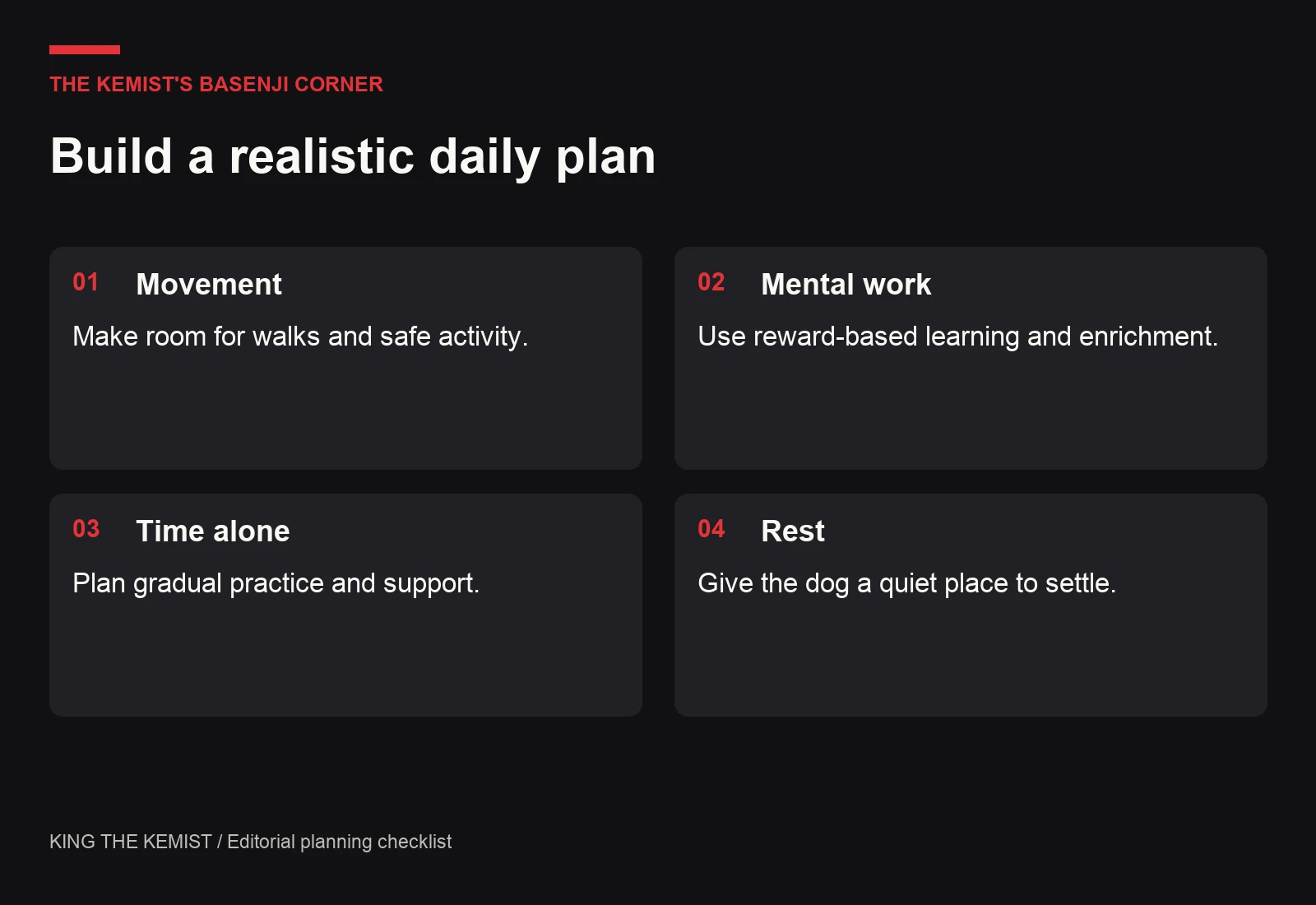
Both need daily physical activity, mental stimulation and a plan for time alone. Match the individual dog's needs to your schedule rather than assuming one breed tolerates long absences better. Ask what a normal weekday looks like in the dog's current home: walks, play, rest, feeding and behavior when people leave. Then compare that with the weekday you can realistically provide.
Kids, Cats and Other Dogs
Both breeds can live happily with families, but neither is a guaranteed fit for every household.
For Basenjis, the AKC says the breed is "loving and solicitous with children," while BRAT is more cautious: "Many are wonderful with children, but others don't like them much at all." BRAT also says that "same-sex aggression can often be a problem with Basenjis" and that, especially with adult dogs, opposite-sex placements are easier and safer. Cats are a real question too, given that chase instinct. BRAT's listings note whether a particular dog does well with cats or children, and it asks adopters to read those notes carefully.
For Shibas, the AKC's breed page I read doesn't go into detail on kids or other pets. Ask breeders, rescues and Shiba owners about the specific dog.
For either breed, supervise every introduction, give the dog a safe space of its own and never leave young children alone with any dog.
Apartment Life
Both breeds are small enough for an apartment, and both are clean indoors. But size isn't the whole story.
A Basenji in an apartment needs a lot of exercise outside it. BRAT warns that some people "have read that Basenjis are good apartment dogs, so they think they do not have to provide them with regular exercise," and that's one of the reasons Basenjis end up in rescue. Without enough exercise and mental work, an apartment Basenji will find its own projects, and blinds, door frames and couch cushions are all fair game.
A Shiba may adapt to town or country, but its exercise, attention, noise and alone-time needs still matter in an apartment. Shedding is another practical issue, not the only one. Check building rules, nearby walking routes and how you would arrange care on a long workday.
Either way, think about the door. In an apartment, every trip in and out is a chance for a fast, small dog to slip past you. Practice a sit-and-wait at the door, and make sure everyone in the home does the same.
Clean Dogs, Both of Them
One thing both breeds share: they're tidy. The AKC calls Basenjis "fastidious" and says they clean themselves "all over as does a cat." Shibas often have strong clean-den habits, but puppies still need age-appropriate toileting opportunities and individual house training. If you've lived with a dog that rolls in everything and smells like it, either breed will feel like a change.
Off Leash: Neither One

This is the one thing both breeds' AKC pages agree on, and I want to say it as clearly as possible.
For the Basenji, the AKC says a Basenji "should never run loose, as the breed's instinct to hunt is very strong." BRAT warns that Basenjis "will instantly give chase after anything that moves." BRAT won't place a Basenji in a home that relies on electronic or invisible fencing, and it recommends a 6-foot privacy fence.
For the Shiba, the AKC says "a Shiba can never, ever be considered reliable off lead unless in a confined area. No amount of obedience training will ever change that." It adds: "An open door, an unlocked gate, a moment of inattentiveness, and the Shiba may be gone forever."
So whichever breed you choose: secure fence, leash every time outside it and a household that's careful with doors and gates.
Training
Basenji
People say Basenjis can't be trained. That wasn't my experience. Ghost picked things up fast. The secret is that they're smart and learn quickly when they decide it's worth it.
The AKC says Basenjis "learn readily in an encouraging and rewarding atmosphere, and with the use of positive-training techniques," but that "they also lose interest quickly, so training sessions should last no more than five or 10 minutes." It says early socialization and puppy classes, recommended for all breeds, are "a necessity" for Basenjis.
Shiba
Shibas often have strong clean-den habits, but that is not a promise that a young puppy can hold its bladder overnight. Plan age-appropriate toilet breaks, reward the behavior you want and adjust to the individual puppy. Ask the breeder, rescue or your vet for a routine based on the dog's age and health.
For either breed, use training to build communication and safe routines, not to test whether you can override a hunting instinct. Practicing recall in a securely enclosed space does not make an unfenced area safe. If fear, guarding or distress appears, involve a qualified trainer or veterinary behavior professional rather than treating it as a contest of wills.
Health and Breed Club Testing
Both are generally healthy breeds, but each has things to know. The AKC lists the national breed clubs' recommended health tests on each breed page.
Basenji
The AKC lists these recommended tests from the Basenji Club of America: hip evaluation, ophthalmologist evaluation, thyroid evaluation, a PRA (Basenji) DNA test and a Fanconi syndrome DNA test.
Fanconi is the big one for me. The Basenji Club of America calls it "the most common inherited lethal disease in basenjis." It's a kidney disorder, there's a DNA test, and for Affected or unknown-status dogs a lifelong monitoring plan should be agreed with the vet. Home urine strips are one possible part of that plan, not a diagnosis or a way to rule the condition out on their own. I lost Ghost to Fanconi. Where I lived, I was the person who knew the most about the breed, and no vet around me knew how to handle it. If you choose a Basenji, learn the word Fanconi before you need it. My full guide is Basenji Fanconi Syndrome: What Owners Should Know and Ask Their Vet, and Basenji Health Tests, Explained breaks down every test.
Shiba Inu
The AKC lists these recommended tests from the Shiba's national breed club: patella evaluation, hip evaluation and ophthalmologist evaluation. It says the most common health condition in Shibas is allergies, which usually show up as skin irritation and itching and don't usually appear until a dog is at least six months old.
What this means for you
For either breed, ask a breeder for the parents' results on the breed club's recommended tests. For a rescue dog, ask what's known and talk to your vet about what to check.
Time, Money and Commitment
Both breeds can live well into their teens, so either one is a long commitment. Budget for the basics any dog needs, plus a few breed-specific extras. For a Basenji, that means a truly secure fence or a commitment to leashed walks every day, sturdy enrichment toys and, for Fanconi, DNA testing if it isn't known and urine test strips if your dog is Affected. For a Shiba, that means grooming tools that can handle a heavy shed and, likely, a good vacuum. For both, the biggest cost is time: daily exercise, training in short sessions and the attention a smart, independent dog needs to stay out of trouble.
Which One Fits Your Life?
These are generalizations. Every dog is an individual, and Rocco and Ghost were different dogs even though they were the same breed. But here's how I'd think about it.
A Basenji might fit if you:
- Want a short coat with almost no grooming and no doggy smell
- Have the time and energy for real daily exercise and mental work
- Can Basenji-proof your home and stay ahead of a clever escape artist
- Have, or can commit to, a secure fence and a leash every time
- Think a dog that yodels and outsmarts you sounds fun, not frustrating
- Are ready to learn about Fanconi and work with your vet on it
A Shiba might fit if you:
- Don't mind serious seasonal shedding and regular brushing during sheds
- Want an active, independent dog and can meet its daily exercise and attention needs
- Can commit to a leash every time outside a confined area
- Like an alert, independent companion
Neither might fit if you:
- Want a dog that's reliably obedient off leash
- Want a dog that loves every stranger instantly
- Are away most of the day with no plan for exercise and company
Questions to Ask a Breeder or Rescue
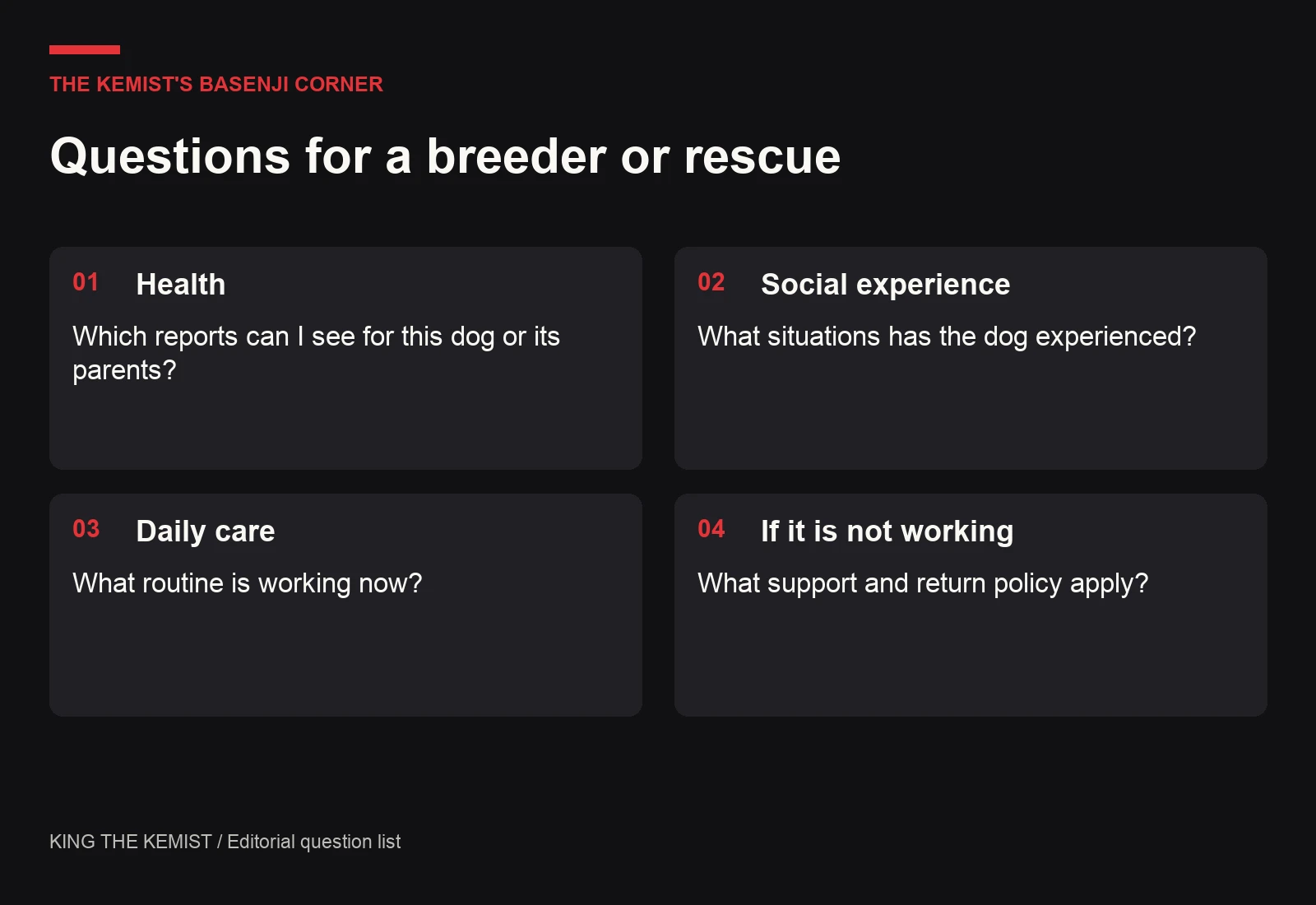
Whichever breed you lean toward, ask:
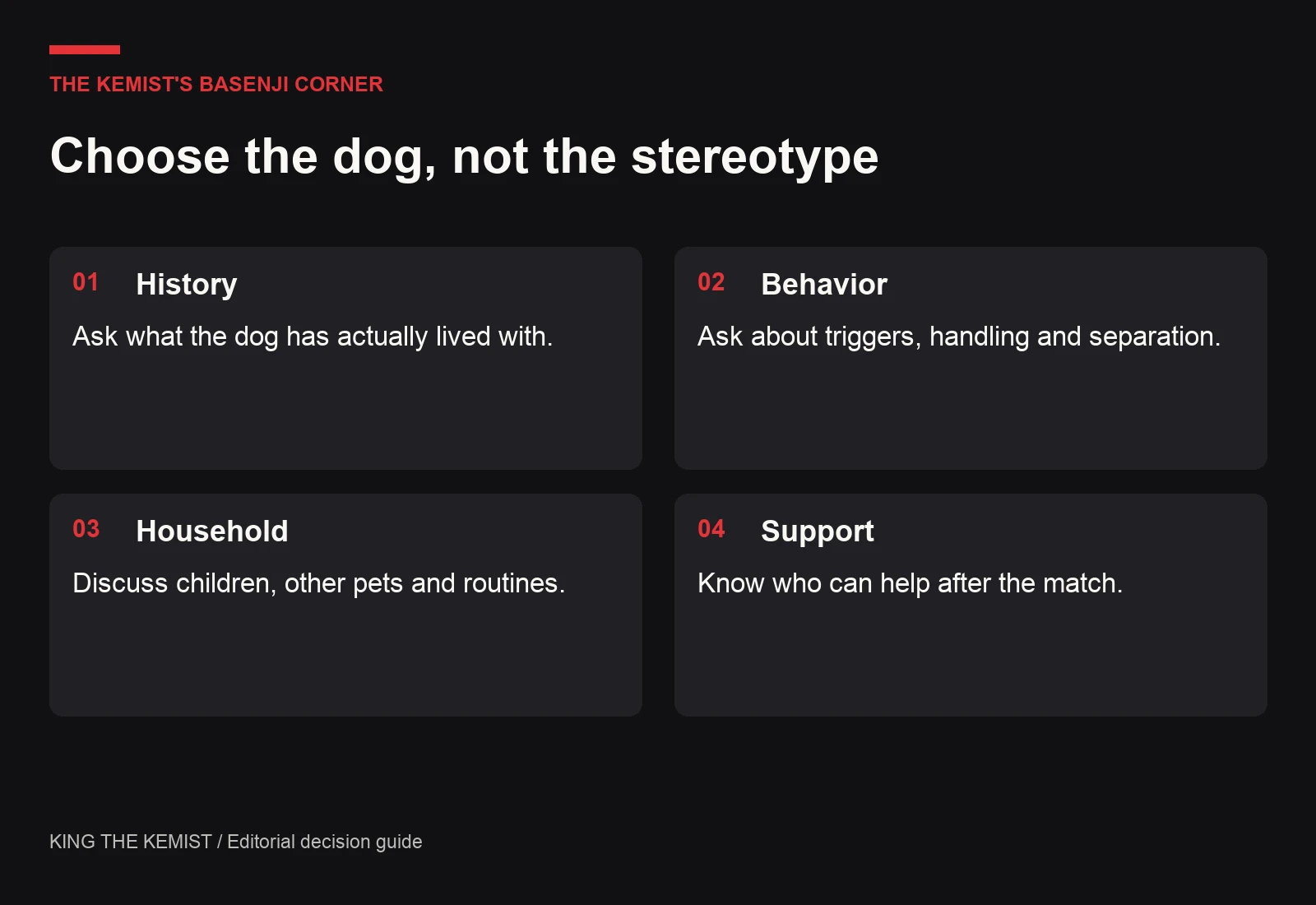
- What health tests have the parents had, and can I see the results? (For Basenjis, ask specifically about Fanconi and PRA DNA results.)
- How does this dog, or these parents, do with strangers, kids, cats and other dogs?
- How much exercise does this dog get now, and what happens when it doesn't get enough?
- Has the dog ever escaped a yard, crate or house? How?
- How does it do left alone?
- What surprised you most about this breed?
- Will you take the dog back if it doesn't work out?
A good breeder or rescue will ask you just as many questions back. That's a good sign.
Rescue Is an Option for Both
You don't have to go to a breeder. Basenji Rescue and Transport places Basenjis across the country, and many of its dogs are adults whose personalities are already known. BRAT's current Adoption Process page says finding a match might take a month or several months or more. Shiba-specific rescues exist too. Foster observations can give you more information about energy, noise and interactions, though behavior may change as a dog settles into a new home. Ask what was actually observed and in which situations, rather than treating a profile as a guarantee.
Meet Them Before You Decide

Reading only goes so far. Before you commit, spend time with adult dogs of each breed. Talk to owners, visit breed club events or meet rescue dogs in foster homes. Ask owners what surprised them, what they'd do differently and what a normal day looks like.
Let the individual dog set the pace of a meeting and ask the handler how to interact. A yodel or any other single behavior does not prove acceptance or comfort; consider the whole interaction and the handler's knowledge of that dog.
This guide is part of Basenji Corner. New to the breed? Start with Basenji: The Barkless Dog, Explained and What I Wish Every Basenji Owner Knew.
About the Author
King The Kemist has lived with two Basenjis, Rocco and Ghost. Basenji Corner combines his owner experiences with attributed breed-club and veterinary resources. These educational guides are not veterinary diagnoses or individualized treatment plans.
Frequently asked questions
Is a Basenji or Shiba Inu bigger?
They're close. The AKC lists Basenjis at 16 to 17 inches and 22 to 24 pounds, and Shibas at 13.5 to 16.5 inches and 17 to 23 pounds.
Which sheds more, a Basenji or a Shiba?
The Shiba. The AKC says Shibas "shed – a lot," while the Basenji's short coat needs only a weekly once-over.
Do Basenjis bark?
Not in the usual way. The AKC says the Basenji "does not bark but does make yodeling noises." They can still make other sounds.
Can either breed go off leash?
No. The AKC says a Basenji "should never run loose" and that a Shiba "can never, ever be considered reliable off lead unless in a confined area."
Which lives longer?
The AKC lists 13 to 14 years for Basenjis and 13 to 16 years for Shibas.
Is a Shiba automatically better if I work long hours?
No. Both breeds need daily activity, attention and a plan for time alone. Ask about the individual dog's routine and behavior rather than assuming a breed label guarantees tolerance of long absences.
Does a Basenji yodel mean it likes me?
Not by itself. A single sound does not establish comfort or acceptance. Let the dog set the pace and ask its handler how to interact safely.
Can an adult rescue dog's behavior change after adoption?
Yes. Foster observations are useful information, not guarantees. A new environment, routine and relationships can change how a dog behaves as it settles in.
Sources
- Basenji (American Kennel Club)
- Shiba Inu (American Kennel Club)
- Basenji Health (Basenji Club of America)
- BRAT FAQ (Basenji Rescue and Transport)