Libra Shit
Why Do Libras Overthink Everything? A Libra Man's Honest Answer
Texts, decisions, what people think of me. A little of everything. Here's why Libras live in their heads, and how I get out.

What do I overthink?
Honestly? A little of everything. 😂
A text I’m about to send. A text somebody sent me. A decision that should take two minutes. How I came across in a conversation that ended three hours ago. A song I already finished.
If you’ve been reading my Libra series, this probably doesn’t surprise you. I already told you I can take forever to pick a restaurant. I already told you I avoid conflict until I don’t. Overthinking is the engine running underneath all of it.
So let’s talk about it. Why Libras overthink, what overthinking actually is, what the research says it does to you, and the two things that actually get me out of my head.
Quick reminder before we start: astrology is not science. A birthday can’t diagnose how your brain works. But a lot of people search "why do Libras overthink," and a lot of Libras recognize themselves in the answer. In a 2024 survey of more than 9,500 U.S. adults, Pew Research Center found that 28% consult astrology or horoscopes at least once a year, and most of them say they do it mostly for fun.
Same here. I don’t use my sign as an excuse. I use it as a shortcut. "I’m Libra-ing right now" gets the point across faster than a full explanation of my thought process. 😂
Why Libras overthink, according to astrology
Libra’s symbol is the scales. That’s the whole story in one picture.
Scales don’t decide. Scales weigh. They hold one thing on the left, one thing on the right, and they keep moving until everything is even. That’s how astrology describes the Libra mind: always comparing, always balancing, always checking whether something is fair.
Libra is an air sign, which astrology connects with thinking, talking and ideas. It’s ruled by Venus, the planet of love, beauty and harmony. And it’s a cardinal sign, which is supposed to mean Libras like to start things and lead.
Put that together and you get a strange combination. A mind that lives in ideas. A heart that wants everybody to be okay. And a drive to move forward, held back by the need to get it exactly right first.
That’s the Libra overthinking loop in astrology terms. You want to act. You want to be fair. You want peace. And those three things argue with each other in your head all day.

I wrote about the decision side of this in Why Are Libras Indecisive?. Indecision is what you see on the outside. Overthinking is what’s happening on the inside while you wait for me to pick the restaurant.
What I actually overthink
When I sat with the question, my honest answer was: a little of everything. But it clusters into three buckets, and I think most overthinkers will recognize at least one.
Texts. Writing them, rewriting them, reading into the ones I get. The period at the end of a short reply. The "ok" with no emoji. The three dots that show up and then disappear.
Decisions. Big ones and tiny ones. The weird part is that tiny ones can eat more time than big ones, because big decisions feel like they deserve the thinking and small ones don’t, so you feel silly the whole time you’re doing it.
How people see me. The conversation replay. Did that joke land? Did I say too much? Did I come off rude when I was just tired?

None of that is unique to Libras. That’s the point. Overthinking is human. Libras just get a zodiac sign to blame it on. 😂
What overthinking actually is
"Overthinking" isn’t a clinical term, but psychologists study the same thing under a few names.
Rumination is going over the past. Replaying what happened, why it happened, what it says about you. Psychologist Susan Nolen-Hoeksema spent much of her career studying it.
Worry is going over the future. What might happen, what could go wrong, what you’ll do if it does.
Reflection is the healthy cousin. You look back, learn something, and move on.
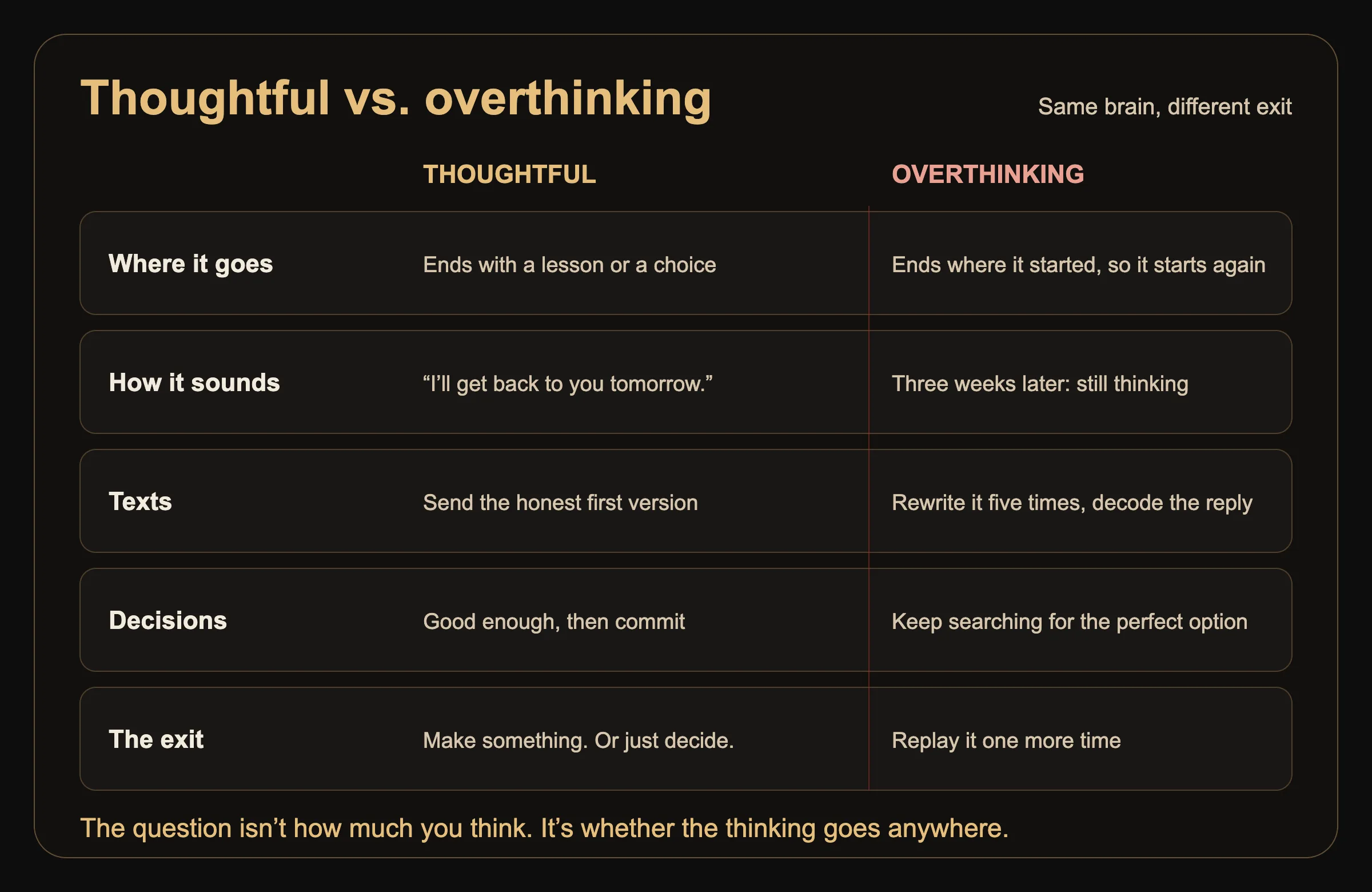
The difference between reflection and rumination isn’t how much you think. It’s whether the thinking goes anywhere. Reflection ends with a lesson. Rumination ends where it started, so you start again.
In a 2008 review in Perspectives on Psychological Science, Nolen-Hoeksema and her colleagues Blair Wisco and Sonja Lyubomirsky summed up years of research. Rumination tends to make low moods worse, pulls your thinking more negative, gets in the way of problem solving, and makes it harder to follow through on goals.
That’s the part that got me. Overthinking feels like working on the problem. A lot of the time, it’s the thing standing in the way of solving it.
How common is overthinking?
Very.
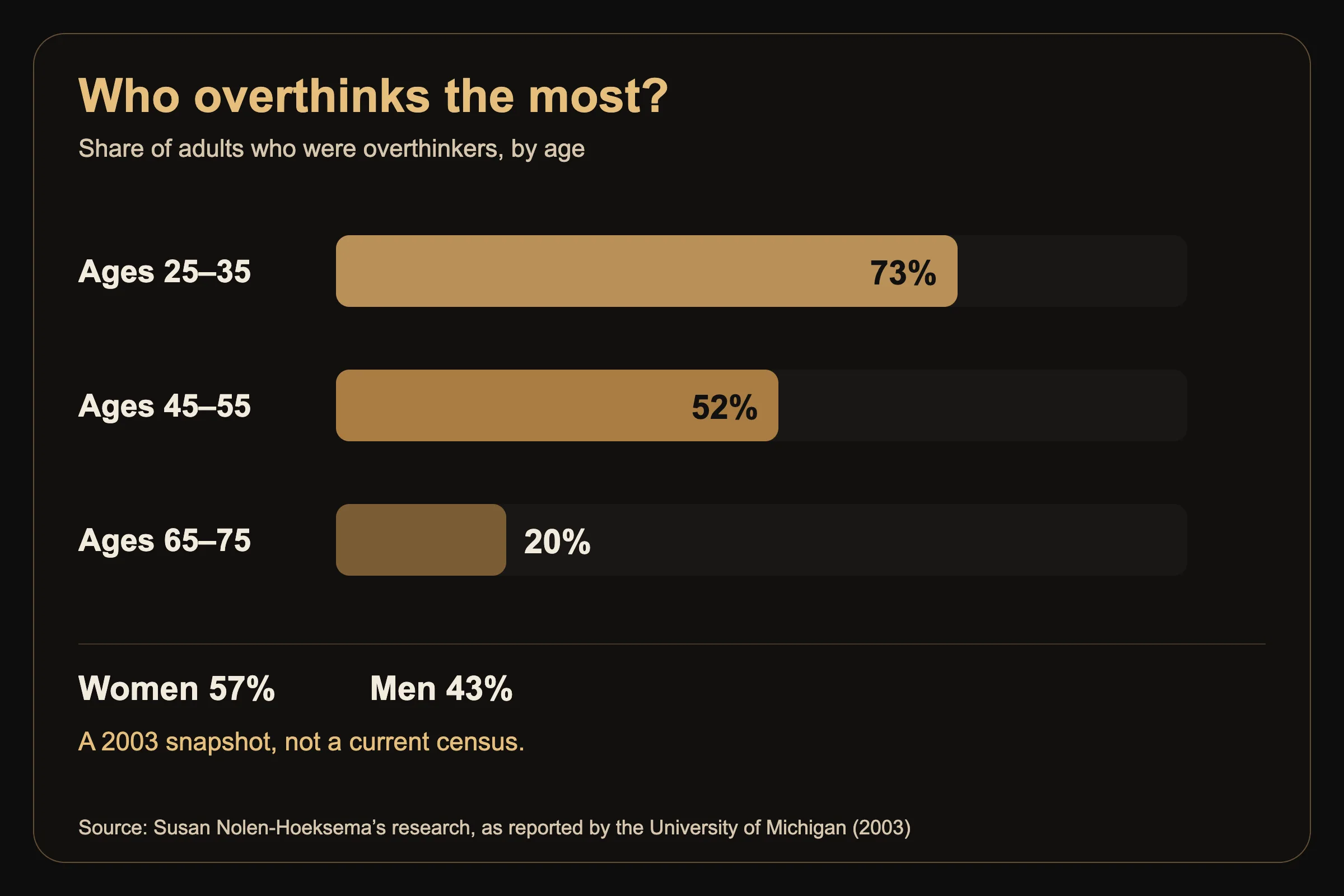
Back in 2003, the University of Michigan reported on Nolen-Hoeksema’s research: 73% of people aged 25 to 35 in her studies were overthinkers. So were 52% of people aged 45 to 55, and 20% of people aged 65 to 75. Overall, 57% of women and 43% of men qualified. Those numbers are more than twenty years old, so treat them as a snapshot, not a current census.
Two things jump out at me.
First, the youngest adults in that research overthought the most. I can’t prove why. But I know my own late twenties and thirties came with a lot of decisions that felt like they might change everything.
Second, 43% of men. People act like men don’t overthink. We do. We just don’t always say it out loud. We go quiet instead. (If you’ve wondered what’s happening during that quiet, I wrote about it in Why Does a Libra Man Go Quiet?.)
The modern version shows up in newer surveys too. A 2025 Center Fresh and YouGov report on overthinking in India, covered by Storyboard18, found that 42% of people feel anxious or assume the worst when their boss replies with just "Ok." And 63% said choosing what to order at a restaurant was more stressful than choosing a political leader to vote for.
Sixty-three percent. I’m not alone at the restaurant. 😂
Overthinking texts: the "Ok" problem
Let’s start with the one everybody knows.
A text has no face. No tone of voice. No body language. You get the words and nothing else, so your brain fills in the rest. And an overthinking brain doesn’t fill it in with "they’re probably busy." It fills it in with every possible reason they might be upset with you.
For a Libra, that hits a specific nerve. Libras want harmony. A short text feels like a crack in the harmony. So we go looking for the crack. We reread. We check the time stamps. We compare this reply to the last one.
Here’s what I’ve learned to tell myself: one short reply doesn’t give me enough information to know what someone means. People text short when they’re working, tired, busy, or just not texters. If I really need to know, I can ask.

And on the sending side, rewriting a message five times usually doesn’t make it better. It makes it stiffer. The first honest version is often the best one.
Overthinking decisions: why "the best" option is a trap
This one is the most Libra thing about me.
Psychologist Barry Schwartz and his colleagues split decision makers into two types. Maximizers want the best possible option, so they keep searching and comparing. Satisficers want an option that’s good enough by their own standards, and once they find it, they stop.
In their 2002 study in the Journal of Personality and Social Psychology, maximizers reported more regret, less happiness and lower life satisfaction than satisficers. Later research has argued about how strong that effect is. One 2008 study found maximizers were more prone to regret but not clearly less happy. But a 2014 study of 300 university students found that the "decision difficulty" part of maximizing, the agonizing itself, was tied to more regret and lower life satisfaction.
That’s the Libra trap in research form. The scales want the perfect balance. But there’s almost never a perfect option. There’s a good option, and then there’s the time you spend making sure there isn’t a slightly better one.
That time adds up. And at the end of it, you still might feel regret, because the whole time you were thinking about the options you didn’t pick.
Overthinking how people see me: the spotlight effect
Then there’s the conversation replay.
You leave a room and your brain starts the review. That joke. That pause. That thing you said that might have sounded wrong.
Here’s a study that helps me. In 2000, Cornell psychologists Thomas Gilovich, Victoria Medvec and Kenneth Savitsky had students put on an embarrassing T-shirt and walk into a room full of other students. The students wearing the shirt guessed that about half the room noticed. In reality, only about a quarter did. The researchers called it the spotlight effect: we think people are paying far more attention to us than they actually are.
Everybody else is busy replaying their own conversations. Most of them didn’t clock the thing you’re stuck on.
For a Libra, this is useful because we care a lot about how we come across. We like to be liked. We want people to leave a room feeling good. That’s a nice trait. It just means we can spend a lot of energy grading a performance nobody else was watching that closely.
Why overthinking backfires
If overthinking actually solved problems, I’d say keep going. The research says it mostly doesn’t.
In classic experiments by Sonja Lyubomirsky and Susan Nolen-Hoeksema, people in a low mood were asked either to ruminate (think about their feelings and themselves) or to distract themselves for a few minutes. Then they worked on real-life interpersonal problems. The ruminators came up with worse solutions than the people who had been distracted. The 2008 review I mentioned earlier pulls that line of work together.
Another study, led by Annette van Randenborgh in 2010, found that inducing rumination made decisions feel harder and lowered people’s confidence in the choices they made.
So the loop works like this:
Overthinking makes a decision feel harder. A harder decision gives you more to overthink. And once you finally decide, you trust the decision less, so you go back and overthink it again.
That’s the Libra loop in one sentence. Weigh it, weigh it again, decide, doubt it, reopen it.
What actually gets me out of my head
When I asked myself what really works for me, the honest list was short. Two things.
1. Making music
When my head gets loud, I make something.

Here’s what I think happens. Overthinking goes around in circles. Making a song has a direction. A thought that keeps looping in my head becomes a line, then a verse, then a hook. It has to go somewhere, because a song has to end.
It also changes my relationship with the thought. Inside my head, the thought is happening to me. In a song, I’m working with it. I’m choosing words, picking a melody, deciding what stays and what goes. Same feeling, but now I’m the one in control of it.
There’s research that points in the same direction. Psychologist James Pennebaker’s "expressive writing" studies, where people write about difficult experiences for a few short sessions, have been repeated many times. A 2020 study in Frontiers in Psychology had piano students do a short expressive writing exercise before performing, and they made fewer playing errors afterward. It didn’t test songwriting, and I’m not claiming a song is therapy. I just know what works for me: getting the thought out of my head and into a shape changes it.
You don’t have to make music. Writing it down, drawing it, voice-noting it, any of that counts. The point is giving the loop an exit. If creating is how you get out of your head too, I wrote more about getting into that state in Creative Flow.
2. Just deciding
The second thing sounds too simple. It works anyway.
At some point, I stop weighing and pick.
Not because I found the perfect answer. Because I realized more thinking wasn’t going to give me new information. It was just going to give me the same information again, with more anxiety attached.
That’s satisficing in practice. Decide what "good enough" looks like, find something that meets it, and commit. The decision is made. If it turns out wrong, I’ll adjust. Most decisions can be adjusted. Very few are permanent.

And here’s the thing about deciding: it ends the loop. You can’t keep weighing a choice you’ve already made. Well, you can, but it gets a lot less fun. 😂
More tools that help overthinkers
Those are my two. These are some others that have research behind them, in case music isn’t your thing and deciding still feels impossible.
Give your worry an appointment. In a 1983 study led by Thomas Borkovec, chronic worriers were taught to set aside a specific worry period each day and postpone worries until then. Their worrying went down. Therapists still call this "worry postponement." When a thought hits at 11pm, you tell it: not now, tomorrow at 6.
Talk to yourself by name. In a 2014 study led by Ethan Kross, people who talked to themselves in the third person ("Why is King nervous?") instead of the first person ("Why am I nervous?") handled stressful tasks with less anxiety. Using your own name creates a little distance, like advising a friend instead of being stuck in it.
Cut the options down. If you’re choosing between eight things, pick your top two first. Comparing two is a lot faster than comparing eight, and it stops the scales from swinging forever.
Set a deadline for small decisions. Restaurant, outfit, which text to send: give it five minutes, then go with the front-runner.
Ask, "Is this a one-way door or a two-way door?" Two-way doors can be walked back. Most decisions are two-way doors. They deserve a lot less thinking than we give them.
Move the thought out of your head. Write it, say it out loud, make something with it. The loop is hardest to break when it only lives in your head.
Overthinking vs. being thoughtful
I want to be fair to overthinkers, because that’s what a Libra does. 😂
Thinking things through is a strength. Libras notice how other people feel. We see both sides. We think before we speak. A lot of conflicts never happen because a Libra thought it through first.
The question isn’t "do you think a lot." It’s "does your thinking go anywhere."
Thoughtful sounds like: "Let me think about that and get back to you tomorrow." And then you actually get back to them tomorrow.
Overthinking sounds like: "Let me think about that." And three weeks later you’re still thinking about it, and now you’re also thinking about how long you’ve taken.
The first one is a gift. The second one is a trap. Same brain, different exit.
That’s a lot of what emotional maturity looks like to me: not feeling less, but knowing what to do with what you feel.
If you love a Libra who overthinks
A few things that help, from the Libra side.
Be direct. If something is wrong, say it. If nothing is wrong, you can say that too. A clear "we’re good" can end an hour of us reading into your texts.
Give us two options, not ten. "Tacos or Thai?" gets you dinner. "Where do you want to eat?" gets you a presentation.
Ask about the pause. When I go quiet, I’m usually processing, not punishing anybody. But don’t guess. Ask what’s on my mind. You might get the whole spreadsheet.
Let us change our minds once. Not five times. Once. 😂
And if you’re a Scorpio who loves a Libra, I already wrote you a whole article: Libra and Scorpio.
What people actually ask about Libras and overthinking
When you look at what people search around this topic, the same questions come up again and again. Here are my honest takes.
Do Libras overthink in relationships? In my experience, yes. Relationships are where Libras care most about harmony, so that’s where we watch hardest for cracks. Texts, tone, plans, whether we said the right thing. The fix is usually directness from both sides.
Why do Libras overthink so much at night? Night is when everything else gets quiet, so your thoughts get louder. There’s nothing left to distract you. That’s exactly why the "worry appointment" trick helps: you give the thought a time that isn’t 2am.

Are Libras the biggest overthinkers in the zodiac? Astrology articles argue about this. Virgo, Gemini and Scorpio usually get mentioned too. Honestly, every sign overthinks something. Libras overthink fairness and decisions. Ask a Virgo about details and you’ll see a different kind. 😂
Is overthinking a sign of anxiety? Overthinking and anxiety are connected, but overthinking on its own isn’t a diagnosis. If it’s constant, it’s affecting your sleep, work or relationships, or it’s hard to get out of, talk to a doctor or a licensed therapist. That’s not a Libra thing. That’s a human thing.
Quick answers
Why do Libras overthink? In astrology, Libra is the sign of the scales: always weighing, comparing and trying to be fair. That shows up as overthinking texts, decisions and how they come across.
What do Libras overthink the most? In my case, a little of everything. Usually it’s decisions, relationships and how other people see them.
How do Libras stop overthinking? Give the thought an exit (make something, write it down), limit the options, set a deadline and decide. Good enough beats perfect.
Is overthinking bad? Thinking things through is useful. Overthinking, the kind that loops without going anywhere, has been linked in research to worse problem solving, harder decisions and lower mood.
How common is overthinking? Very common. In Susan Nolen-Hoeksema’s research, reported in 2003, 73% of adults aged 25 to 35 were overthinkers.
The scales don’t have to stop moving
Here’s where I’ve landed.
I’m a Libra. I’m going to weigh things. I’m going to notice how people feel. I’m going to think about the text before I send it. That’s not going away, and I don’t want it to. A lot of what I like about myself comes from that same place.
But I’ve learned the scales don’t need to land perfectly level before I’m allowed to move. Sometimes the answer is to make a song about it. Sometimes the answer is to just decide.
Either way, I get out of my head and back into my life.
And if you’re reading this at 2am, overthinking something you can’t fix tonight: give it an appointment for tomorrow. Then go to sleep. 😂