Libra Shit
Why Do Libras Avoid Conflict? Because Peace Was Their Job.
Somebody said something wrong at dinner. I smiled, passed the bread, and started drafting the perfect response I would deliver never.

Somebody said something wrong at dinner.
I smiled. I passed the bread. I started drafting the perfect response in my head, and I will be delivering it never. 😂
That is the Libra stereotype in one scene. We would rather keep the room comfortable than say the sentence that changes the temperature.
Is astrology science? Still no.
Is it a useful language for a pattern I recognize in myself and in a lot of people born under that little set of scales? Absolutely.
So let’s talk about it honestly. Not "Libras are fake." Not "Libras are angels." Something more useful: why some of us treat peace like a job, what that job quietly costs, and how to keep the balance without keeping our mouths shut forever.
Why the scales get the blame
Libra season runs from about September 23 to October 22, and the sign’s symbol is a set of scales. It is the only sign in the zodiac represented by an object instead of a person or an animal, which is fitting for a sign that people describe as measuring everything.
Astrologers call Libra a cardinal air sign ruled by Venus. In plain language: it starts things, it lives in ideas and conversation, and it is pulled toward beauty, partnership, and fairness.
Put those together and you get the stereotype. The friend who can make any room feel nice. The one who hates rudeness more than they hate being wrong. The one who would rather negotiate a compromise than watch two people they love stop talking.
None of that is a diagnosis. Plenty of Libras will argue with a parking meter. But if you recognize yourself in the friend who smooths everything over, keep reading, whatever your birthday is.
Peace was never supposed to be a full-time position
Some people walk into a room and notice the furniture.
I walk into a room and notice who is not speaking to whom, who laughed a second too late, and which comment is about to start a war over the seating chart.
That sensitivity is real. It makes you good at reading people, good at hosting, good at mediating, good at making strangers feel welcome.
But somewhere along the way, a lot of people who are good at keeping the peace start believing peace is their responsibility.
If the room gets tense, it feels like your fault.
If somebody is upset, it feels like your assignment.
If there is a disagreement, your instinct is not "what do I think?" It is "how do I make this stop?"
That is a lot of unpaid labor.
Nobody hired you as the emotional HR department. You applied for the position yourself, probably as a kid, and never noticed the hours getting longer.
The difference between peace and quiet
Here is the distinction that changed how I see this.
Quiet is the absence of noise.
Peace is the absence of unfinished business.
You can have a very quiet house where nobody is at peace. Everybody is polite. Everybody says "it’s fine." And underneath, there is a list of things nobody has said, growing like a pile of mail you refuse to open.
Avoiding conflict usually buys quiet. It rarely buys peace.

The disagreement does not disappear because you did not mention it. It moves. It shows up in your tone a week later. It shows up as resentment you cannot explain. It shows up when you finally say something about the dishes, and the dishes have nothing to do with it.
That is not balance. That is storage.
Why some of us run from the hard conversation
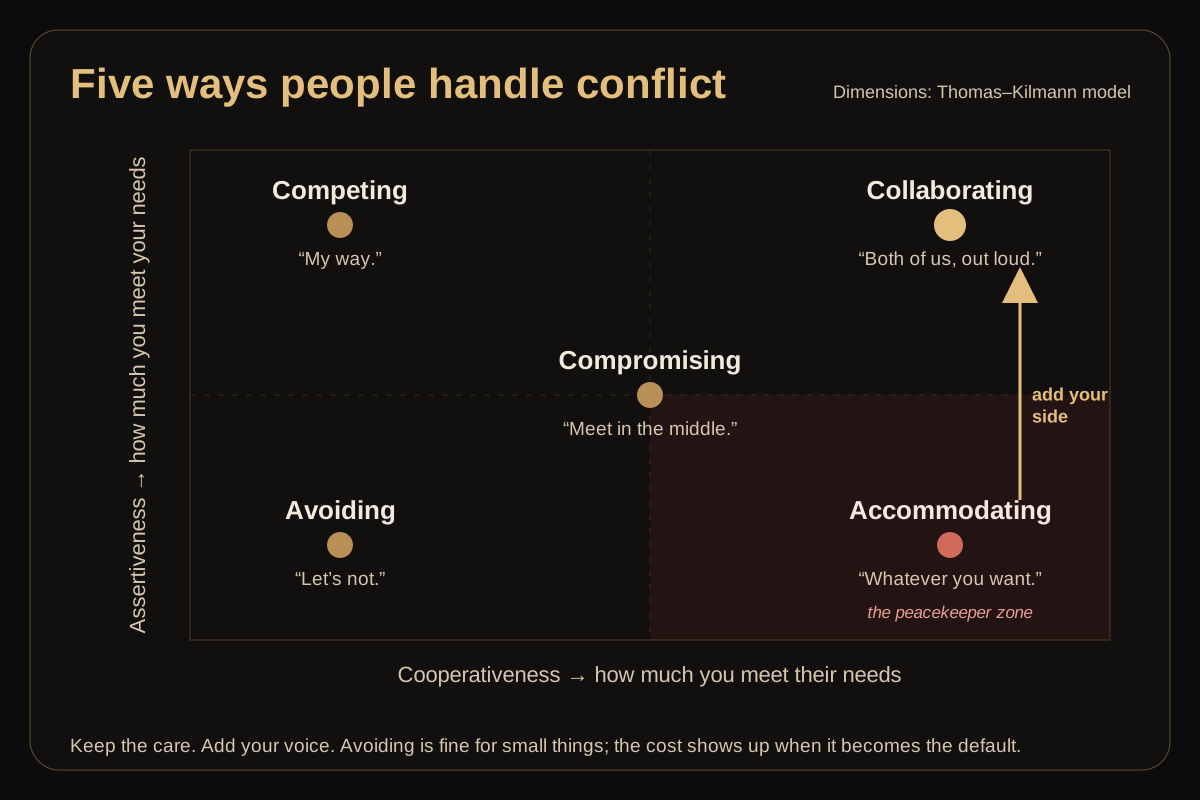
"Avoid conflict" sounds like one thing. It is usually several different things wearing the same nice outfit.
Fear of being disliked. If your sense of being okay depends on everybody being okay with you, every disagreement feels like a vote on whether you still get to belong.
Fear of being wrong. Saying something out loud means it can be challenged. Keeping it in your head means you never lose the argument.
Seeing every side. I wrote about this in Why Are Libras Indecisive?. If you can genuinely see the other person’s point, it gets harder to defend your own. You start arguing their case for them. Then you lose to yourself.
Old training. Some people learned early that disagreement meant yelling, punishment, or someone leaving. Staying agreeable was how you stayed safe. That made sense then. It may not fit the adult life you have now.
Simple efficiency. Sometimes the fight is honestly not worth it. Not every bad opinion about pineapple on pizza needs a debate.
Those reasons need different responses. The person protecting themselves from an old fear needs patience. The person skipping a pointless argument needs nothing at all. The person swallowing something important every week needs to start talking.

Not every disagreement deserves your energy
Let me defend the Libra for a second, because the internet loves to call us fake.
Choosing your battles is not cowardice. It is resource management.
Researcher John Gottman’s work on couples described several stable ways of handling conflict, and one of them is avoidance: couples who agree to disagree and focus on what they share. The U.S. military’s Human Performance Resource Center summarizes it well: these couples avoid specific fights, not each other. The risk is that skipping emotional expression can create distance and loneliness over time.
So avoidance is not automatically a failure.
The question is not "Do I avoid conflict?"
The question is "What am I avoiding, and what is it costing?"
Skipping a debate about a movie is free.
Skipping the conversation about how somebody keeps talking to you is not free. You are paying for it. You are just paying in installments.
The bill for silence comes later
Here is where the research gets less cute.
Communication researchers have studied a pattern called demand/withdraw: one person pushes to talk about a problem, and the other shuts down, changes the subject, or leaves. A meta-analysis of 74 studies with more than 14,000 participants linked that pattern to lower relationship satisfaction, less intimacy, and poorer communication. The authors described it as a serious sign of distress.
A 2022 study of 175 couples found something similar from a different angle: withdrawing during conflict was tied to lower satisfaction for the person doing the withdrawing. Quiet was not making them happier. It was making them lonelier inside the relationship.
None of this says anything about zodiac signs. It says something about people.
When one person always retreats, the other person often pushes harder. The harder they push, the more the first person retreats. Now you are not discussing the original problem. You are running a chase scene.
And the one who keeps the peace usually believes they are the reasonable one.

"I didn’t even raise my voice."
Right. You also didn’t raise the issue. 😂
What it feels like on the other side of the table
Peacekeepers rarely think about how the silence lands on the other person.
From the inside, avoiding the conversation feels generous. You are sparing everybody the drama. You are being the bigger person.
From the outside, it can feel like a locked door.
Your partner knows something is off. Your friend notices you got quieter. Your collaborator can tell you hated the mix but said "it’s fire" anyway. They can feel the distance. They just do not know what caused it, so they guess. And people usually guess worse than the truth.
That is the part that changed my mind. I thought staying quiet protected the relationship. A lot of the time, it was protecting me from a few uncomfortable minutes and leaving the other person to carry the confusion.
Honesty, delivered with care, is not an attack on the relationship. It is an invitation into it. You are telling someone, "I trust you enough to show you what is actually going on."
Fake peace has a few signatures
If you are not sure whether you are keeping the peace or hiding in it, here are a few tells I have caught in myself.
You say "I don’t mind" when you mind.
You complain to three friends about something you never told the one person who could fix it.
You rehearse arguments in the shower and win every single one.
You agree in the moment and feel annoyed later, and you cannot explain the annoyance because officially, you agreed.
You make jokes right when the conversation gets real. (I am a comedian. I am not throwing stones. I live in this glass house and I decorated it beautifully.)
You feel relief when plans get canceled because it means you do not have to bring it up yet.
None of these make you a bad person. They are signals. They point to a sentence you have not said.

How to say the hard thing without losing your balance
Here is the good news. Being a peace-oriented person is actually an advantage in conflict, once you stop running from it. You already know how to read the room. You already care about the other person’s side. You just need to add one thing: your side, out loud.
A simple structure helps, because a structure keeps you from either exploding or folding:
1. Name what happened. One specific thing. Not "you always." Not a list of everything since 2019. "When you made that comment about my music in front of everybody last night…"
2. Say what it did. "…I felt dismissed, and I didn’t say anything in the moment."
3. Say what you want next. "I’d like you to bring it to me privately if you have a problem with something I make."
That is it. Three sentences. No courtroom. No closing statement.
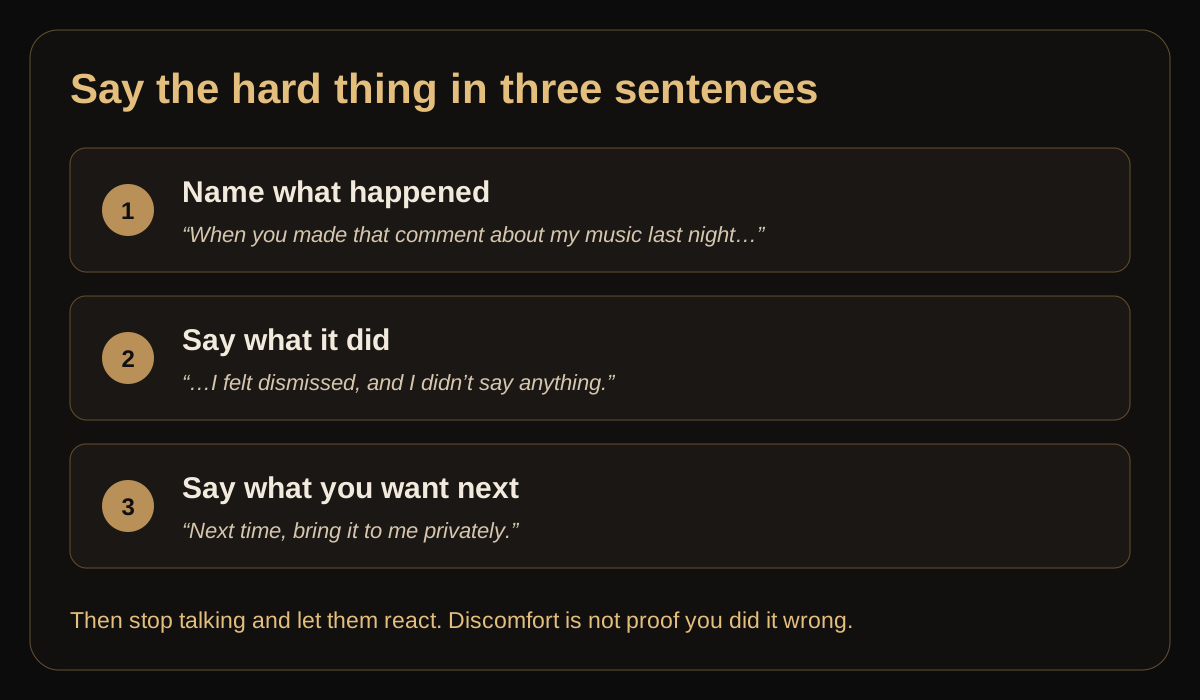
Then the important part: let them have a reaction.
You are not responsible for making the conversation feel good the whole way through. A little discomfort does not mean you did it wrong. It means you said something real.
In Emotional Maturity Is Sexy, I wrote that repair means naming the action, acknowledging the effect, and changing the next behavior. The same steps work from the other side of the table. You are giving the other person the information they need to repair. Silence takes that chance away from them.
When they get defensive
This is the moment most peacekeepers fold.
You say your three sentences. The other person gets prickly. "I was just joking." "You’re being sensitive." "So now I can’t say anything?"
And every cell in your body wants to take it back. "No, you’re right, forget it, it’s nothing."
Don’t.
Defensiveness is usually the first reaction, not the final answer. People need a minute to hear something they did not expect. You do not have to win the exchange, and you do not have to retreat from it either. You can simply hold your ground calmly:
"I hear that it was a joke. It still landed badly for me, and I wanted you to know."
Then stop talking. Let the silence do some work. You are allowed to sit in a little discomfort without rushing to fix it.
If it escalates into something unproductive, you can pause: "Let’s come back to this later." Then actually come back.
Practice on small things first
You would not try to lift your maximum weight on the first day at the gym.
Do not make your first honest disagreement the one about whether your relationship is working.
Start small:
Tell the waiter your food is wrong instead of eating it.
Say "Actually, I’d rather not" when a friend suggests the restaurant you hate.
Give your honest opinion when someone asks which outfit is better, instead of "they’re both great."
Each small honest moment teaches your nervous system the same lesson: I said the true thing, and the world kept going.
It also teaches you something about the people in your life. Most of them can handle a lot more honesty than you have been giving them credit for. The waiter fixes the order. The friend picks another restaurant. Nobody leaves. The disaster you have been rehearsing for years usually never shows up.
That lesson builds. Eventually the bigger conversations feel less like jumping off a building and more like walking down a step.
Scripts for the places it actually happens
Structure is nice in theory. Here is what it sounds like in real life.
With a partner. "Hey, can I bring something up? When plans change last minute, I end up feeling like an afterthought. I’m not mad, I just want us to check with each other first."
With a friend. "I love you, and I’m going to be honest with you for once instead of being nice. That joke about my job bothered me more than I let on."
With family. "I know you mean well. I’m not going to discuss my relationship at the dinner table anymore. Ask me about anything else."
With a collaborator. "I don’t think the hook is landing yet. I’d rather tell you now than nod along and resent the song later."
In the group chat. "Not trying to start anything, but I don’t agree with that. Here’s why." Then one sentence. Then you are allowed to put the phone down.
With yourself. This one counts too. "I said yes because I didn’t want to disappoint them. Next time, I’m going to take a minute before I answer."
Notice what these have in common. They are short. They are specific. They say what you want. None of them require you to win.
A point of view needs a voice
There is a creative side to this too.
In You Don’t Need a Niche. You Need a Point of View., I argued that a point of view is what makes different kinds of work feel like one person made it.
A point of view that never gets spoken does not exist in public.
Artists who are afraid of disagreement make work that tries to please everybody. And work that tries to please everybody tends to move nobody. The songs that hit, the jokes that land, the writing that sticks, usually contain at least one sentence somebody could argue with.
Your opinions are part of your art. Your boundaries are part of your character. If you keep editing both down to something inoffensive, you are not keeping the peace. You are erasing the person.
When avoiding is the right call
To be fair to every side (I am still a Libra):
If disagreeing with someone has ever felt unsafe, physically or emotionally, staying quiet may have been protection, not a personality flaw. That is a different situation from the ones in this article, and it deserves real support. A counselor or a trusted person outside the situation can help you figure out what is safe to say and where.
Sometimes the other person is not ready, is exhausted, or is in crisis. Timing matters. "Can we talk about this tomorrow?" is not avoidance if tomorrow actually happens.
And sometimes, honestly, the hill is not worth it. Let the bad movie take.
The skill is not becoming someone who argues about everything. The skill is knowing the difference between letting something go and letting something rot.
Quick answers
Are Libras really conflict avoidant? Astrology is not science, so no sign guarantees a personality. But the traits people associate with Libra, like caring about fairness, harmony, and how everybody feels, can make conflict feel heavier. Those traits are worth understanding whatever your sign.
Is avoiding conflict always bad? No. Letting small things go is healthy. It becomes a problem when it is your default for important things, when it keeps you from asking for what you need, or when it leaves resentment behind.
How do you have a hard conversation with a Libra? Make it safe to be honest. Be specific, stay calm, and ask what they think instead of assuming silence means agreement. Then give them a minute. Many peacekeepers need time to find their own opinion under all the other perspectives they are weighing.
How do I stop people-pleasing? Start small, use short and specific sentences, and expect a little discomfort. It is not a personality transplant. It is a skill, and it gets easier with reps.
Peace that includes you
Here is what I am learning.
The goal was never to stop caring about harmony. Harmony is beautiful. It is part of why I make music.
But harmony needs more than one note. If I keep silencing my note so the chord sounds smoother, it is not harmony anymore. It is a solo, and I am not even in it.
Real peace includes you.

It includes the sentence you have been holding.
It includes the slightly awkward pause after you say it.
It includes the other person getting to respond to the actual you instead of the agreeable version you have been sending in your place.
So say the thing. Kindly. Clearly. Once.
Then pass the bread. 😂
— King