The Inner Lab
Spiritual Awakening Can Feel Lonely. Nobody Warns You About That Part.
Sometimes awakening does not feel like floating into the light. It feels like realizing your old life still fits around you, but no longer fits inside you.

Spiritual awakening gets beautiful lighting on the internet.
Sunrise. Closed eyes. A calm face pointed toward the universe. Somebody has finally released what no longer serves them, and apparently what no longer served them also took the bills, confusion, family group chat, and need for human contact on its way out.
Very peaceful. Very beige. 😂
The quieter truth is that a change in consciousness can disturb your sense of belonging before it gives you a new one.
You begin questioning ideas that once organized your life. Certain conversations feel different. Old habits stop comforting you. Relationships built around an earlier version of you may no longer know what to do with the person asking new questions.
You can feel more connected to life and less understood by the people in it at the same time.
That contradiction is where the loneliness enters.
Awakening is a word, not one universal experience
People use “spiritual awakening” to describe many things: a sudden feeling of unity, a gradual change in values, a crisis that rearranges what matters, a deepening religious experience, a shift after grief, or the unsettling realization that the identity carrying you this far cannot carry you forever.
Those experiences are not identical. They do not have one cause, one meaning, or one guaranteed result.

In a 2021 study of 152 people who reported spontaneous spiritual or kundalini awakening experiences, participants described experiences involving changes in their sense of self, reality, and connection. Most evaluated the experience more positively than negatively, even when it began as something difficult. The researchers also stressed the limits of a self-selected survey and the need for more research. That matters because subjective spiritual experience deserves curiosity without pretending science has settled every explanation.
I am less interested in arguing over who is officially awakened than in what happens after a person can no longer unsee something about their own life.
The realization may arrive in a meditation. It may arrive during grief. It may arrive in traffic after the same lesson has chased you through four relationships and finally gets tired of being subtle.
However it arrives, insight does not automatically come with integration.
Seeing differently is one moment.
Learning how to live differently can take much longer.
The old version of you had a social life
Identity is not private in the way we like to imagine.
The people around you know a version of you. Families have roles. Friend groups have rhythms. Relationships develop agreements, spoken and unspoken, about what everybody will tolerate, laugh at, avoid, and pretend not to notice.
When you change, you disturb more than your own routine.

Maybe you stop participating in conversations that used to feel normal. Maybe approval loses some of its power. Maybe the performance that once protected you begins to feel heavier than the truth it was hiding.
That does not make everybody around you bad. It means the relationship learned one shape, and you are no longer holding it the same way.
I wrote in “I Was Never One Thing. That’s the Point.” that none of my labels tell the whole story. Awakening can make that sentence personal in a different way. It can expose how many labels were not descriptions at all. They were contracts.
The reliable one. The agreeable one. The funny one. The strong one. The one who never asks for much. The one who makes everybody comfortable while quietly disappearing from his own life.
When you stop honoring a contract you never consciously signed, some people will call the change selfish.
Sometimes it is selfish. Spiritual language does not magically remove accountability.
Sometimes it is the first honest thing you have done in years.
Knowing the difference requires more than a quote about protecting your energy.
Nobody tells you there is grief in it
Here is the part I did not expect. Growth can come with a funeral.
Not a dramatic one. Nobody sends flowers. But something does end, and it deserves to be mourned like something that mattered.
You can miss the old jokes, even the ones you would not laugh at now. You can miss the version of a friendship where you both wanted the same things on a Friday night. You can miss the certainty you used to have, back when the map was simpler and you never questioned where it led.
Missing it does not mean you are going backward.
It means the old life gave you something real. Belonging. Familiarity. People who knew your order before you sat down. Letting go of a shape does not require pretending it was worthless.
I think a lot of the loneliness people describe after a big inner shift is actually unprocessed grief wearing a spiritual costume. We call it “outgrowing people” because it sounds wiser than “I am sad, and I miss how things were.”
Grief also explains why the loneliness can show up at strange times. You feel fine for weeks, then a song comes on in the car, or somebody tags you in an old photo, and suddenly you are homesick for a life you chose to leave. That is not regression. That is your heart catching up with your decisions.
Both can be true. You can be moving in the right direction and still feel the loss of what you left behind.
Give the grief some room. Write about it. Talk about it with somebody who knew the old you. Let yourself say, out loud, “I miss that,” without immediately adding a lesson to it.
Not everything has to be a lesson. Some things just need to be felt.
Solitude and loneliness are not the same room
Solitude can be chosen. Loneliness is the pain of feeling disconnected.
One may help you hear yourself. The other can make you wonder whether anybody else can.
Spiritual culture sometimes romanticizes being alone as proof that you have outgrown everybody. That story can flatter the ego while pretending to transcend it.
Everybody who disagrees with you is not “low vibration.” Every uncomfortable conversation is not an attack on your evolution. Sometimes people are reacting to the fact that you have become impossible to question while calling it peace.
But the opposite mistake is just as real. You can stay inside familiar relationships long after they stop being honest because belonging feels safer than becoming.
The work is not to choose isolation and call it enlightenment.
The work is to learn which connections allow the changing version of you to remain truthful, accountable, and human.
A recent longitudinal study of transformative religious or spiritual experiences found a complicated picture. People reporting those experiences later showed signs of greater social engagement in some areas, while also reporting elevated loneliness and other forms of distress. Connection and vulnerability can appear in the same story.
That makes sense to me. A major inner shift can open you toward the world while disrupting the map you previously used to move through it.
Not everybody needs the full download
Part of spiritual integration is learning how to speak like a person again. 😂
You do not have to explain every realization to everybody in real time. A new insight is not automatically ready to become a sermon, a caption, a tattoo, and the opening statement at brunch.
Some things need quiet before they need witnesses.

Ask yourself what you are trying to receive from the person in front of you.
Do you want them to understand the experience? Respect the change? Agree with your interpretation? Reassure you that you are still lovable? Confirm that you have become special?
Those are different needs. One conversation may not be able to hold all of them.
You can be honest without handing somebody a vocabulary they do not share and then punishing them for not speaking it fluently.
Sometimes the most accurate sentence is not “I have awakened.”
It is “I am changing, and I do not completely understand the change yet.”
That sentence leaves room for truth without turning uncertainty into shame.
Integration needs both reflection and relationship
Inner work can reveal the pattern. Relationship shows you whether the pattern has actually changed.
It is easier to feel healed alone in a quiet room where nobody interrupts you, misunderstands you, needs something inconvenient, or leaves a spoon in the sink like they are conducting a psychological experiment.
The real test is not whether you can maintain perfect peace.
It is whether you can remain present when peace is not available.
Can you listen without abandoning yourself? Can you set a boundary without performing cruelty? Can you admit when the new language is hiding an old wound? Can you let somebody love you without requiring them to validate every belief you hold?

Researchers studying difficult meditation-related experiences found that social context could complicate integration, especially when people moved from an intensive practice environment back into ordinary life. Changes in identity, worldview, and the sense of self did not stay neatly inside meditation.
That is why integration cannot be only private.
You need places where you can think without performing certainty. That might include grounded friends, a spiritual or religious community, a therapist who respects your beliefs without treating every interpretation as fact, or people who have lived through a similar transition and kept both their wonder and their common sense.
Find people who do not need to shrink the experience or inflate it.
Both can be dangerous.
If a friend or partner does not share your language for what is changing, try starting with the part they can actually meet: “I have been rethinking some things, and I feel unsettled. I do not need you to agree with every conclusion. I would like you to listen.” Then ask about their life too. A relationship needs room for both people, not an entrance exam on your new vocabulary.
You can also keep one ordinary point of contact—a walk, a meal, a call—while you search for people who understand the deeper questions. Connection does not have to wait until somebody can explain your whole experience back to you.

Signs you are integrating, not isolating
Pulling back for a season is not the same thing as disappearing. But from the inside, they can feel identical.
So here are a few honest check-ins I use on myself.
You can still laugh at yourself. If every joke about your new beliefs feels like an attack, something got fragile. Real change can take a little teasing. Mine gets plenty. 😂
You are curious about other people’s lives. Not just about whether they have reached your level of understanding. If every conversation turns into a recruitment pitch or a quiet evaluation, that is distance, not depth.
Your boundaries have reasons you can say out loud. “I need less of this right now” is a boundary. “They are beneath my frequency” is a story.
You can be around people who see things differently and still feel like yourself. Not comfortable every minute. Just intact.
Your daily life is not falling apart. You still sleep, eat, show up, pay attention, and keep the commitments that matter. Insight that cannot survive a Tuesday probably needs more grounding.
In “Emotional Maturity Is Sexy.”, I wrote that maturity shows up in how you handle the moments that test you. Awakening works the same way. The proof is not how elevated you feel alone. It is how you treat people when they do not understand you.
You let people show up in their own way. Somebody who will never read the books you are reading may still drive across town when you need them. Counting that as connection is part of being grounded.
If most of these sound like you, the loneliness may be part of a transition. If very few do, it may be worth asking whether the solitude is still serving you or quietly protecting you from connection.
Keep your wonder. Keep your feet too.
Spiritual language can help people make meaning. It can also become a way to avoid sleep, grief, medication, responsibility, or help.
Not every unusual experience is a revelation. Not every difficult experience is pathology either. A blog cannot determine the difference for somebody living through it.
If an experience becomes frightening, disrupts sleep or daily life, makes it hard to recognize what is real, or creates thoughts of harming yourself or somebody else, reach for qualified support. The National Institute of Mental Health explains that psychosis can involve disrupted thoughts and perceptions and difficulty recognizing reality. In the United States, call or text 988 for immediate crisis support.
Getting help does not betray your spirituality.
Grounding is not the enemy of awakening.
Tell one person what changed without asking them to convert
And leave room for the possibility that a relationship can change shape without disappearing. A friend may not want to discuss your beliefs but may still show up when you need help moving a couch. A family member may need time before they understand the words you use. Those limits can hurt. They do not automatically erase the care that has been present. Look for the forms of connection people can honestly offer, then decide whether those forms are enough for this season.
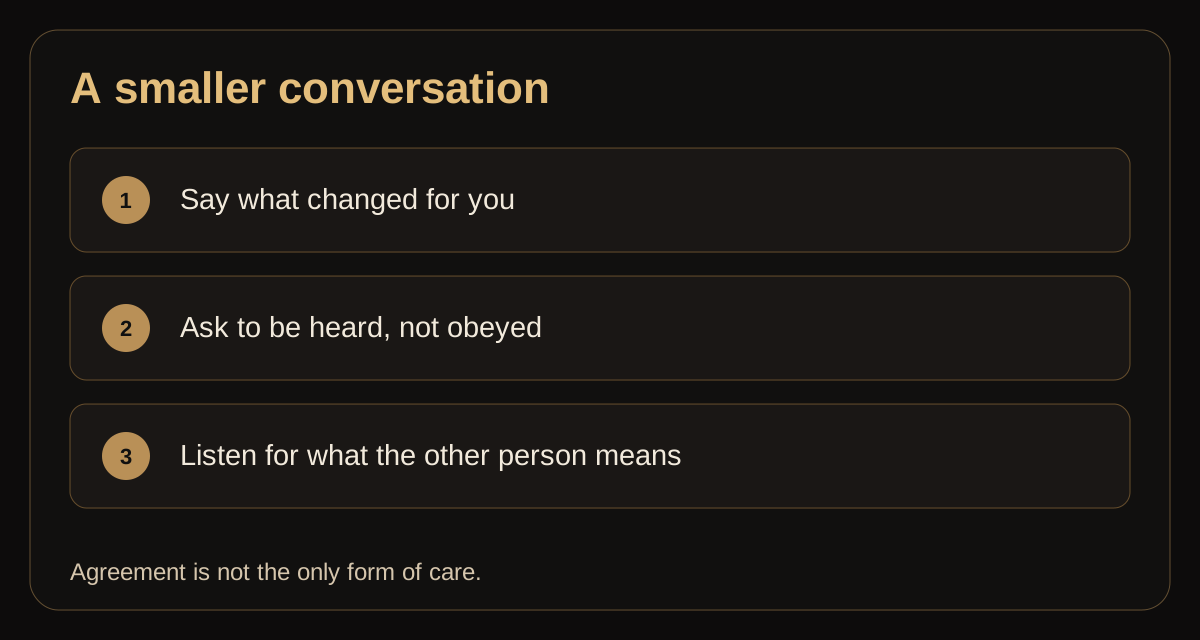
A difficult conversation can begin smaller than a complete explanation of your new worldview. Try: “I have been rethinking some things, and I am still finding words for it. I would like you to hear what this has felt like for me. You do not have to agree.” That sentence leaves room for the other person to be a person. It also makes a clearer request than dropping a hundred conclusions into the middle of dinner.
If the conversation goes badly, notice what actually happened. Did they mock you? Did they simply not understand? Did you ask them to affirm something they cannot honestly affirm? These are different problems. One may call for a boundary, another for patience, another for a different listener. Treating every confused response as proof that you have outgrown someone can make loneliness worse.
A synthesis of qualitative loneliness studies found that transitions and identity struggles can be part of how people describe feeling disconnected. That does not prove every spiritual change creates loneliness; it supports taking the social side of change seriously. Ordinary connection still counts: a walk, a meal, a shared joke, a friend who can listen without solving. Read the loneliness review.

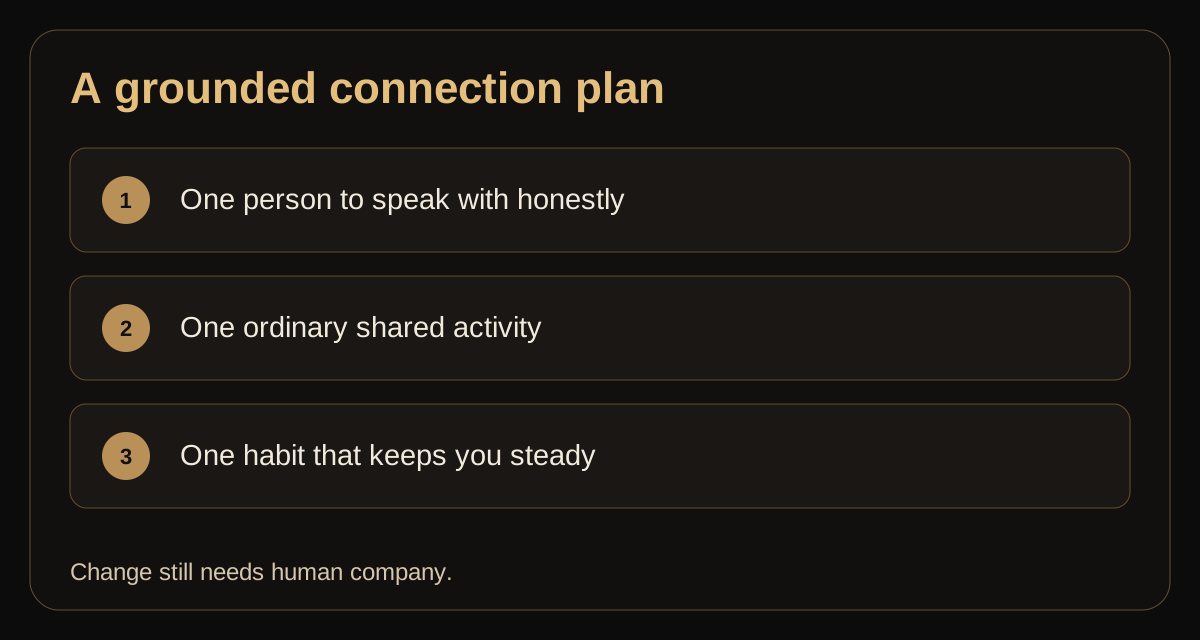
Make a practical plan for the next week. Name one person you can speak with honestly, one activity that brings you into ordinary life, and one habit that helps you stay grounded. If you cannot find a supportive person nearby, a qualified counselor or a well-run community can help you talk without turning your experience into a contest over who is more awake. You deserve connection that does not demand a performance.
Quick answers
Why does spiritual awakening feel so lonely? Because a shift in how you see yourself can change how you fit with the people around you. Relationships often rest on shared assumptions and familiar roles. When those change, you can feel more connected to life and less understood by others at the same time. That gap can contribute to loneliness.
Is it normal to lose friends after a spiritual awakening? Relationships often change when people change, and some friendships will shift shape or fade. That does not mean everyone who struggles with your new perspective is wrong for you. Before you write someone off, ask whether they rejected you or simply did not understand the words you used.
How long does the loneliness last? There is no fixed timeline, and anyone who promises one is guessing. Supportive relationships and integrating the change into everyday life may help. If it feels heavy or stuck, talking with a counselor or a trusted person can help.
How do I find like-minded people after a spiritual awakening? Start where people gather around a practice, not just an identity: meditation groups, faith communities, classes, workshops, volunteer work. Look for people who stay curious and grounded, not people who need you to agree with everything. And keep your existing relationships in the mix. Like-minded does not have to mean identical.
The space between versions is still a life
In “Creative Flow Is Not Something You Can Bully Into the Room.”, I wrote about creating the conditions for something to happen without demanding that it happen on command.
Change can require the same patience.
You may not be able to force the new identity into focus. You may only know that the old performance has become unbearable.
That middle space can feel lonely because it has no clean introduction. You are no longer who you were, but you do not yet have language for who you are becoming.
Stay close to what is honest. Stay close to people who can hold complexity without turning your life into a diagnosis or a prophecy. Let the new understanding become visible in your choices before you make it responsible for explaining the universe.
An awakening should not make you less human.
It should make you more willing to live like you are one.
— King