Frequency
That Chill Down Your Spine Has a Name: Frisson.
The body sometimes answers a song before the mind has prepared a statement. Goosebumps. A chill. A sudden lump in the throat. Music got there first.

You know the moment.
The harmony changes. A voice enters from somewhere behind the beat. The drums disappear for half a second, then the whole record opens. Your skin tightens. A chill climbs your arms or runs down your back before your mind has prepared any respectable explanation.
The body has already voted.
Researchers often call that response frisson: a brief, intense physical and emotional reaction that can include chills, tingling, goosebumps, tears, a lump in the throat, or a sudden rush of pleasure.
I love that the feeling has a name. I also love that giving it one does not make it less mysterious.
Knowing the chemistry of a kiss has never stopped anybody from wanting one. 😂
Music can touch the reward system without giving you anything
Food rewards you. Money can reward you. Sex can reward you.
A song is vibrations organized across time. You cannot eat the bridge. The chorus does not pay rent. Yet the right sound can make the brain and body react as if something important has arrived.
That reaction is measurable.
In a pharmacological study, researchers altered dopamine activity while participants listened to music. Increasing dopamine availability increased reported musical pleasure and motivation, while blocking dopamine reduced them. The experiment offered causal evidence that dopamine helps shape the reward people experience from music.

Earlier brain-imaging research also found a difference between the build toward a musical peak and the peak itself. Anticipation and release involved different parts of the striatum, a collection of structures involved in reward. The brain was responding before the chill arrived and during the moment it landed.
That makes musicians sound slightly evil when you think about it.
We spend hours creating a promise, delaying the answer, and deciding exactly when to let your nervous system have it. 😂
The build matters because prediction matters
Listening is not passive.
Your brain keeps making predictions about what comes next. Rhythm teaches you where the next hit belongs. Harmony creates expectations. Repetition gives the mind a pattern it can recognize.
Then music plays with the pattern.
A chord arrives later than expected. A new instrument enters. A singer reaches a note that changes the emotional temperature of the room. The beat drops out and leaves a space your body leans toward.
Research on musical chills has repeatedly linked the response with moments such as crescendos, changes in dynamics, unexpected harmony, new voices or instruments, and interactions between a soloist and the accompaniment. Those features do not guarantee chills, but they help explain why tension, surprise, and release matter.
The surprise has to live inside enough familiarity for you to feel it.
Pure randomness gives the brain nothing to anticipate. Total predictability gives it nothing to discover.

The sweet spot is often a pattern that earns your trust, then breaks its own rule beautifully.
What building a chill actually looks like in the studio
Here is the unglamorous version.
I’m sitting at the console at an hour no responsible adult should be awake. The hook is written. The verse works. Something is still missing, and I can feel it more than I can name it.
So I start subtracting.
Mute the hi-hats for two bars before the chorus. Pull the bass out under the last line of the verse. Let the vocal sit alone for one breath. Then bring everything back at once.
Play it. Too early. Move it. Play it again. Too obvious. Undo. Try a chord that leans somewhere the ear didn’t expect, then lands home a beat later.
Somewhere around the twentieth pass, I stop trusting myself.
That’s the funny part about building for surprise. By then I’ve heard the song so many times that nothing in it can sneak up on me anymore. I know every turn before it happens. The guessing game that makes the moment work for a fresh listener is over for me.
So I walk away. Get water. Listen to something completely different. Come back with ears that forgot a little.
Then I play it for somebody else and watch their face instead of the speakers. Not their compliments. Their face. A head that stops nodding for a second right before the chorus tells me more than “that’s hard, bro” ever could. 😂
If their shoulders jump when the drums come back, I keep it. If they reach for their phone during my favorite part, I have notes to take.
Sometimes the moment I almost deleted is the one that makes my arm hair stand up on the first fresh listen. Sometimes the part I was proudest of does absolutely nothing. Both happen more than I’d like to admit.
The craft is real. The control is not total. You build the runway and hope something takes off.
The same sound does not enter the same person
A musical moment does not carry one fixed emotional instruction.
The listener brings a body, a culture, a history, a mood, and a thousand associations the producer cannot see.
A certain rhythm may feel like home to one person and unfamiliar to another. A vocal run may sound excessive to somebody who did not grow up hearing that language of emotion. A bass line can carry a whole geography before anybody names the island.
That is one reason Caribbean rhythm matters in my world. Rhythm is not decoration added after the meaning. Rhythm can be the memory carrying the meaning.
The same song can also change as you change.
A record you played during a breakup may feel unbearable for months. Years later, it may no longer return you to the person who left. It may return you to the version of yourself who survived.
The audio file stayed the same.
The listener did not.
Music does not only remind you. It rebuilds a moment.
Memory is rarely a clean little video stored in the brain.
A song can bring back fragments: the smell of a room, the color of a dashboard, the person sitting beside you, the version of your life that still believed something would last.

Emotion helps some experiences become easier to remember, and research suggests it also affects musical memory. In one study, listeners completed immediate and delayed recognition tests for musical excerpts. The results showed that emotional valence influenced long-term musical recognition and that musical memory continued consolidating across the delay.
That does not mean every chill is a buried memory knocking on the door.
Sometimes the arrangement is doing the work. Sometimes familiarity is involved. Sometimes the voice hits a quality you find beautiful. Sometimes your body responds to intensity before your autobiography gets involved.
Usually, human emotion refuses to pick one department.
Sad music can feel good without making sadness fake
One of music's strangest gifts is that it lets us approach difficult emotion inside a structure.
The song can hurt, but it also holds the hurt. The chord changes. The measure ends. The voice returns. Pain receives shape, timing, and somewhere to move.
That may help explain why chills are not limited to cheerful music. Research links them with awe, being moved, sadness, tension, expectation, and pleasure. Different musical moments can produce a similar physical response through different emotional paths.
A goosebump does not tell you whether the song made you happy.
It tells you the song mattered to the body.

That distinction is useful when people reduce music to mood management. Music can calm you, energize you, or help you focus. It can also let you feel something too mixed for a playlist label.
Grief with beauty inside it.
Desire with fear underneath it.
Joy carrying the knowledge that the moment will end.
The body is often better at holding contradiction than language.
Comedy taught me the same timing
I don’t only make music. I write, and I do comedy, and the two keep teaching each other. I wrote about that in “I Was Never One Thing. That’s the Point.”, and frisson is one of the clearest examples I know.
A joke has a setup and a punchline. A song has a build and a release. Both run on the same deal with the audience: give them a pattern, let them lean in, then pay it off in a way they didn’t see coming but accept instantly.
Hit the punchline too early and it dies. Wait too long and the room checks its phone. Same with a drop. Same with the moment the background vocals finally come in.
The silence is doing work in both cases. In stand-up, the pause before the last word is where the audience tries to finish the thought ahead of you, then finds out you went somewhere better. In a song, the beat that drops out is the same pause. The listener leans into the gap, and the return lands harder because they were waiting for it.
The live room adds another layer. When a crowd sings a line back, or the whole place goes quiet right before a big note, you can feel yourself reacting to everybody else reacting. The sound is only part of what is happening.
Researchers who study chills have pointed to social context, familiarity with the music, and personality traits such as openness to experience as factors that may shape who feels them and when. The same research notes that chills are not consistent from one listener to another, or even within the same listener.
I believe that completely. I’ve had nights where a song gave me chills while I was performing it and nights where it was just a song I knew the words to. Same lyrics. Same beat. Different night, different body.
Timing is a skill. The reaction is a gift.
What if the song is unfamiliar and still gives you chills?
You do not need a personal memory attached to a song for it to move you. A voice entering at the right moment, a harmony that changes what you expected, or a buildup that finally releases can be enough. Memory and culture can deepen the reaction, but they are not tickets required at the door.
People sometimes call every pleasant tingle ASMR. The experiences can feel related, but they are not interchangeable. In a study of people who experience ASMR, most respondents who also reported frisson said they could distinguish the two. And if music has never given you goosebumps, that says nothing about whether you understand or love it.
Producers build the doorway. Listeners complete the room.
As an artist, I can shape attention.
I can change the harmony, pull the drums, leave more air around a vocal, move the bass, delay the answer, or let one imperfect texture remain because cleaning it would remove the feeling.

I cannot order somebody to experience frisson.
In “Creative Flow Is Not Something You Can Bully Into the Room.”, I wrote about preparing the conditions for creativity without demanding the result. Music asks for the same humility after the record leaves your hands.
You prepare the conditions for feeling.
The listener's nervous system, memory, culture, attention, and timing decide what enters.
That is why taste matters so much. A recognizable point of view is not only the list of sounds an artist uses. It is the judgment behind when to give the listener what they expect and when to open a door they did not know was there.
Technology can reproduce the ingredients.
Taste decides whether they become a meal.
Why an unfamiliar song can still hit you
That is part of the pleasure of listening closely. A new song gives you no personal backstory yet, but it can still organize expectation in real time. Your ear begins guessing where the melody will go; the artist can meet that guess, delay it, or turn away at the last second. The reaction belongs to that encounter, not to a quiz about whether you knew the track before pressing play.
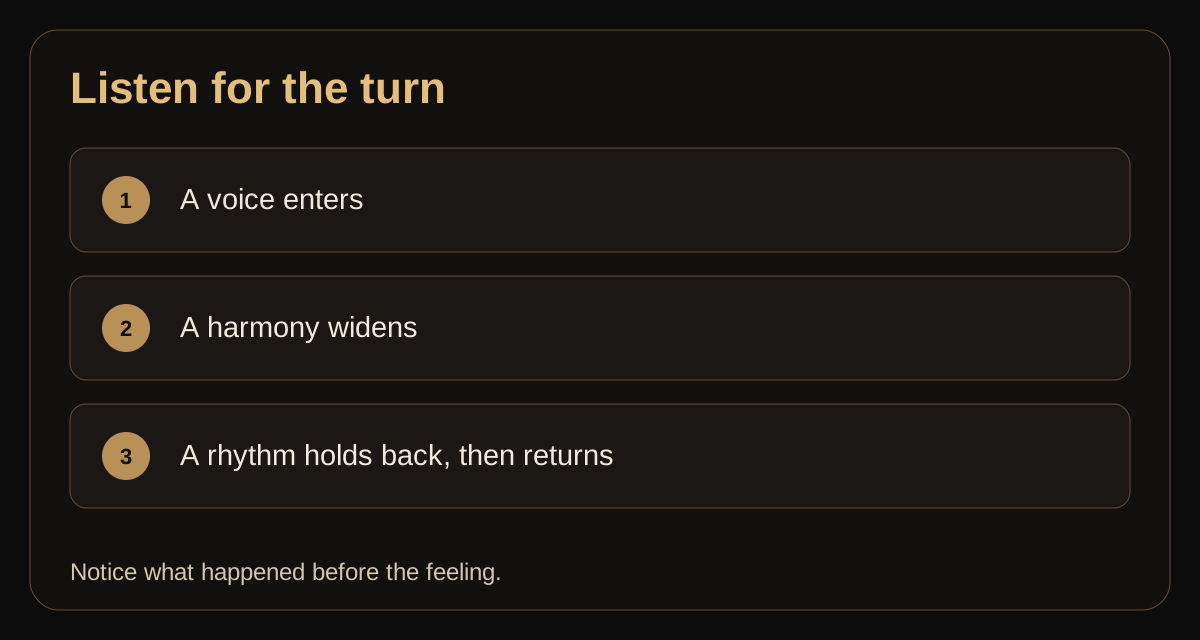
You do not need a memory attached to a song for your body to react. A quiet phrase can set an expectation, then the full harmony arrives somewhere you did not predict. A voice can enter after a long wait. The rhythm can pull back just before returning. Those moments can be powerful even when you have never heard the track before. A memory may add another layer, but it is not a ticket required at the door.
Think of a scene where the room suddenly gets quiet. You can sense that something is about to happen without knowing what. Music works with that kind of attention. It can establish a pattern, delay a resolution, and make a tiny change feel enormous because your mind was already leaning forward. The exact route varies by listener and by piece; there is no universal “chills chord” that works on demand.
The same song can also meet you differently on another day. You may know the notes but hear a new detail in the singer's breath, the harmony below the melody, or the way the drummer waits. Familiarity can deepen anticipation rather than remove it. Or the track may leave you cold this time. That does not measure your sensitivity or your love of music.
Chills, tears, and ASMR are different descriptions
There is no need to rank listeners by how visibly they react. Some people cry at a certain melody. Some feel a wave in their arms. Some listen with an entirely still face and remember the song for years. The outside signal does not tell the whole story. Even for the same person, the reaction can depend on attention, context, and the moment in life when the music arrives.
If you make music, this matters. You can study how tension and release work, but you cannot demand a particular body response from everyone. Instead, ask what the passage is trying to make possible. Is it preparing a surprise? Is it letting a voice enter alone? Is it giving someone a place to recognize their own history? Craft the moment, then let the listener complete it.
For a listener, the useful question may be simpler: What did I hear just before I felt something change? You might hear a harmony you missed, a tiny silence, a shift from one singer to a crowd, or a lyric delivered with a different weight. You do not need a laboratory vocabulary to pay close attention. Curiosity is enough to make the next listen richer.
People use “goosebumps,” “frisson,” “tingles,” and “ASMR” in overlapping ways, but the labels are not interchangeable. Musical chills often name a brief peak tied to a passage, buildup, or emotional turn. ASMR often describes a calmer tingling response to particular sensory triggers. A comparative study found differences between the experiences as well as areas of overlap. It is fine to describe what happened to you without deciding that every bodily response has one mechanism. Read the comparative study.

Try noticing what happened just before your next chill. Was there a pause, a new voice, a widening chord, or a lyric that finally made sense? That little act of listening can teach you more about your own ear than a generic list of supposedly magical songs. A producer can build the conditions. You bring the history, the expectations, and the present moment.
Quick answers
Why do I get chills from music? Researchers link musical chills to the brain’s reward system, including dopamine, and to anticipation. Moments like a crescendo, a new voice, or an unexpected harmony can build tension and then release it. Your body can answer with goosebumps, tingles, or a rush of pleasure before your mind has an explanation ready.
Is frisson rare? It is common enough to have a name and its own research, but it is not universal. Research notes that many listeners never experience chills, and people who do don’t get them every time. If music has never given you goosebumps, that says nothing about how much you love it.
Can you train yourself to get frisson? There is no reliable switch, and I wouldn’t trust anybody selling one. What you can do is give the music better conditions: listen closely, somewhere quiet, without scrolling, and notice what happens right before you feel something. That won’t guarantee chills, but it will make you a sharper listener.
Why do sad songs give me chills? Chills are not reserved for happy music. Research links them with sadness, awe, being moved, tension, and pleasure. A sad song can hold a painful feeling inside a structure with timing and shape, so the body can respond strongly even when the emotion is mixed.
Your body heard the truth before you named it
Science can describe some of what happens during musical chills: reward circuits, dopamine, anticipation, arousal, attention, memory, and the physical signs of emotion.
It cannot tell you which song will find you at the exact moment you are ready for it.
That part belongs to the meeting between the music and the life listening to it.
Maybe the chill comes from surprise. Maybe it comes from recognition. Maybe the song gives form to something you have been carrying without language.
Whatever the route, the body answers before the explanation arrives.
That is not music escaping science.
That is science showing us how much music has to work with.
— King