Money & Making
How to Read a Credit Card Statement Without Getting Lost
Two balances, three dates, a minimum payment and a box full of years. A credit card statement can feel like a puzzle. Here's what every number means, using a fictional statement you can compare with your own.

You open your credit card statement, or the app, and there’s a lot going on.
There’s a statement balance and a current balance, and they’re different. There’s a minimum payment that seems small. There’s a closing date and a due date. There’s a percentage labeled APR. And there’s a box that says something like "If you make only the minimum payment, you will pay off the balance in 11 years."
Most people look for one number, pay something and close the app. That works until it doesn’t, like when interest shows up on a card you thought you paid off, or a payment lands a day late.

This article walks through a credit card statement piece by piece. It uses a fictional, labeled statement so you can see every part in context, then a billing-cycle timeline so you can see how the dates connect. By the end, you should be able to open your own statement and know exactly what you’re looking at.
Important: this is general educational information, not financial or legal advice. Card terms vary, so your card’s agreement and statement are the final word on how your account works. The statement in this article is fictional, and the numbers are made up for illustration. The images of me in this article are AI-generated illustrations.
The big idea: a statement is a snapshot
A credit card statement is a snapshot of your account at one moment: the end of a billing cycle.
A billing cycle is the stretch of time, usually about a month, that one statement covers. Every purchase, payment, fee and interest charge that posts during that stretch shows up on that statement.
The last day of the cycle is the statement closing date. When the cycle closes, the card issuer adds everything up, and that total becomes your statement balance.
Then there’s a gap, often a few weeks, before the payment due date. That gap matters a lot, and we’ll come back to it.
Meanwhile, you keep using the card. New purchases after the closing date don’t appear on this statement. They go into the next cycle. That’s why the balance in your app can be different from the balance on your statement.
Keep that picture in mind: one cycle closes, a statement is created, a due date follows, and the next cycle is already running.
A fictional statement, piece by piece
Here’s the made-up statement we’ll use. Imagine it belongs to someone named Alex. The layout of real statements differs by issuer, but most include these same parts.
Statement period: October 4 to November 3
Statement closing date: November 3
Payment due date: November 28
Previous balance: $1,950.00
Payments and credits: −$1,950.00
Purchases: +$2,480.00
Fees charged: $0.00
Interest charged: $0.00
New balance (statement balance): $2,480.00
Minimum payment due: $72.31
Purchase APR: 22.99%
Credit limit: $5,000
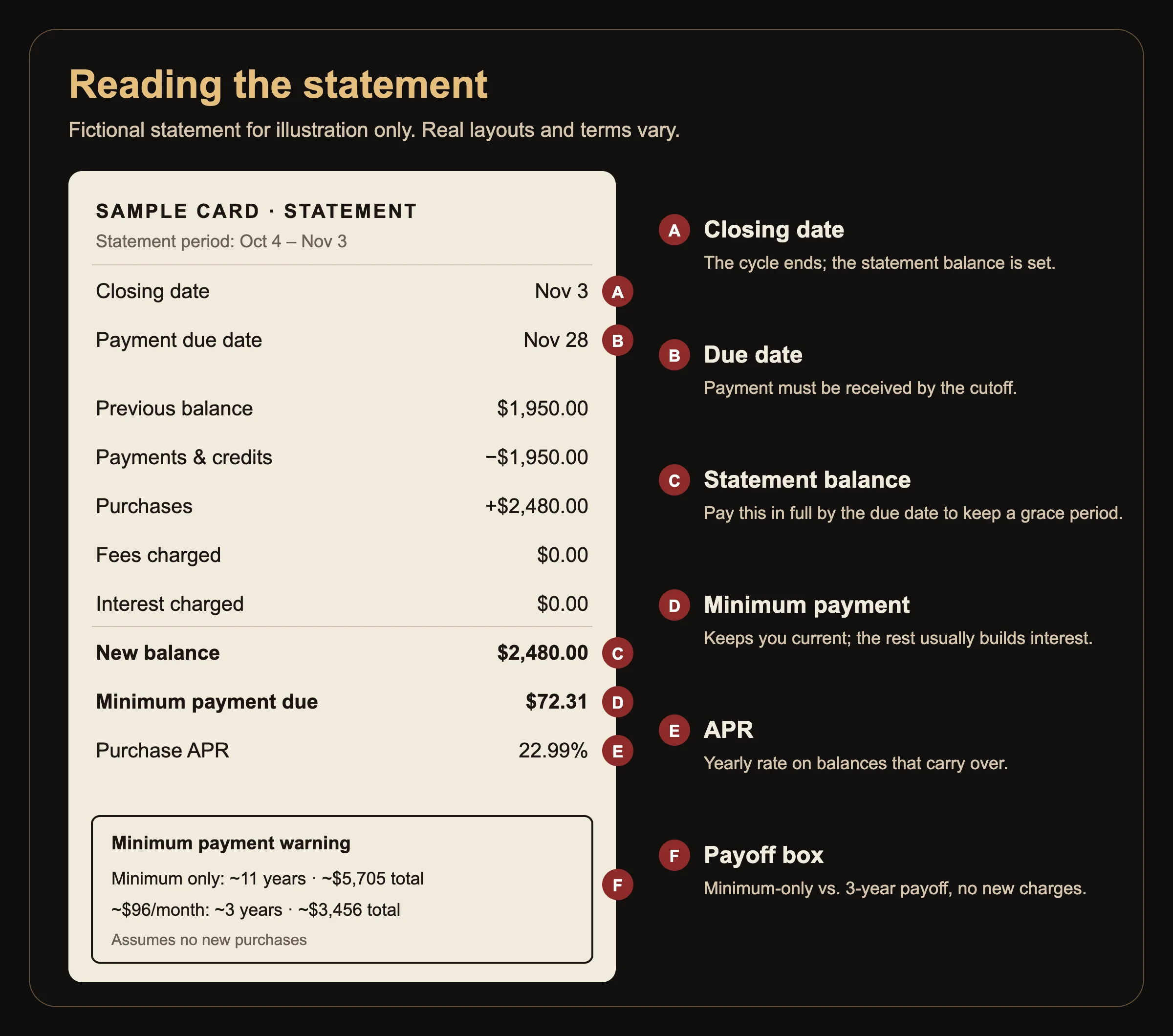
Now let’s go through what each of those means.
What each number means
Previous balance
What you owed at the end of the last statement. In Alex’s case, $1,950.
Payments and credits
Money you paid toward the card during this cycle, plus any refunds or credits. Alex paid the previous balance in full, so this is −$1,950.
Purchases
Everything you bought on the card during this cycle. Your statement should list each transaction with a date, a merchant name and an amount. This is the section worth scanning line by line.
Fees charged
Things like late fees, annual fees, foreign transaction fees or cash advance fees, if any apply. Alex has none this month.
Interest charged
The interest added during this cycle. Alex’s is $0 because last month’s statement was paid in full, which leads us to the grace period, covered below.
New balance (statement balance)
This is the total as of the closing date: previous balance, minus payments and credits, plus purchases, fees and interest. For Alex, that’s $2,480.
This is the number that usually matters most if you want to avoid interest on purchases, as you’ll see.
Minimum payment due
The smallest payment you can make by the due date to keep the account in good standing. For Alex, $72.31.
The minimum is not the same as the amount that avoids interest. Paying only the minimum keeps you current, but the rest of the balance usually starts building interest.
How the minimum is calculated varies by card. Your cardholder agreement explains the formula.
Payment due date
The day your payment needs to be received. According to the Consumer Financial Protection Bureau, payments are generally considered on time if they’re received by 5 p.m. on the due date, in the time zone listed on your statement. The CFPB also notes that if the due date falls on a day your issuer doesn’t accept mail, like a weekend or holiday, a payment received by 5 p.m. the next business day is generally on time. Online and in-person cutoffs can differ, so check your statement.
The key word is "received." Mailing a payment on the due date isn’t the same as the issuer receiving it.
APR
The annual percentage rate, the yearly interest rate on balances that carry over. Many cards have more than one APR, such as one for purchases, one for cash advances and sometimes a penalty APR. Your statement usually lists each one.
For context, the Federal Reserve’s data showed an average interest rate of 22.36% on credit card accounts that were charged interest in August 2026. Your rate may be higher or lower.
Credit limit and available credit
Your credit limit is the maximum the issuer lets you borrow on the card. Available credit is how much of that limit is left right now, based on your current balance and any pending charges.
The grace period: the part that saves (or costs) you money
This is where the statement balance becomes important.
The CFPB explains that a grace period is the time between the end of a billing cycle and the payment due date. If your card has one, you can generally avoid interest on new purchases by paying the full statement balance by the due date.
A few things from that CFPB explanation are worth knowing:
Grace periods aren’t required. Card issuers don’t have to offer one, though the CFPB notes that most cards do for purchases.
Statements have to arrive in time. The CFPB says issuers must make sure your statement reaches you at least 21 days before the payment is due.
Cash advances usually don’t get one. Interest on cash advances and convenience checks typically starts right away.
You can lose it. If you don’t pay the full statement balance, interest generally applies to the unpaid part, and new purchases can start building interest from the day they post. The CFPB notes that paying in full some months but not others can cost you the grace period for the month you don’t pay in full and the following month.
So in Alex’s case, if the card has a grace period on purchases and Alex pays the full $2,480 statement balance by November 28, Alex generally won’t pay interest on those purchases.

Statement balance vs. current balance
This is the most common source of confusion, so it gets its own section.
Statement balance is what you owed as of the closing date. It’s fixed until the next statement.
Current balance is what you owe right now. It includes everything on the statement plus anything that posted after the closing date, minus any payments since then.
Here’s a fictional example. On November 6, three days after the statement closed, Alex buys $120 worth of headphones.
Statement balance: still $2,480.00
Current balance in the app: $2,600.00 (the $2,480 statement balance plus the $120 purchase, assuming nothing else has changed)
Which one does Alex need to pay to keep the grace period? Generally the statement balance, $2,480, by November 28. The $120 headphones belong to the next cycle and will show up on the December statement.
Paying the current balance instead also works. It just means paying for the headphones early. Some people prefer that because it keeps things simple.

The bigger mistake is going the other way: paying less than the statement balance because the app showed a smaller "minimum" or because you thought the headphones were already included.
What happens if you only pay the minimum
Let’s say Alex pays only the $72.31 minimum by the due date.
The account is in good standing, and there’s no late fee. But about $2,407.69 of the statement balance carries over, and interest generally starts building on it. New purchases may also start building interest from the day they post, because Alex didn’t pay the full statement balance.
How much interest? It depends on how the issuer calculates it. Many issuers use an average daily balance method, so your exact number depends on timing. As a rough, hypothetical illustration, 22.99% a year works out to about 0.063% a day. On roughly $2,400 for about 30 days, that’s about $45 in interest, before counting any new purchases.
That’s the key thing the minimum payment can hide. It keeps you current, but it doesn’t stop the balance from costing you money.
The payoff box (minimum payment warning)
Most statements include a box that shows how long it would take to pay off the balance if you made only the minimum payment, and what you’d pay each month to pay it off in three years.
The CFPB explains that this information is based on your balance as of the statement date and assumes you make no new charges. It also notes that the three-year payment amount isn’t required. The minimum is still the only amount you have to pay, and if you keep using the card, the three-year estimate doesn’t account for the new charges.
Here’s what Alex’s box might look like. These figures come from our own hypothetical calculation, assuming a 22.99% APR, no new purchases and a minimum payment of 1% of the balance plus interest, with a $35 floor. Real issuers use their own formulas, so your box will be different.
If you make only the minimum payment each period: about 11 years to pay off, and about $5,705 paid in total.
If you pay about $96 each month: about 3 years to pay off, and about $3,456 paid in total.
Same $2,480 balance. The difference is roughly $2,249 and eight years. That box is one of the most useful parts of the statement, and one of the most skipped.

Other things on your statement worth checking
Transactions you don’t recognize. Merchant names on statements can look different from store names, so look up anything unfamiliar before assuming fraud. If something really isn’t yours, contact your issuer right away.
Billing errors. The Federal Trade Commission explains that under federal law, to protect your rights you generally need to send a written dispute so it reaches the issuer within 60 days after the first bill with the error was sent to you, to the address for billing inquiries rather than the payment address. The FTC says the issuer must acknowledge it in writing within 30 days of receiving it, unless the problem has already been resolved, and resolve it within 90 days.
Fees. Annual fees, foreign transaction fees, late fees and cash advance fees all show up here. If one surprises you, your cardholder agreement explains when it applies.
Interest by balance type. If you have more than one kind of balance, like purchases and a balance transfer, many statements break down interest by type. Under federal rules, when you pay more than the minimum, issuers generally must apply the extra amount first to the balance with the highest APR, with some exceptions.
Changes to your terms. Notices about rate or fee changes sometimes appear on or with a statement. They’re easy to miss and worth reading.
Rewards. If your card earns points or cash back, the statement may summarize what you earned. Nice to see, but rewards rarely outweigh interest if you carry a balance.
The billing-cycle timeline
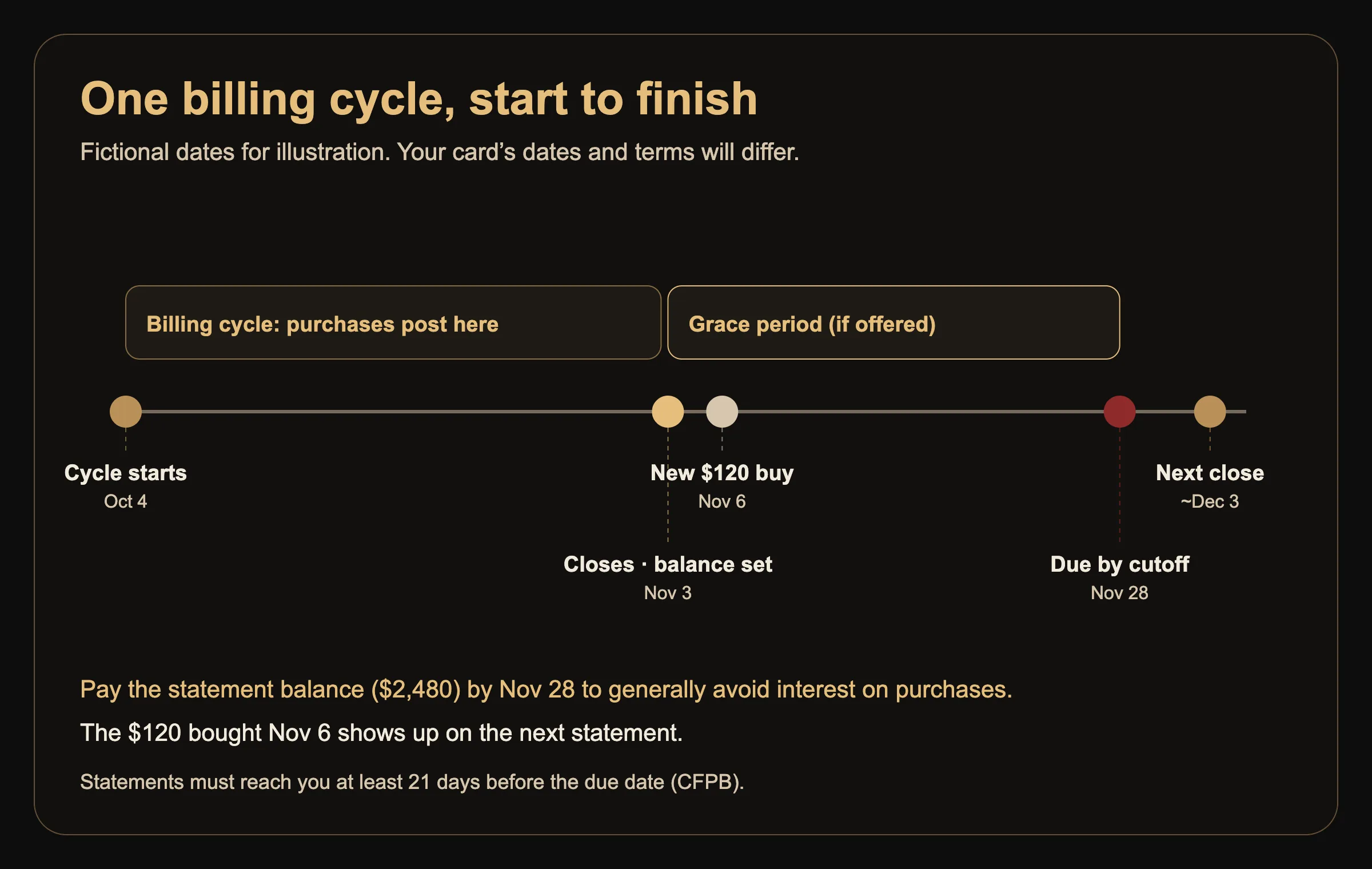
Here’s how the dates in Alex’s fictional example connect.
October 4: the billing cycle starts.
October 4 to November 3: purchases, payments and any fees or interest post to this cycle.
November 3: the cycle closes. The statement balance is set at $2,480.
Shortly after November 3: the statement is created and sent. The issuer has to make sure it reaches Alex at least 21 days before the due date.
November 6: Alex buys headphones. That purchase belongs to the next cycle.
November 3 to November 28: the grace period, if the card has one. Paying the full statement balance in this window generally avoids interest on purchases.
November 28: the payment due date. The payment needs to be received by the cutoff time.
December 3 (approximately): the next cycle closes, and the headphones show up on that statement.
Your dates will be different, but the pattern is the same every month.
What to check every month
You don’t need to study your statement like a contract every time. A quick, consistent check catches most problems.
1. The statement balance and the due date. Put the due date in your calendar, or set up a payment reminder.
2. The transactions. Scan the list for anything you don’t recognize or anything charged twice.
3. Interest and fees. If either isn’t $0, make sure you understand why.
4. The payoff box. Glance at it, especially if you’re carrying a balance.
5. Your plan. Decide how much you’ll pay and when, and make sure the money will be there. The payday routine can help you line up card payments with your paychecks.
Common mistakes
Paying the minimum and thinking you’re done. You’re current, but the rest of the balance usually starts costing interest.
Paying the current balance after a big refund or payment and missing part of the statement balance. Timing can make the two numbers move in confusing ways. If you’re trying to avoid interest, the statement balance is the one to check.
Mixing up the closing date and the due date. The closing date sets the balance. The due date is when payment has to arrive.
Waiting until the due date to pay by mail or by a slow method. Payments generally need to be received by the cutoff time, not just sent.
Forgetting autopay is set to the minimum. Many people set up autopay once and forget which amount they chose. Check whether it’s paying the minimum, the statement balance or a fixed amount.
Ignoring the statement when the balance feels stressful. Looking is uncomfortable, but you can only fix what you can see.

If you’re carrying a balance you can’t pay off
This article can’t tell you what to do with your specific debt. But a few general steps tend to help:
Know your numbers. List each card’s balance, APR and minimum payment.
Always try to make at least the minimum on time. Late payments can bring fees, possible penalty APRs and credit damage.
Pay more than the minimum when you can. Your payoff box shows how much that can change.
Call your issuer if you’re struggling. Some issuers offer hardship programs or payment plans. It doesn’t hurt to ask.
Look into nonprofit credit counseling. A reputable nonprofit credit counselor can help you look at your full picture.

If irregular expenses are part of why balances build up, How to Budget for Bills That Don’t Come Every Month gets into that. If your paycheck is smaller than you expected and that’s squeezing your payments, Why Is My Paycheck So Much Smaller Than My Salary? breaks down where it goes. And if you’re thinking about long-term saving, What’s the Difference Between a 401(k), IRA and Brokerage Account? and the Money Map are good next stops. Everything money-related lives in Money & Making.
Save this: which balance is which?
Screenshot this section or bookmark this page.
Statement balance. What you owed when the billing cycle closed. Paying this in full by the due date generally keeps your grace period on purchases, if your card has one.
Current balance. What you owe right now, including anything that posted after the statement closed.
Minimum payment. The least you can pay by the due date to stay current. It usually doesn’t stop interest on the rest.
Closing date. The day the cycle ends and the statement balance is set.
Due date. The day your payment needs to be received, generally by 5 p.m. in your statement’s time zone.
The monthly 5-check: statement balance and due date, transactions, interest and fees, payoff box, your payment plan.
Quick answers
What’s the difference between statement balance and current balance? Your statement balance is what you owed when the billing cycle closed. Your current balance is what you owe right now, including purchases and payments since then.
Do I need to pay the statement balance or the current balance? If your card has a grace period, paying the full statement balance by the due date generally avoids interest on purchases. Paying the current balance also works, and simply pays newer purchases early.
What happens if I only pay the minimum? Your account generally stays in good standing, but the remaining balance usually starts building interest, and new purchases may too.
When is a credit card payment considered late? The CFPB says payments are generally on time if received by 5 p.m. on the due date in the time zone on your statement, with some exceptions for weekends, holidays and online or in-person cutoffs.
What is the box about paying off in three years? It shows how long payoff would take paying only the minimum, and the monthly amount to pay it off in 36 months, based on your current balance and assuming no new purchases. The three-year amount isn’t required.
How do I dispute a charge on my statement? Contact your issuer. For billing errors, the FTC says to send a written dispute to the billing inquiries address so it arrives within 60 days after the first statement with the error was sent.