Money & Making
I Got Paid. Now What? A Realistic Payday Routine
The money lands, you feel relief for about an hour, and then it's somehow already spoken for. Here's a short routine to run every payday, with real-world examples, including the paychecks that don't stretch.

Payday hits. You check your account and there it is. For a minute, everything feels possible.
Then the rent reminder comes in. The phone bill. A subscription you forgot about. Gas. Groceries. By the next morning, it already feels like the money is gone, and you’re not totally sure where it went.

If that sounds familiar, you’re not bad with money. Most people were never taught what to actually do when a paycheck arrives. They were told to "budget," handed a spreadsheet template and left on their own.
This article is a payday routine. It’s short enough to run every time you get paid, it works whether you’re paid weekly, every two weeks or twice a month, and it doesn’t assume you have money left over to invest. It includes two worked examples, one where the numbers work and one where they don’t, because both are real.
Important: this is general educational information, not financial, legal or tax advice. Everyone’s situation is different. If you’re behind on bills or dealing with debt, a nonprofit credit or housing counselor can help with your specific situation. The images of me in this article are AI-generated illustrations.
Why payday feels so confusing
A big part of the problem is timing. Most bills run on a monthly calendar. Paychecks often don’t.
Here’s how common each pay schedule is. In a February 2023 snapshot, the Bureau of Labor Statistics found that among U.S. private businesses, 43.0% paid biweekly, 27.0% weekly, 19.8% semimonthly and 10.3% monthly. Those are shares of businesses, not workers, but they show how much variety there is.
The differences matter more than people think:
Weekly means 52 paychecks a year. Some months have four paydays and some have five.
Biweekly (every two weeks) means 26 paychecks a year. Most months have two paydays, but usually two months a year have three.
Semimonthly (twice a month) means 24 paychecks a year, often on set dates like the 1st and 15th, or the 15th and the last day of the month.
Monthly means 12 paychecks a year and one long stretch to make each one last.
So "my rent is $1,200 a month" and "I get paid every two weeks" don’t line up neatly. That mismatch is where a lot of the stress comes from.

It’s also why so many people feel stretched even when they’re working. In the Federal Reserve’s report on economic well-being of U.S. households in 2025, 73% of adults said they were doing at least okay financially, and 63% said they would cover a $400 emergency expense with cash or its equivalent. That means a large share of adults couldn’t, which is exactly why having a plan for each paycheck matters.
The payday routine: five steps
Set aside 20 to 30 minutes on payday, or the day after. Grab your banking app, your list of bills and something to write on. Then go through these five steps in order.
Step 1: Confirm what actually arrived
Start with the real number, not the number you expected.
Check the deposit amount. Is it what you thought it would be? If it’s different, look at your pay stub. Hours, overtime, taxes and benefit deductions can all change your take-home pay. (This guide walks through reading a pay stub line by line.)
Look at your available balance, not just your current balance. Banks often show both. The available balance usually accounts for pending transactions and holds. If a few card purchases haven’t posted yet, your current balance can look higher than what’s actually free to spend.
Note anything still pending. Charges from the last few days, a check you wrote, an automatic payment scheduled for tomorrow. Those are already spoken for.
The goal of Step 1 is simple: know exactly what you’re working with before you decide anything.
Step 2: List what’s due before your next payday
This is the most important step, and it’s the one most people skip.
Look at the window from today until the day before your next paycheck. That’s the stretch this paycheck has to cover. Write down every bill and payment due in that window:
Fixed bills. Rent or mortgage, car payment, phone, internet, insurance, utilities.
Debt payments. At least the minimum on credit cards and loans.
Automatic payments and subscriptions. Streaming, apps, gym, cloud storage. These are easy to forget because they happen without you.
Day-to-day essentials. Groceries, gas or transit, household basics, for the number of days until your next check.
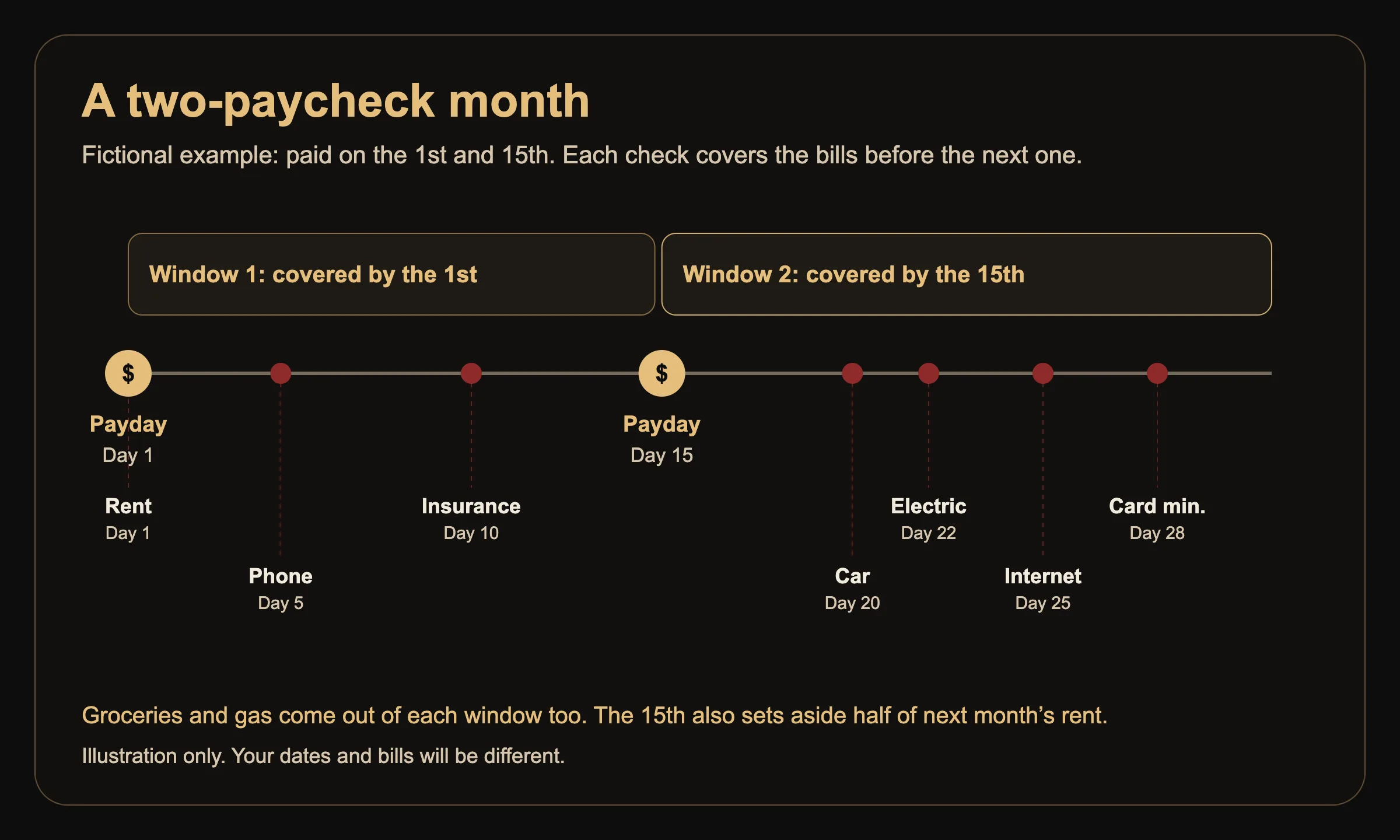
The Consumer Financial Protection Bureau has a free bill calendar tool for exactly this. You can also use your phone calendar, a notebook or the timeline chart below. The format matters less than doing it every payday.
Step 3: Cover the essentials first
Once you know what’s due, decide what gets paid first. If everything fits, great. If it doesn’t, the order matters.
The CFPB’s guide to prioritizing bills suggests thinking about what happens if each bill goes unpaid, and starting with the ones that protect your basic needs and your ability to earn:
Bills that protect your income. Getting to work, like a car payment, gas or transit fare, plus things like childcare or work equipment.
Housing and utilities. Rent or mortgage, electricity, gas, water.
Insurance. Car, health, renters or homeowners.
Court-ordered payments. Like child support.
Food and basic needs. Groceries and household essentials.
Credit cards and other loans usually come after those in that guide, but they still matter, because missed payments can bring late fees, higher interest and credit damage. The guide’s key point is to avoid simply paying whoever is pushing hardest, and instead to know the consequences of each bill.

Step 4: Set aside a little for bills that don’t come every month
Some of the biggest money stress comes from expenses that aren’t monthly: car registration, annual subscriptions, holiday gifts, school costs, a yearly insurance premium, a car repair.
They feel like surprises, but most of them aren’t. They’re just on a longer cycle.
A simple way to handle them: estimate the yearly total, divide it by the number of paychecks you get in a year, and set aside that amount each payday if you can. For example, if you expect about $780 a year in irregular costs and you’re paid every two weeks, that’s $780 ÷ 26 = $30 per paycheck.
Even a small amount helps. The point is to stop being ambushed by the same "surprise" every year. This guide goes deeper on bills that don’t come every month.

Step 5: Decide what happens to the rest
If anything is left after Steps 2 through 4, give it a job on purpose. Some common jobs:
A buffer. A small cushion in checking so one unexpected charge doesn’t cause an overdraft.
Emergency savings. Money set aside in a separate place for real emergencies.
Paying down debt. Extra toward a balance, beyond the minimum.
Goals. A trip, a new piece of equipment, moving costs.
Guilt-free spending. Money you’re allowed to spend without second-guessing.
Investing, if it fits your situation. If you’re putting money into an investing or retirement account, the Money Map explains what’s actually inside those accounts, and this guide explains the difference between a 401(k), an IRA and a brokerage account.
How you split it is up to you, and the right mix depends on your situation. What matters is that the leftover money doesn’t just quietly disappear.
Example 1: paid weekly, and the numbers work
Here’s a fictional example. The names and numbers are made up to show the process, not to suggest what anyone should spend.
Jordan is paid weekly. Take-home pay this week is $700. The next paycheck is in seven days.
Jordan’s rent is $1,200 and due on the 1st. To avoid one paycheck carrying all of it, Jordan sets aside $300 from each of the four paychecks before rent is due.
Here’s what’s due or needed before the next payday:
Phone bill: $55
Car insurance: $120
Groceries and gas for the week: $175
Rent set-aside: $300
Irregular-expense set-aside: $30
That adds up to $680. Jordan has $20 left, which goes into the checking buffer.

Not much room, but everything due is covered, rent is being built up ahead of time and the irregular-expense fund is growing. That’s a working paycheck.
One thing to watch: in months with five Fridays, Jordan gets an extra paycheck. Because rent is already covered by the first four, that fifth check can go toward savings, debt or the next month’s rent set-aside.
Example 2: paid twice a month, and it doesn’t stretch
Maya is paid on the 1st and the 15th. Each paycheck is $1,400 after taxes and deductions. This is the paycheck on the 15th, which has to cover the 15th through the end of the month.
Maya’s rent is $1,300, due on the 1st. To avoid the paycheck on the 1st carrying all of it, Maya sets aside half from each check.
Due or needed before the next payday:
Car payment (due the 20th): $310
Electric bill (due the 22nd): $90
Internet (due the 25th): $65
Groceries and gas for two weeks: $320
Credit card minimum (due the 28th): $45
Rent set-aside for the 1st: $650
That totals $1,480. Maya has $1,400. That’s $80 short.
This happens to a lot of people, and it isn’t a character flaw. It’s math. Here’s how Maya might work through it.
When the numbers don’t stretch
If your paycheck doesn’t cover everything due before the next one, these are some of the options people commonly use. Which ones make sense depends on your situation.
Look at the essentials list first. Using the CFPB’s approach, Maya knows the car payment protects getting to work, rent and electricity protect housing, and food is non-negotiable. Those come first.
Look for flexible amounts. Groceries and gas are estimates. Could $320 become $280 for these two weeks by planning meals around what’s already at home?
Check for anything that can pause. Subscriptions, takeout, a nonessential purchase. Maya cancels one streaming service, for example.
Call before you miss a payment, not after. Many companies will talk about a due date change, a short extension or a payment plan if you reach out early. The CFPB tool also recommends contacting creditors if you can’t pay, rather than ignoring the bill. There’s no guarantee, but asking costs nothing.
Ask about moving due dates for the future. Some lenders and service providers let you change your due date. Lining bills up so they fall right after each paycheck can make every month easier to manage.
Use the buffer if you have one. That’s what it’s for. Then rebuild it next payday.
Look into help if it’s more than a one-time gap. Calling or texting 211 can connect you with local assistance programs in many areas, and nonprofit credit counseling and housing counseling services can help you look at the bigger picture.
Be careful with expensive borrowing. Some quick-cash options come with high fees or interest that can make the next paycheck even tighter. Before using one, read the full cost carefully.
In Maya’s case, trimming groceries by $40, canceling one $15 subscription and calling the internet provider about moving the due date to the 2nd covers the gap. Next month, Maya might also ask the car lender about a due date closer to the 15th.
Not every shortfall closes that neatly. But walking through it step by step is better than finding out from an overdraft notice.

Adjusting the routine to how you get paid
The five steps stay the same. A few details shift depending on your schedule.
Weekly. Your windows are short, so bills land in fewer of them. Splitting large monthly bills across four checks, like Jordan’s rent, keeps any one week from getting crushed. Plan for the months with a fifth payday.
Every two weeks. Most months have two paychecks, but usually two months a year have three. Some people budget as if every month has two, then use the third check to build savings, pay down debt or get a month ahead.
Twice a month. The dates are predictable, which helps. Look for bills that all land in one half of the month, and consider asking to move some of them so each paycheck carries a similar load.
Monthly. One paycheck has to last a long time. It can help to move money for later weeks into a separate account or envelope right away, so the first week doesn’t quietly eat the fourth.
Irregular income (freelance, gigs, creative work). If your income changes from month to month, the routine still works, but the starting point is different. Many people with irregular income figure out their bare-minimum monthly costs first, then pay themselves a steady amount from a separate account when money comes in, keeping the extra for slower months. If you’re self-employed, taxes may not be withheld from what you’re paid, so it’s worth learning what applies to you from the IRS or a tax professional before you spend the whole deposit.
Common payday mistakes
A few patterns trip up a lot of people. Spotting them is half the fix.
Spending first, planning second. The first purchase after payday often feels free. Running the routine before you spend anything changes that.
Only thinking about this week. Paying today’s bills while forgetting the one due the day before your next check is how overdrafts happen. That’s why Step 2 looks at the full window.
Forgetting the small automatic stuff. A few subscriptions can quietly add up. Seeing them listed every payday makes it easier to cut the ones you don’t use.
Treating irregular costs as emergencies. Car registration and holiday gifts come every year. Setting a little aside each payday turns them from emergencies into plans.
Not leaving any buffer. Running checking down to almost zero leaves no room for a charge that posts a day early or a bill that’s slightly higher than expected.
Avoiding the numbers when they’re bad. It’s tempting not to look when money is tight. But a hard look on payday is easier than a surprise later in the week.
Make it a habit, not a project
The routine works because you repeat it. A few things make it easier:
Same time, every payday. Put a recurring reminder on your phone for payday or the morning after.
Keep the bill list in one place. A note on your phone, a page in a notebook or a printed calendar. Update it whenever a new bill appears or an old one ends.
Use automatic payments carefully. Autopay can prevent missed payments, but only if the money is there. Keep autopay dates in your bill list so they don’t surprise you.
Review once a month. Are your grocery estimates realistic? Did any new subscriptions sneak in? Did a bill go up?
Give yourself credit. Running the routine on a hard month is a win, even if the numbers aren’t pretty.
If money stress is draining the energy you need for your creative work, My Job Takes All My Energy talks about that side of it. If you’re building extra income, Why Aren’t My Digital Products Selling? and How Do I Build a Portfolio When I Don’t Have Clients Yet? are good next reads. And everything money-related on this site lives in Money & Making.
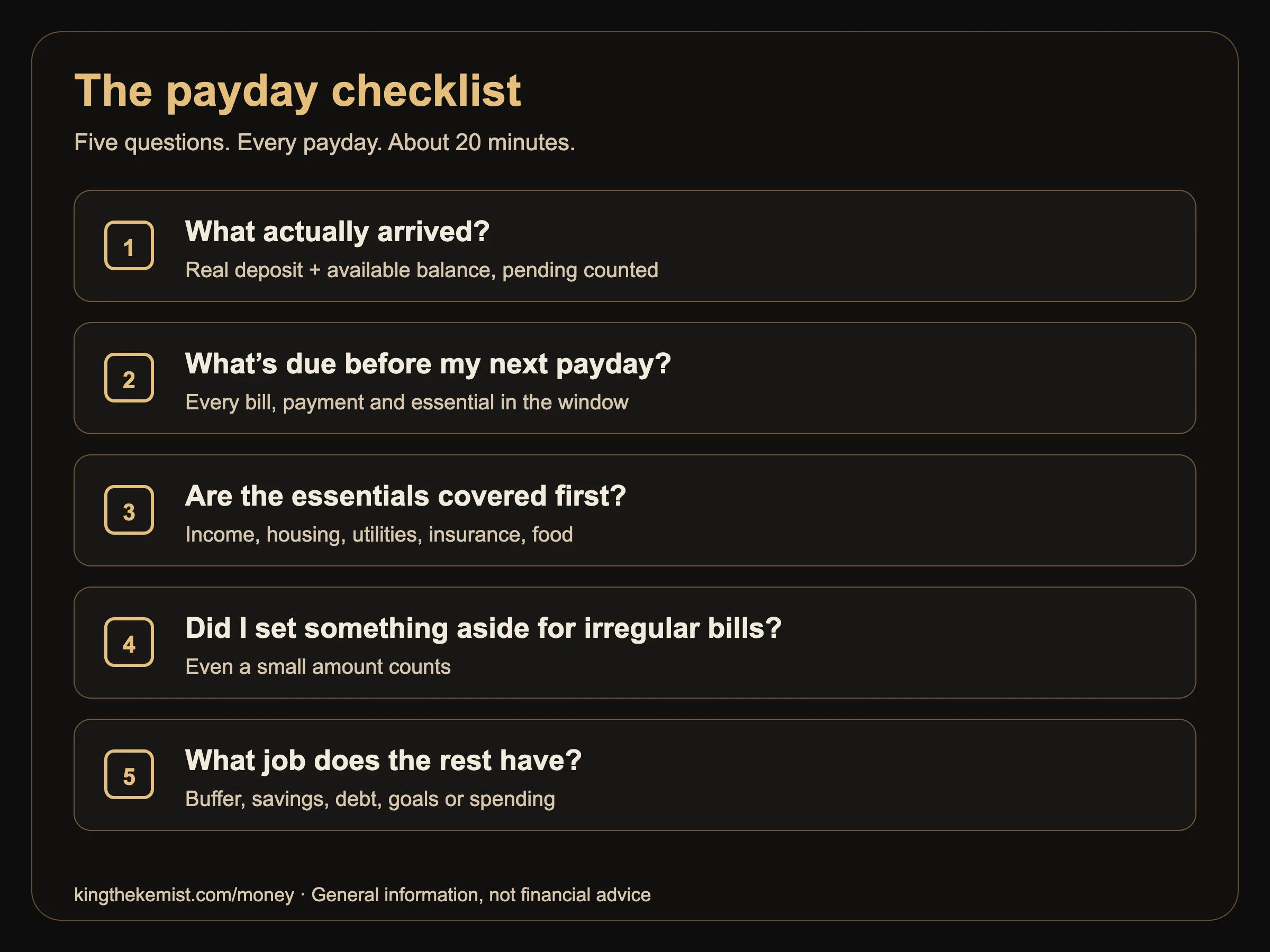
The payday checklist: save this
Screenshot this section or bookmark this page and run through it every time you get paid.
1. What actually arrived? The real deposit amount and your available balance, with pending charges accounted for.
2. What’s due before my next payday? Every bill, payment, subscription and essential in the window.
3. Are the essentials covered first? Income-protecting costs, housing and utilities, insurance, court-ordered payments, food.
4. Did I set something aside for irregular bills? Even a small amount.
5. What job does the rest have? Buffer, savings, debt, goals or spending, chosen on purpose.
If you can answer all five, you ran the routine. That’s the whole thing.
Quick answers
What should I do as soon as I get paid? Confirm the actual deposit and your available balance, then list every bill and essential due before your next paycheck. Cover essentials first, set something aside for irregular bills if you can, and decide on purpose what happens to anything left.
How do I budget if I’m paid every two weeks but my bills are monthly? One common approach is to list which bills fall between each pair of paydays and split larger monthly bills, like rent, across the paychecks before they’re due. In months with a third paycheck, many people use that extra check for savings, debt or getting ahead on next month.
What bills should I pay first if I can’t pay everything? The CFPB suggests thinking about what happens if each bill goes unpaid, and considering first the bills that protect your income, housing, utilities, insurance, court-ordered obligations and basic needs. Contact creditors before you miss a payment if you can.
What’s the difference between available balance and current balance? Your current balance usually reflects posted transactions, while your available balance generally accounts for pending transactions and holds. Exact definitions vary by bank, so check yours.
Should I invest my paycheck? That depends on your whole situation, and this article can’t answer it for you. If you do invest, the Money Map explains what’s inside an investing account. For personal advice, talk to a qualified professional.