Money & Making
How Do I Build a Portfolio When I Don't Have Clients Yet?
You need a portfolio to get clients, and clients to get a portfolio. That loop is real, but it's breakable. Here's how to build proof of your skills honestly, from zero.

You can design. Or edit video. Or write, shoot photos, build websites, mix tracks, run social accounts, make thumbnails. You know you can do the work.
But every gig post, every job listing and every potential client asks the same thing: "Can I see your portfolio?"
And you don’t have one. Not because you’re not good, but because nobody has paid you yet.

That’s the loop. No clients, so no portfolio. No portfolio, so no clients. A lot of people sit inside that loop for months, waiting for someone to take a chance on them first.
Here’s the good news: a portfolio doesn’t have to be a list of past clients. It has to be proof. Proof that you can do the work, proof that you can think through a problem, and proof that you can be trusted. You can build all three without a single paying client, as long as you do it honestly.
This article walks through how. It’s general information about building a creative or freelance portfolio, not legal advice. If you’re working with real brands, trademarks or contracts, check the specifics for your situation. The images in this article are AI-generated illustrations, not photos of real client work.
Why proof matters more than your résumé
Hiring is shifting toward showing what you can do, not just listing where you’ve been.
In TestGorilla’s State of Skills-Based Hiring 2025 survey of 1,084 employers in the US and UK, 85% said they use skills-based hiring, up from 81% the year before, while the share using résumés dropped from 73% to 67%. TestGorilla sells skills-testing tools, so keep that in mind, but the direction matches other research.
The National Association of Colleges and Employers found that 64.8% of surveyed employers use skills-based hiring practices for new entry-level hires, based on its Job Outlook 2025 survey of 237 employers. That research is about college hiring, not freelancing, and it focuses on things like interview rubrics and assessments rather than portfolios. But the message for anyone starting out is the same: people want to see evidence of skill.
On the freelance side, the field is crowded. Upwork’s 2023 Freelance Forward study estimated that 64 million Americans freelanced in 2023, about 38% of the U.S. workforce, and that 47% of freelancers provided knowledge services like programming, marketing and consulting. That’s a lot of people saying "I can do this." A portfolio is how you show it instead of saying it.
So the goal isn’t to look experienced. It’s to make your skill easy to see.

What a portfolio actually needs to prove
Before you make anything, it helps to know what a portfolio is for. Most people who review one are quietly asking three questions:
Can you do the work? Is the quality there? Does it look, sound or read like something they’d pay for?
Can you think? Do you understand why you made the choices you made? Can you solve a problem, not just make something pretty?
Can I trust you? Are you honest about what you did? Do you communicate clearly? Would working with you be easy?
Client logos help with the third question, but they aren’t the only way to answer it. Clear explanations, honest labels and well-documented process can do a lot of that work too.
That’s why a strong beginner portfolio is often built around a few deep pieces with real explanations, rather than a big grid of images with no context.
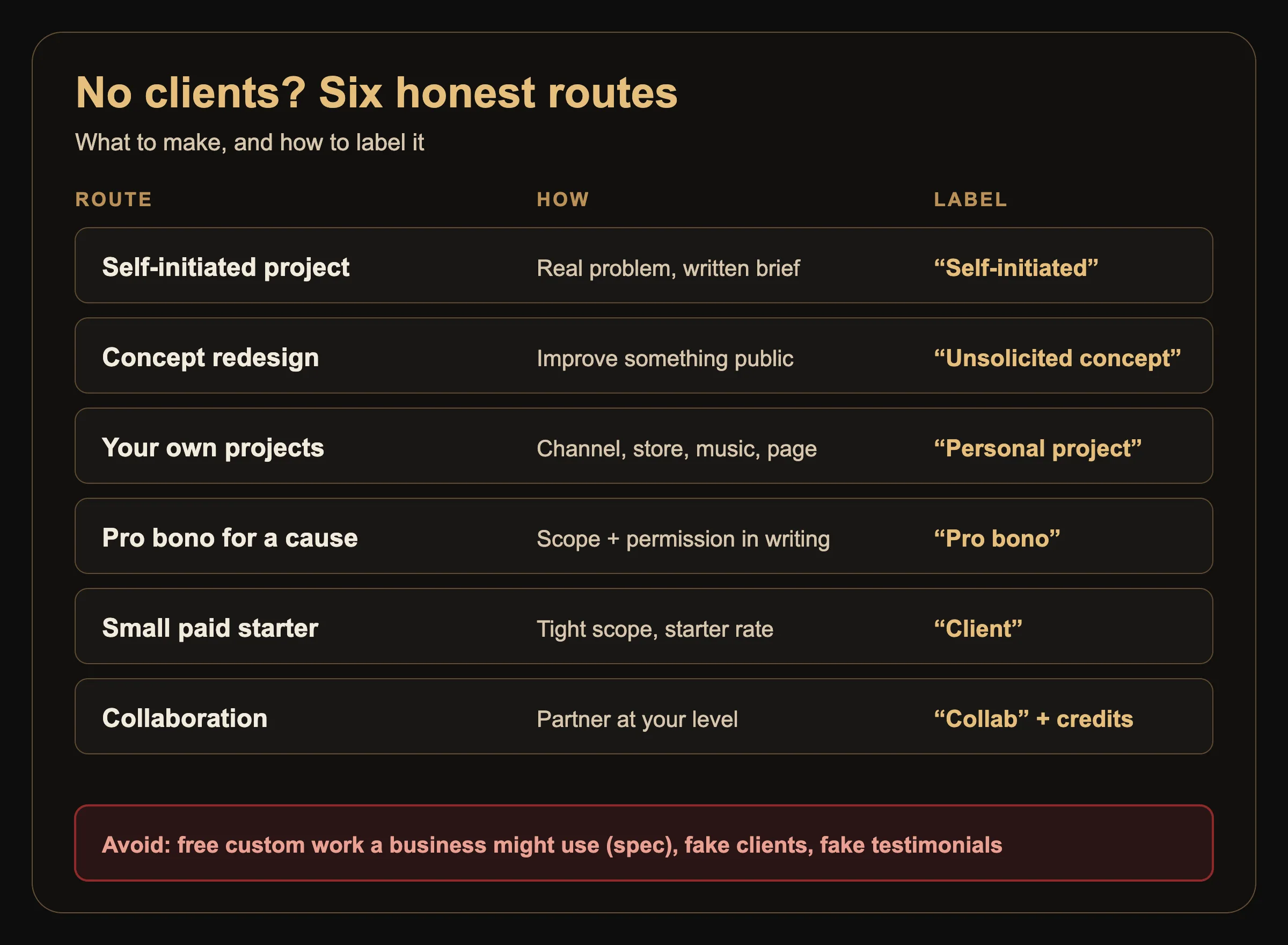
Six ways to build portfolio pieces without clients
1. Self-initiated projects with a real brief
This is the most flexible option. You pick a real problem and solve it as if someone hired you.
The key is the brief. "I made a logo" is weak. "A neighborhood coffee shop with no online presence needs a simple identity and menu that works on Instagram and on a printed board" is a project.
Write yourself a short brief before you start:
Who is this for? Describe the audience.
What’s the problem? One or two sentences.
What are the constraints? Budget, platform, timeline, format, tone.
What does success look like? How would you know it worked?
Constraints are what make it feel real. Real client projects almost always have them, so your self-initiated work should too.

Label these clearly as self-initiated or concept projects. That’s not a weakness. It shows initiative, and it keeps you honest.
Self-initiated work gives you control of the brief and the process. It doesn’t automatically mean you hold every right in everything inside it. Stock photos, fonts, music, footage, a collaborator’s contributions and AI-generated elements can all come with their own licenses or terms, so check what you’re allowed to do with each before you publish.
2. Concept redesigns of things that already exist
Pick something public that could be better, like a confusing app screen, a cluttered website, a weak album cover, a boring product label or a slow-paced YouTube intro, and show how you’d improve it.
This works well because the reviewer can compare the before and the after. It shows judgment, not just taste.
A few cautions:
Label it as an unsolicited concept. Make it clear the brand didn’t hire you and isn’t affiliated with the work.
Be careful with real logos and trademarks. Using a company’s brand in a way that suggests they endorsed you can cause problems. When in doubt, use a fictional brand inspired by the real problem.
Credit isn’t permission. Labeling a redesign honestly and naming the original is the right thing to do, but it doesn’t give you permission to use someone else’s protected work. Their photos, illustrations, copy, logos and other assets still belong to them. Recreate placeholders, use your own material or use assets you’re licensed to use.
Don’t trash the original. Explain what you’d change and why, respectfully. The people who made the original might be the people reviewing your work someday.
3. Your own projects, with real results
If you run your own channel, page, store, podcast, newsletter, music project or side business, that’s real work with real stakes. It can be some of the strongest material in your portfolio, because it comes with real outcomes.
A video editor who grew their own channel can show retention graphs. A designer who built their own product page can show before-and-after conversion changes. A marketer who ran their own small campaign can show what happened, even if the numbers are small.
Small numbers are fine. What matters is that they’re real and that you explain what you did and what you learned. If you write about selling your own products, the diagnostic in Why Aren’t My Digital Products Selling? can double as a case study framework.
4. Pro bono work for a cause you care about
Nonprofits, community groups, local events, churches, schools and mutual aid groups often need creative help and can’t afford it. Doing a real project for them gives you a real client, real feedback and a real outcome.
AIGA, the professional association for design, separates speculative work from other kinds of unpaid work like volunteer work, internships and pro bono work for the public good. It leaves the decision to the designer and client, while pointing out the risks.
If you do pro bono work, treat it like paid work:
Agree on the scope in writing. What you’ll deliver, how many revisions, and the timeline.
Ask up front whether you can show it in your portfolio. Most groups say yes, but ask.
Ask for honest feedback afterward. If they’re happy, ask whether they’d be willing to give a short testimonial in their own words.

5. Small, clearly scoped starter projects
Instead of working for free for businesses, consider small paid projects at a starter rate with a tight scope. A single social graphic set, a short edit, one landing page section, a cover design.
Even a modest fee changes the dynamic. Both sides take it more seriously, you get to practice the business side (scope, invoices, deadlines, communication), and it counts as real client work.
Be clear that it’s a starter rate for a defined scope, so you’re not stuck at that price forever.
6. Collaborations with other creators
Find someone at a similar stage in a skill next to yours. A photographer and a stylist. A beatmaker and a video editor. A writer and a designer. Make something together.
Both of you get a finished piece, both of you learn how to work with someone else, and both of you can credit each other. Just be honest about who did what when you present it.
What to avoid
Building from zero is fine. Faking it isn’t. A few things can damage trust fast.
Spec work that a client didn’t pay for
AIGA defines speculative work as work done before engagement with a client "in anticipation of being paid." Think contests, "send us a sample logo and we’ll pick one," or "do this test project for free and we’ll see."
AIGA points to three risks: lower-quality outcomes because spec work often skips research and testing, designers being exploited and their work undervalued, and possible intellectual property problems for both sides.
This is different from self-initiated work, where you control the brief, the process and what happens to the result (subject to any stock, collaborator or AI tool terms inside it). It’s also different from an agreed volunteer or pro bono project, where both sides know up front that the work is unpaid, the scope is set and you can show it. Spec work is the unpaid work you do in the hope of winning a paid job, often for a business that could use your work whether or not they hire you. That’s the deal worth thinking carefully about before you say yes.
Fake clients, fake results and fake testimonials
Don’t invent clients, inflate numbers or write testimonials for people who never gave them.
Beyond the trust problem, there are rules around this. In August 2024, the Federal Trade Commission announced a final rule banning fake reviews and testimonials, including testimonials from people who don’t exist (such as AI-generated ones), from people who never actually used the business, or that misrepresent someone’s experience.
If the work is self-initiated, say so. If a testimonial is real, use it as written. If you don’t have testimonials yet, leave that section out. Honest and small beats impressive and fake.
Copying someone else’s work
Recreating a famous piece for practice is a time-honored way to learn. But putting it in your portfolio as if it were original work is a problem. If you include a study or recreation, label it clearly and credit the original.
Keep in mind that credit isn’t the same as permission. Naming the original artist is honest, but it doesn’t authorize you to publish their protected work. For anything you plan to post publicly, especially a close recreation, it’s safer to keep it as private practice or get permission.
How to present each piece
The work is only half the portfolio. The other half is the explanation. A short case study for each piece shows how you think, which is exactly what reviewers are trying to figure out.
You don’t need an essay. A simple structure works:
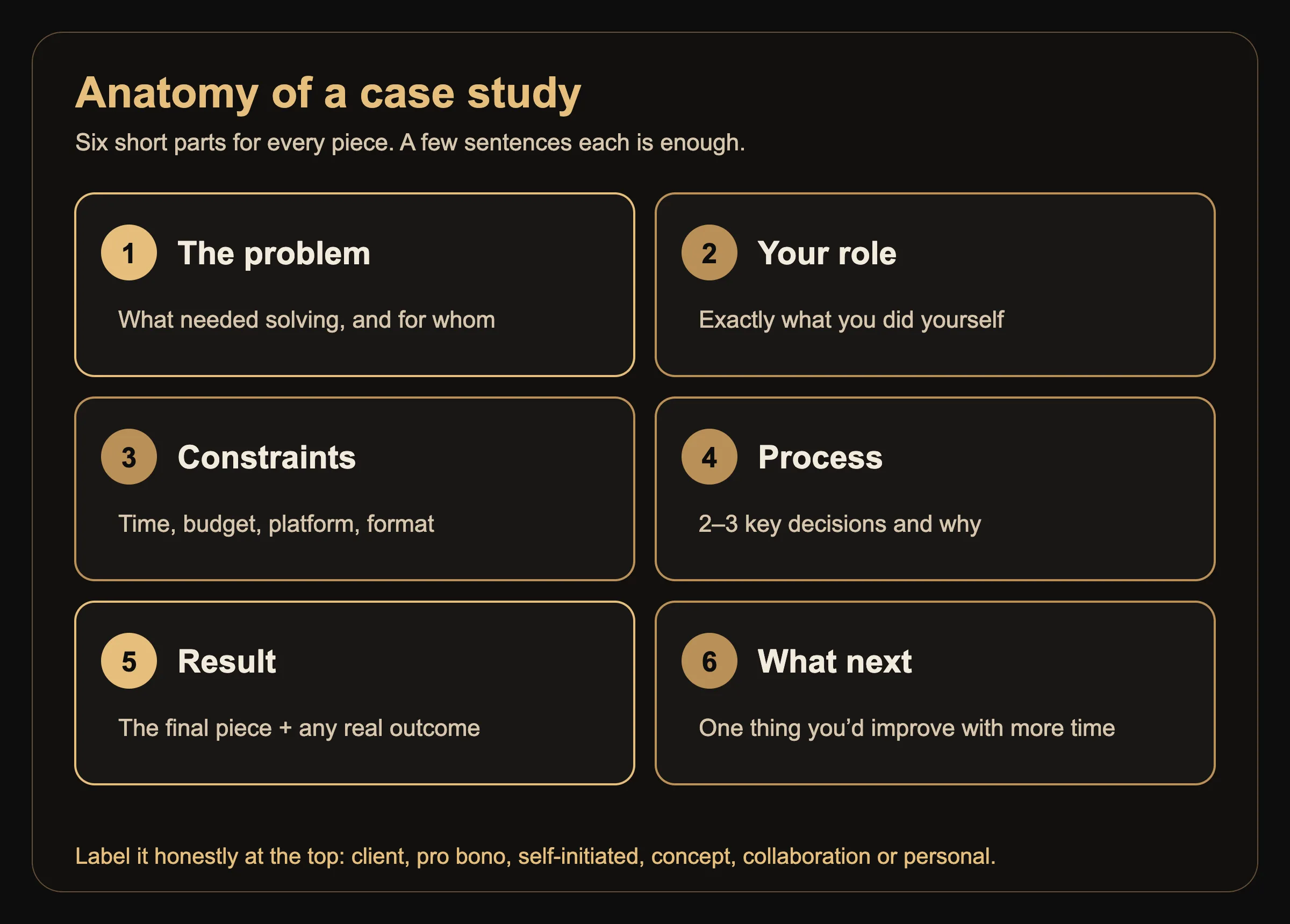
The problem. What needed to be solved, and for whom. One or two sentences.
Your role. What you did yourself. Be specific, especially on collaborations.
Constraints. Time, budget, platform, format, any limits you worked within.
The process. Two or three key decisions and why you made them. Show a rough sketch or early version if you have one.
The result. The final piece, plus any real outcome. If it’s a concept, say what you’d measure if it were live.
What you’d do next. One improvement you’d make with more time. This shows maturity, not weakness.
Label every piece honestly
One of the easiest ways to build trust is to label each project for what it is. A simple tag at the top of each case study does it: Client, Pro bono, Self-initiated, Concept redesign, Collaboration or Personal project.
Reviewers aren’t put off by self-initiated work. What tends to hurt is discovering later that something was presented as client work when it wasn’t.

Quality over quantity
There’s no official number, but many reviewers would rather see a handful of strong, well-explained pieces than a wall of everything you’ve ever made. A common starting point is somewhere around three to six solid projects. Pick work that matches the kind of job or client you want next, not just your favorite pieces.
If you want video editing clients, lead with editing. If you want brand design work, lead with brand projects. Your portfolio should point in the direction you want to go.
What this looks like in different crafts
The same principles apply everywhere, but the pieces look different depending on what you do.
Graphic and brand design. A small identity system for a fictional or real local business, a concept redesign of a cluttered package or menu, and one piece of your own work. Show the system, not just the logo: colors in use, a social post, a sign or a label.
Video editing. Re-edit footage you shot yourself or footage you have permission to use, like a short brand-style piece, a fast-paced short and a longer story edit. Include a before-and-after or a short breakdown of your choices.
Writing and copywriting. Rewrite a weak product page or email as a labeled concept, write articles for your own blog and offer pro bono copy to a local nonprofit. Show the original problem next to your version.
Photography. Build small, consistent sets, like a product series, a portrait series and an event or street series, instead of a random mix of single shots. Get model releases where needed.
Web development. Build a small working site or tool that solves a real problem, publish the code where appropriate and explain the decisions you made.
Music production and audio. Produce for your own releases, collaborate with an artist at your level, or remix stems that are officially released for remixing. Check the rules before you post any remix publicly.
Whatever your craft, the formula stays the same: a real problem, honest labels and a clear explanation.
Where to put your portfolio
You have a lot of options. Each has trade-offs.
Your own website. Most control over how your work is presented, and it’s yours no matter what happens to any platform. It takes more setup, but it’s a long-term asset. A simple site with a clean case study page per project is enough to start.
Portfolio platforms. Behance, Dribbble, ArtStation, Contra, GitHub for developers, and others. They’re quick to set up and some have built-in discovery, but you’re working inside their layout and rules.
LinkedIn’s Featured section. Useful if your clients or employers live on LinkedIn. You can link case studies and upload samples.
A simple PDF or shared document. Good for sending to a specific person, especially if you tailor it to their needs.
Many people use a combination: a platform for discovery and their own site as the home base that everything links back to.
Turning the portfolio into your first clients
A portfolio sitting on the internet doesn’t do much on its own. It works best as the thing you point to when you reach out.
Be specific about who you help. "I’m a designer" is easy to ignore. "I design menus and social graphics for small restaurants" is easier to remember and easier to refer.
Reach out with something relevant. When you contact a potential client, link the one or two pieces closest to what they need, not your whole portfolio.
Use your network. Friends, family, former coworkers and people you’ve collaborated with often know someone who needs help. Tell them exactly what you do.
Share the process publicly. Posting how you made a piece, not just the final result, shows your thinking and keeps your work in front of people.
Keep adding. Every real project, even a small one, can replace a self-initiated piece over time. The portfolio is never finished.

If finding time for all this is the hard part, My Job Takes All My Energy. How Do I Keep Creating? breaks down working by energy level instead of hours. And if putting your work out there at all feels scary, I Finished the Song. Why Am I Afraid to Release It? gets into that fear.
A simple 30-day plan
If you want structure, here’s one way to go from nothing to a working portfolio in about a month. Adjust the pace to your life.
Week 1: Decide and brief. Pick the type of work you want to get hired for. Write three short briefs: one self-initiated project, one concept redesign and one piece from your own work or a pro bono project.
Week 2: Make the first piece. Complete one project fully, start to finish. Save early sketches and versions as you go.
Week 3: Make pieces two and three. Finish the other two. Done beats perfect.
Week 4: Write it up and publish. Write a short case study for each piece using the structure above, label each honestly and publish them somewhere you can link. Then send it to five people who might need what you do or know someone who does.
Three honest, well-explained pieces and five conversations is a real start.
The checklist: save this
Bookmark this page or screenshot this section and check your portfolio against it.
1. Does every piece point toward the work you want to be hired for?
2. Does every piece have a short explanation: problem, role, constraints, process, result?
3. Is every piece labeled honestly (client, pro bono, self-initiated, concept, collaboration, personal)?
4. Are all numbers and testimonials real and used with permission?
5. Are real brands, logos and other people’s work used carefully, labeled and credited?
6. Can someone find it, open it on a phone and contact you within a minute?
7. Have you actually sent it to someone this month?
If you can say yes to all seven, your portfolio is doing its job, whether or not it has a single client logo on it.
Quick answers
Can I have a portfolio without any clients? Yes. Self-initiated projects, concept redesigns, your own projects, pro bono work and collaborations can all go in a portfolio, as long as you label them honestly.
Is it okay to redesign a real company’s work for my portfolio? Concept redesigns are common, but label them as unsolicited concepts, make it clear the company isn’t affiliated, and be careful about using real logos in a way that suggests endorsement. Crediting the original doesn’t give you permission to use its protected photos, art or copy, so use your own material or licensed assets.
Should I work for free to build my portfolio? It depends on the kind of free. Unpaid work you do in the hope of winning a paid job, like a contest entry or a "free sample" for a business, is spec work, and AIGA points out real risks. An agreed volunteer or pro bono project, where the scope is set and both sides know it’s unpaid, is a different arrangement. Self-initiated projects and small paid starter projects are other ways to build experience.
How many projects should a beginner portfolio have? There’s no official number. A handful of strong, well-explained pieces, often around three to six, tends to be more useful than a large collection with no context.
Can I write my own testimonials or use made-up results? No. Testimonials should come from real people describing their real experience, and results should be real. The FTC’s 2024 rule bans fake reviews and testimonials.