Creative Chemistry
I Finished the Song. Why Am I Afraid to Release It?
I've held songs back more than once. Here's what was really going on, and the one thing that finally gets me to hit release.
The song is done.
The beat is right. The vocals are right. You’ve listened to it in the car, in the shower, on cheap earbuds and on good headphones. You know it’s done.
And it’s just sitting there.
Not because it’s bad. Because putting it out means people will hear it. And once people hear it, they get to have an opinion about it.
Have I held back songs because I was nervous about how people would take them? Yes. More than once.
So if you’ve got a folder of finished music that nobody has heard, I get it. This one is for you. Let’s talk about why it happens, what the research says about artists and pressure, and the one thing that actually gets me to hit release.
Spoiler: it’s not complicated. 😂
Finishing and releasing are two different things
I wrote about getting into a creative zone in Creative Flow. Flow is about starting and making. This is a different problem.
Making music is private. It’s you, the beat and your thoughts. Nobody is judging you while you work. You can try anything.

Releasing music is public. It’s the moment the song stops being yours alone. Now it belongs to anybody who presses play.
That’s a big shift. And a lot of artists who have no trouble making music get stuck right at that line.
It’s also why "just finish it" isn’t helpful advice for this. The song is finished. The problem is what comes next.
Why releasing feels so scary
When I sit with it honestly, the fear usually comes down to a few things.
You put yourself in it. A song isn’t a spreadsheet. If it’s real, there’s a piece of you in there: something you felt, something you went through, something you were scared to say out loud. Releasing it can feel like letting strangers read your journal.
Silence feels worse than criticism. A lot of artists say the scariest response isn’t a bad review. It’s nothing. You release the song and the world just keeps scrolling.
People you know will hear it. Strangers are one thing. Your family, your coworkers, your old classmates, your ex? That’s a different kind of pressure.
It might not be your best. There’s always a voice saying, "Wait, the next one will be better. Release that one instead."
Once it’s out, it’s out. Before release, the song can be anything. After release, it is what it is. Some artists hold back because they like the song better as a possibility.
If any of those sound familiar, you’re in good company.
Musicians are under real pressure
This isn’t just in your head.
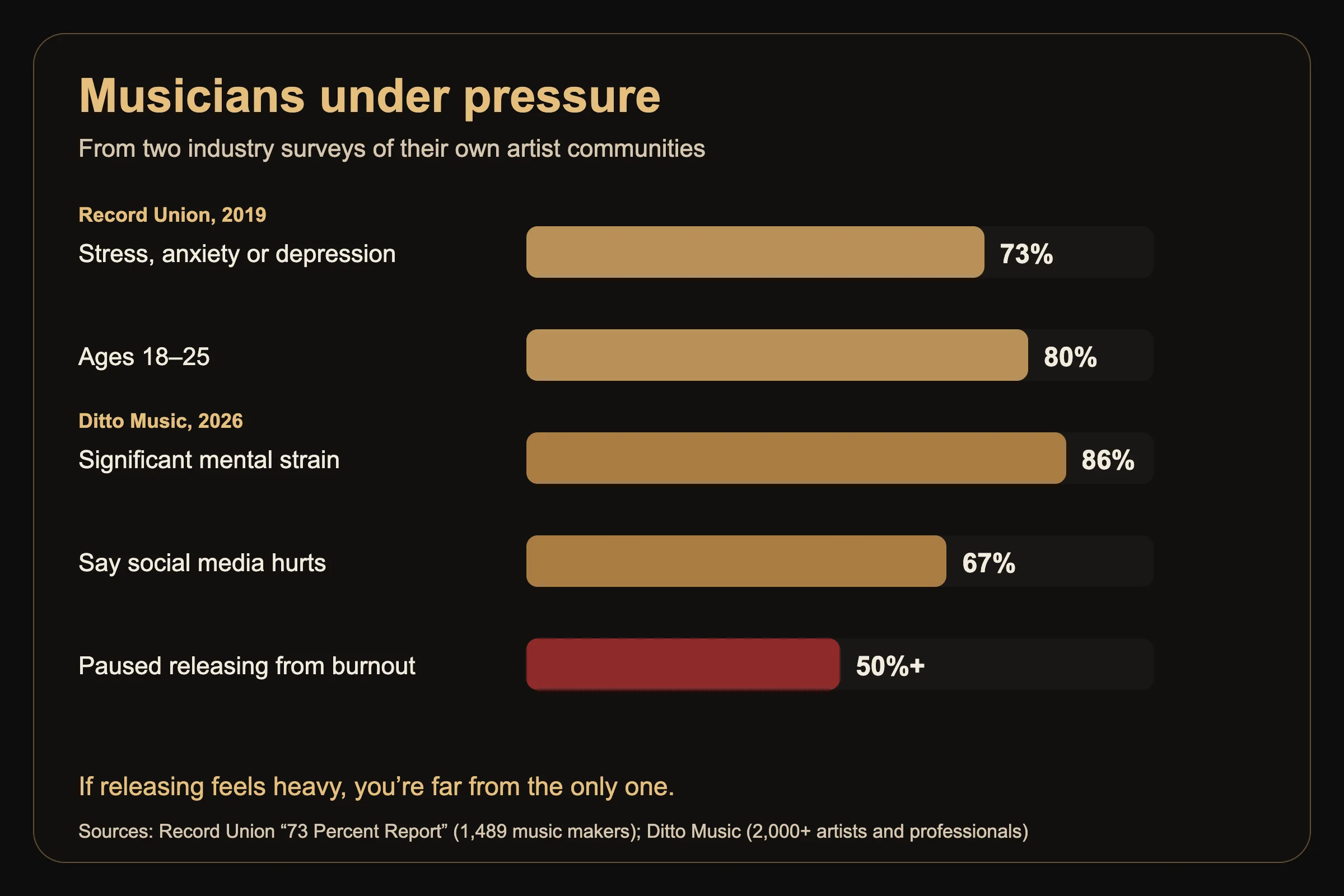
In 2019, the music distribution company Record Union surveyed 1,489 independent music makers around the world. In its "73 Percent Report," 73% said they had experienced stress, anxiety or depression related to making music. Among those aged 18 to 25, it was 80%. The top reasons included fear of failure, financial instability, and pressure to succeed and deliver.
More recently, Ditto Music reported in 2026 that 86% of more than 2,000 artists and music professionals in its community said they had experienced significant mental strain at some point. Two-thirds said social media hurt their mental well-being. And more than half said burnout had led them to pause releasing music.
A quick note on these numbers: both come from music companies surveying their own communities. They’re not random samples of every musician. But they line up with what a lot of artists say out loud: making music is the fun part, and everything around releasing it can be heavy.
So if you feel pressure around putting music out, that’s a common reaction to a stressful part of the job. It doesn’t mean you’re weak or not cut out for this.
The numbers that freak people out
Here’s a stat that sounds discouraging at first.
According to Luminate’s 2024 year-end report, as covered by Music Business Worldwide, there were 202 million tracks on audio streaming services. About 99,000 new tracks were delivered to streaming services every day. And 93.2 million tracks had been played 10 times or fewer.
Ninety-nine thousand songs a day.
The first reaction is usually, "Then why bother? Nobody is going to hear mine."
But flip it around. If that many songs are coming out every single day, nobody is sitting there waiting to judge yours specifically. The pressure you feel, that everybody is watching, isn’t how it actually works. Most people are busy living their lives.
That’s freeing, if you let it be. You don’t need the whole world to notice. You need the right people to find it. And they can’t find it in a folder on your laptop.
Perfectionism: the good kind and the stuck kind
A lot of the "not ready yet" feeling comes from perfectionism.
Psychologists who study perfectionism often split it into two parts. One is perfectionistic strivings: setting high standards and pushing yourself to reach them. The other is perfectionistic concerns: worrying about mistakes, doubting yourself, and fearing what others will think.
In a 2007 study of young musicians, psychologists Joachim Stoeber and Ulrike Eismann found that the strivings side was tied to more motivation, effort and achievement, while the concerns side was tied to more distress.
That matches my experience. High standards are what make the song good. Fear of judgment is what keeps the good song in the vault.
So the goal isn’t to stop caring about quality. It’s to notice which voice is talking. "This hook can be stronger" is the striving voice. Listen to it. "What if people think it’s corny?" is the concerns voice. That one doesn’t get a vote on the release date.
The "one more tweak" trap
If you make music, you know this one.
The song is done. But you go back in "just to adjust the vocal a little." Then the snare. Then the reverb. Then you change the vocal back. Three weeks later, the song sounds almost exactly the same, and it’s still not out.

At some point, tweaking stops being about making the song better. It becomes a polite way of not releasing it.
Here’s a test I like: if you can’t explain what the change makes better in one sentence, it’s probably not a real fix. It’s a delay.
I wrote about how overthinking turns into a loop in Why Do Libras Overthink Everything?. The "one more tweak" trap is the music version of that loop. Every listen gives you something new to second-guess.
The vault is real
Most artists have a vault.
Some songs in there deserve to stay there. They were practice. They taught you something, and that’s their whole job. That’s fine.
But some songs in the vault are good. They’re just scary. They’re too personal, too different from what people expect from you, or too close to something real.
I’ve had songs like that. More than once, I held something back because I was nervous about how people would take it.
A song in the vault usually doesn’t get safer with time. It just gets older. The moment you made it passes, and eventually it stops feeling like you at all.
How to clean out your vault
If you’ve got a folder full of finished songs, here’s a simple way to deal with it instead of letting it sit.
Listen with fresh ears. Wait a few days, then play each song once, all the way through, without stopping to fix anything. Just listen like a fan would.
Sort every song into one of three piles.
Release: It’s good, it’s done, and the only thing stopping you is nerves.
Rework: There’s one clear, specific problem you can name, like a weak second verse or a muddy mix. Fix that one thing, then move it to the release pile.
Retire: It was practice. It taught you something. Let it go with no guilt.
Be honest about the release pile. Most artists find more songs in it than they expected. That’s usually the fear talking, not the music.
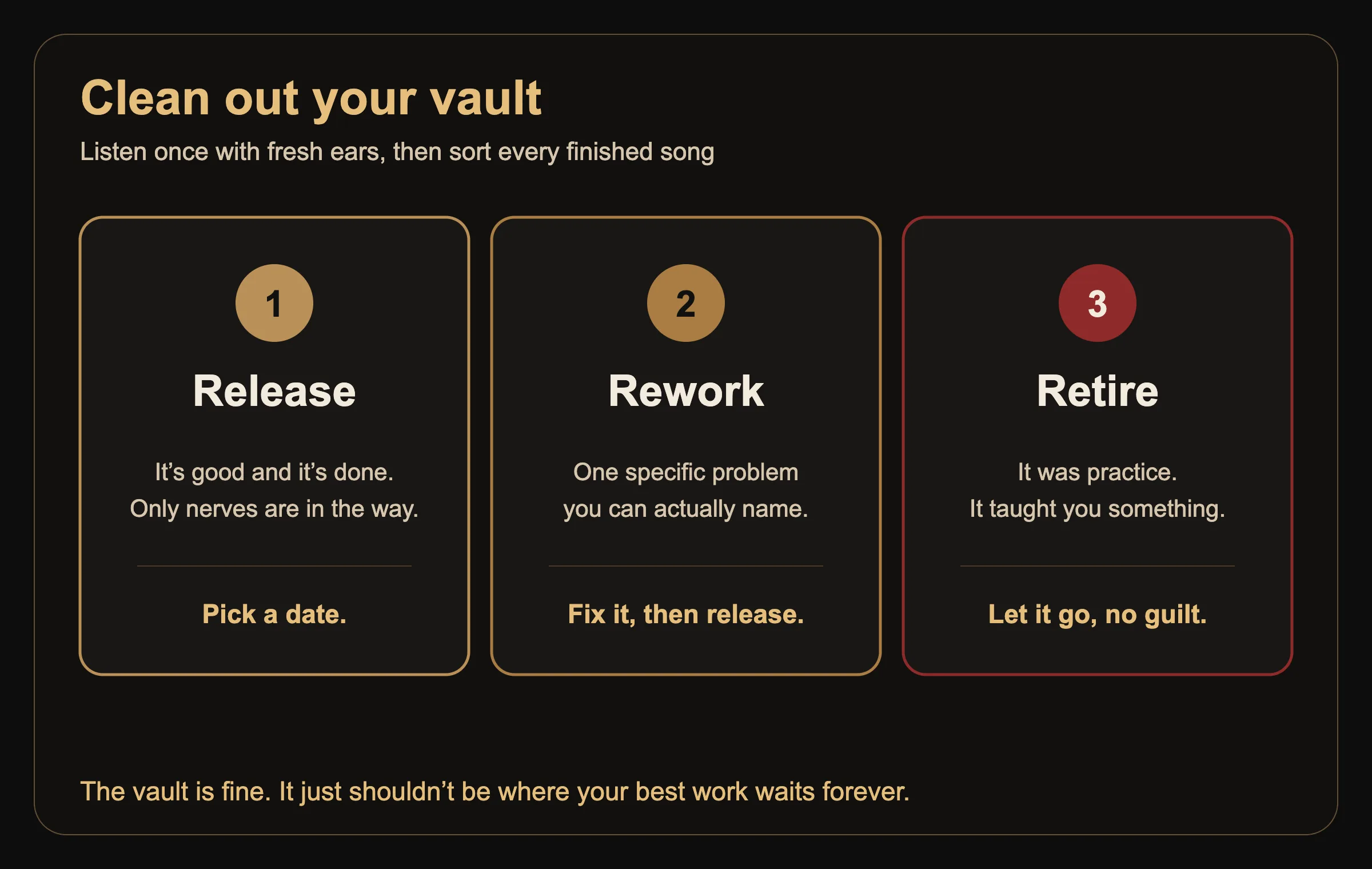
Pick one and put a date on it. Not all of them. One. Momentum matters more than a perfect order.
The vault isn’t a bad thing. It just shouldn’t be where your best work goes to wait forever.
What actually gets me to release
Here’s the honest answer. It’s not a system. It’s not a ritual.
I just do it.
At some point I stop weighing it, stop asking one more person, stop opening the session for one more tweak, and I put it out.
It’s the same thing I said about decisions in my overthinking article: more thinking usually doesn’t give you new information. It just gives you the same information again, with more nerves attached.
I’m not going to pretend I have a ten-step release plan that took the fear away. The fear doesn’t fully go away. Doing it anyway is the plan.
And once it’s out, something shifts. The song stops being a question in your head. It becomes something that exists, and you get to move on to the next one.

If "just do it" isn’t enough for you yet
"Just do it" works for me. If you need a little more structure to get there, here are some approaches that a lot of artists swear by.
Pick a date and tell someone. A deadline that only lives in your head is easy to move. A date you’ve told a friend, a producer or your followers is harder to back out of.
Set a "done" rule before you finish. Decide ahead of time what "done" means. For example: the mix is balanced, the vocals are clean, and two trusted people have heard it. When those boxes are checked, it’s done.
Get feedback from the right people. Pick one or two people whose ears you trust and who want you to win. Not everyone you know. Too many opinions is another way to never release anything.

Separate the song from your worth. A song that doesn’t blow up isn’t a verdict on you. It’s one song. Your catalog is the long game.
Start smaller. If a full release feels huge, share a snippet, a demo or a live clip first. Let a few people hear it before the whole world does.
Remember who it’s for. You’re not making music for every person on earth. You’re making it for the people it’s meant to reach. They can’t find it if it’s not out.
The difference between a song and a release
One thing that helps people is understanding that "release" doesn’t have to mean a huge event.
You don’t need a big rollout, a music video, a press push and a perfect cover for every song. Some songs get the full treatment. Some songs just need to go out.
Not every release has to change your career. Some of them just need to exist, so you can grow and move on.
That fits how I see my own different sides as an artist. Not every song has to carry the whole brand. Some songs are just a moment.
How to know a song is actually done
"Done" is one of the hardest calls in music. Here’s a checklist that helps a lot of artists stop guessing:
The song says what you meant. If somebody heard it once, would they get the feeling you were going for?
Nothing jumps out wrong. On a few different speakers, nothing sounds off: no harsh vocal, no buried hook, no weird level jump.
Your changes are getting smaller. When you’re adjusting things only you can hear, you’re polishing, not fixing.
You can’t name the problem. If something feels off but you can’t say what, take a break and come back. If it still isn’t clear, it’s probably fine.
You’re starting to hate it. Weirdly, this is often a sign it’s done. You’ve heard it so many times that your ears are tired, not that the song is bad.
If most of those are true, the song is ready. The rest is nerves.
The week you release
Releasing doesn’t end when you hit the button. A few things help the week go smoother:
Tell your people first. Send it directly to the friends and family who’ll be happy for you. Their early support matters more than a big launch.
Share it from your own home base. Your website and your link in bio are where people can find everything you do, not just the one song.
Don’t refresh the stats every hour. Check once a day at most. Watching numbers in real time is a fast way to talk yourself into regret.
Start the next song. The best cure for release nerves is having something new to work on. It reminds you this song is one step, not the whole staircase.
What fear before a release is actually telling you
I want to be fair to the fear, because it isn’t always the enemy.
Sometimes nerves before a release mean the song matters. If you didn’t care, you wouldn’t feel anything.
Sometimes the fear is pointing at something useful: the mix really does need one fix, or a lyric really is unclear. That’s the striving voice, and it’s worth a real listen.
But most of the time, the fear is just fear. It’s your brain protecting you from a risk that isn’t actually dangerous. Nobody gets hurt when you release a song. The worst realistic outcome is that fewer people hear it than you hoped. And that’s exactly what happens if you never release it at all.
Releasing music when it’s personal
Some songs are harder because they’re about real people and real moments.
If a song is about something private, it’s okay to think about who’s in it. You can change details, blur names, or write from a slightly different angle. Art doesn’t have to be a court transcript.
What I’d avoid is letting "it’s too personal" become a permanent reason to hide every song that matters. A lot of the music that hits hardest for listeners is exactly the stuff that felt too personal to release. I wrote about why certain music gives people chills in Why Does Music Give You Chills?. A lot of that comes from songs that feel honest.
What people ask about releasing music
When you look at what musicians search for and talk about, the same questions keep coming up. There’s a whole thread on r/WeAreTheMusicMakers asking why so many good artists are afraid to share their music. Here are my honest takes.
Is it normal to be scared to release music? Very. Even experienced artists feel nerves before a release. The difference is they release anyway.
How do I know when a song is finished? When your changes stop clearly improving it. If you can’t say what a tweak makes better, the song is probably done.
What if nobody listens? Some songs grow slowly. Some never take off. Both are normal. A small audience that connects with your music is still an audience, and you can’t build one with unreleased songs.
Should I wait until I have a big following to release? No. The following usually comes from releasing. Waiting until you have fans before you put out music is like waiting until you’re in shape before going to the gym.
What if people I know judge it? Some might. Most won’t think about it as much as you will. And the people who matter will usually be proud of you for putting something real out there.
Quick answers
Why am I afraid to release my music? Usually it’s fear of judgment, fear of silence, perfectionism, or the song being personal. Making music is private; releasing it is public, and that shift is uncomfortable.
How common is anxiety among musicians? Common. In Record Union’s 2019 survey of 1,489 independent music makers, 73% reported stress, anxiety or depression related to making music.
How do I stop overthinking my release? Set a "done" rule and a date, get feedback from one or two trusted people, and then put it out. More tweaking rarely changes the outcome.
How many songs are released every day? According to Luminate’s 2024 year-end report, about 99,000 new tracks were delivered to streaming services each day.
What helps King The Kemist release music? Honestly, just doing it. At some point I stop weighing it and put it out.
Let it out
Here’s where I’ve landed.
I’ve held songs back. I’ve been nervous about how people would take them. I’ve sat on finished music longer than I should have.
What gets me past it isn’t a perfect plan. It’s deciding that the song deserves to exist outside my head, and then putting it out before I talk myself out of it.
So if you’ve got a finished song sitting in a folder right now, here’s your sign. Check that it’s actually done. Pick a date. And then let it out.
The next song is waiting for you to make room. 👑