Money & Making
What Do I Actually Own in My Investing Account?
You open the app and see a balance, a list of tickers and a line called "cash." But what do you actually own? Here's a plain-English map of what's inside an investing account.

You opened an investing account. Maybe it was a brokerage app, maybe a retirement account through work, maybe an IRA you set up after leaving a job. You moved some money in.
Then you open the app and see a balance. A list of letters you may or may not recognize. A line that says "cash" or "sweep." Maybe something about dividends, pending trades or buying power.
And a quiet question shows up: what do I actually own here?

That’s a fair question, and a lot of people never get a straight answer to it. They know the number on the screen, but not what’s underneath it.
This article is a map. It walks through what’s typically inside an investing account, layer by layer: the account itself, the cash, the investments, the income they produce, the fees and the protections. It’s written in plain English for people who are new to this or who never got the basics explained.
Important: this is general educational information, not financial, investment, legal or tax advice. I’m not a licensed financial professional, and nothing here is a recommendation to buy, sell or hold anything. Every firm works a little differently, so check your own account’s documents, and talk to a qualified professional for advice about your situation. The images of me in this article are AI-generated illustrations.
Start here: the account is a container
The first thing to understand is that the account itself isn’t an investment. It’s a container.
Think of it like a safe deposit box. The box has rules about who owns it, how it’s taxed and when you can take things out. But the value comes from what’s inside it.

Some common types of containers in the U.S.:
A taxable brokerage account. A regular investing account. You can usually add and withdraw money when you want, and investment income and gains are generally taxable in the year they happen.
An IRA (traditional or Roth). An individual retirement account with special tax rules and rules about contributions and withdrawals.
A 401(k) or similar workplace plan. A retirement account offered through an employer, often with a limited menu of investment options.
An HSA. A health savings account, which some providers let you invest.
The tax rules for each are different and they change, so this article won’t go into them. The IRS website and a tax professional are the places for that. What matters here is this: whatever type of account you have, you still need to know what’s inside it. A retirement account full of uninvested cash is still mostly cash.
Layer 1: cash
Almost every investing account has some cash in it. Money you deposited. Money from a sale. Dividends and interest that got paid out. This is the layer people most often misunderstand.
Depositing money isn’t the same as investing it
When you move money into an investing account, it usually lands as cash. It doesn’t automatically become an investment just because it’s in an investing account. In most cases, someone has to choose what to buy with it, whether that’s you, an advisor, an automatic plan or a default option the account is set up with.
This trips up a lot of people. Vanguard looked at its own IRA customers and found that 28% of investors who rolled money into an IRA in 2022 were still holding that money in cash 12 months later, and 55% of direct contributions were still in cash. In a separate look at about 68,000 rollovers from 2015, money that was still in cash after the first year tended to stay there for at least seven years. Younger investors, ages 20 to 29, were the least likely to move out of cash over time.
That’s one firm’s data, and holding cash can be a deliberate choice. But if you assumed your money was invested and it’s actually been sitting as cash, that’s worth knowing.

Where your cash actually sits: sweep programs
Uninvested cash doesn’t usually just float in your account. Most firms put it somewhere through what’s called a cash sweep program. The SEC’s investor education office published a bulletin on cash sweep programs in May 2025 that lays out the common types:
Bank sweep. Your cash is moved into deposit accounts at one or more banks, which may or may not be affiliated with your firm. The interest rate is variable.
Money market fund sweep. Your cash is moved into a money market fund, a type of mutual fund that generally holds short-term, high-quality debt. It’s not a bank product.
Free credit balance. The cash stays at the firm as a balance you’re owed. The firm may or may not pay interest on it.
The rates can be very different from program to program. The SEC bulletin notes that bank sweep programs "often pay less interest than money market fund sweep programs," and that minimums and fees can reduce what you actually earn. It suggests asking which options your firm offers, which one is the default, and what you’re actually earning compared with other options.
Settled vs. unsettled cash
If you sell an investment, the cash isn’t always fully available right away. Trades take a short time to "settle," meaning the official exchange of cash and securities.
In the U.S., the standard settlement cycle for most stock, bond and ETF trades moved from two business days to one business day (T+1) on May 28, 2024. So if you sell on a Monday, the trade generally settles Tuesday.
Your app may show a difference between "cash," "settled cash" and "buying power." Those terms vary by firm and by account type, so it’s worth reading what yours mean before you trade with money from a recent sale.
Layer 2: stocks
A share of stock is a small piece of ownership in a company. If you own one share of a company with a million shares outstanding, you own one-millionth of it, along with whatever rights come with that type of share.
On your positions screen, a stock usually shows:
The ticker. The short code for the company, like a nickname on the exchange.
Quantity. How many shares you own.
Market value. What those shares are worth at the current price.
Cost basis. Roughly what you paid, used to figure gains and losses.
Unrealized gain or loss. The difference between market value and cost basis. It’s "unrealized" because you haven’t sold.
Fractional shares
Many apps now let you buy part of a share, like 0.25 of a share of an expensive stock. FINRA, the industry’s self-regulatory organization, explains in its guide to investing in fractional shares that these can make it easier to invest small amounts, but they come with some limitations:
Transfers. FINRA notes that you currently can’t transfer fractional shares to another brokerage firm. Moving them generally means selling first, which can have tax consequences.
Execution timing. Some firms execute fractional orders in real time. Others batch orders during the day, which can affect your price.
Trading hours. Fractional shares often can’t be traded outside regular market hours.
Voting rights. Fractional owners may not get shareholder voting rights, depending on the firm.
Layer 3: funds (ETFs and mutual funds)
This is where it gets a little more abstract, and where a lot of confusion lives.
When you buy a fund, you don’t directly own the stocks or bonds inside it. You own shares of the fund. The fund owns the underlying investments.
The SEC’s guide to the characteristics of mutual funds and ETFs puts it this way: each fund share represents an investor’s proportionate ownership of the fund’s portfolio. So if the fund’s holdings rise or fall, your share of the fund rises or falls with them.
Both mutual funds and ETFs pool money from many investors. The main differences are how they trade:

Mutual funds are generally bought from and sold back to the fund (or through a broker), at a price calculated once per business day after the market closes.
ETFs (exchange-traded funds) trade on a stock exchange throughout the day, between investors, at market prices that can be slightly above or below the value of what the fund holds.
So if your account shows a fund ticker, you can look up that fund’s holdings on the fund company’s website. That’s how you find out what you indirectly own. One fund might hold hundreds or thousands of companies. Another might hold only bonds, or a single industry, or a mix.
Other things you might see
Bonds and Treasuries. Loans to a company or government that pay interest.
CDs. Certificates of deposit, sometimes available through brokerages.
Money market funds. Funds that hold short-term debt, often used for cash, as described above.
Options, crypto or other products. Some apps offer these. They work very differently from stocks and funds and carry their own risks and rules.
If you see a holding you don’t recognize, look it up by its ticker or name before assuming anything about it.
Layer 4: what your investments pay you
Some investments pay income along the way.
Dividends are payments some companies and funds make to shareholders.
Interest comes from bonds, CDs, money market funds and some cash programs.
When that money gets paid, it goes somewhere. Usually there are two options:
Paid to cash. The money lands in your cash balance, which means it’s in a sweep program until something else happens.
Reinvested. Many firms let you automatically use dividends to buy more of the same investment, often called a dividend reinvestment plan or DRIP.
Check which setting your account uses. If dividends are being paid to cash and you thought they were being reinvested, that cash can quietly build up over time.
Layer 5: fees
Fees are easy to miss because they often don’t show up as a single line item. They can come from several places:
Fund expense ratios. An annual percentage that comes out of a fund’s assets, which reduces the fund’s returns rather than appearing as a charge on your statement.
Advisory or management fees. If you use an advisor or robo-advisor, often a percentage of your balance each year.
Account and transaction fees. Some firms charge for certain trades, transfers, paper statements or account maintenance.
Cash sweep economics. The difference between what your cash could earn and what it does earn isn’t a fee, but it can work like one.
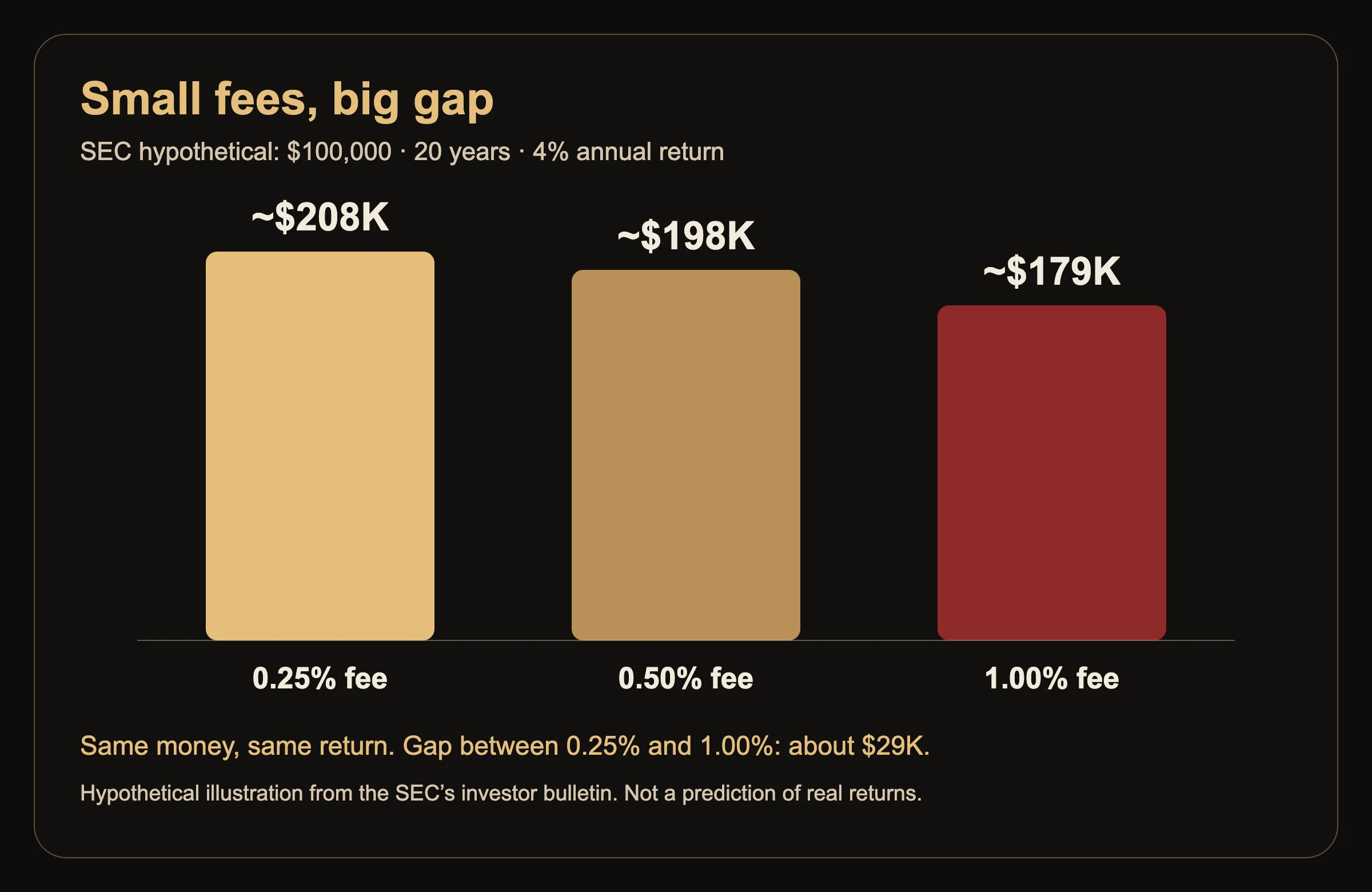
Small percentages add up. In its bulletin on how fees and expenses affect your investment portfolio, the SEC uses a hypothetical example: $100,000 invested for 20 years with a 4% annual return. With an annual fee of 0.25%, the portfolio grows to roughly $208,000. With 0.50%, roughly $198,000. With 1.00%, roughly $179,000.
That’s a hypothetical illustration, not a prediction of any real return. But it shows why it’s worth knowing what you pay. Look for fee information in your firm’s fee schedule, your advisor agreement and each fund’s prospectus or fact sheet.
Layer 6: what protects your account, and what doesn’t
There are two different kinds of protection people often confuse.
SIPC protection. The Securities Investor Protection Corporation protects customers if a SIPC-member brokerage firm fails and customer assets are missing, up to $500,000 per customer, including a $250,000 limit for cash. Different account capacities, like an individual account and an IRA, are generally treated as separate customers.
FDIC insurance. Applies to deposits at FDIC-insured banks. If your cash is in a bank sweep program, it may be eligible for FDIC insurance at each participating bank, up to $250,000 per depositor, per bank, per ownership category, subject to the program’s terms.
And here’s the big one: neither SIPC nor FDIC protects you from investment losses. The SEC is direct about it: SIPC does not protect you against the decline in value of your securities. If a stock or fund drops, that’s market risk, not something SIPC or the FDIC covers. SIPC also doesn’t cover bad advice or cash in a bank sweep program, which falls under the FDIC rules instead.
So the questions to ask are: where is my cash held, which protection applies to it, and do I understand that the value of my investments can go down?

Common moments of confusion
A few situations come up again and again for people new to their accounts.
"My balance went down. Did I lose money?" If the market value of your holdings dropped, your balance drops with it. Until you sell, that change is usually shown as an unrealized loss. It’s still real in the sense that your holdings are worth less today, but nothing has been sold. Prices can move in either direction from there, and nobody can promise which way.
"I deposited money, but it says pending." Transfers from a bank can take a few business days to arrive and become available. Your app may show the deposit before the money can actually be used.
"Buying power is bigger than my cash." In some accounts, especially margin accounts, buying power can include money you could borrow from the firm. Borrowing to invest comes with its own costs and risks, so it’s worth reading exactly how your firm defines buying power before relying on that number.
"The fund’s name doesn’t match what it holds." Fund names can be broad or catchy. The holdings list and fact sheet tell you what’s actually inside.
"I have a position I don’t remember buying." It might be a fund from a default option, a stock you received from a corporate action like a spinoff, or a reinvested dividend. Look at your transaction history before assuming something went wrong.
How to read your own account in 10 minutes
You don’t need to understand everything to get a clear picture. Open your account, or your most recent statement, and go through this.
1. What type of account is this? Taxable brokerage, IRA, Roth IRA, 401(k), HSA or something else.
2. How much is in cash right now? And is that on purpose?
3. Where does the cash sit? Find your sweep program or cash option, and what rate it earns.
4. What are the holdings? List each ticker. Mark which are individual stocks and which are funds.
5. For each fund, what does it hold? Look up the fund’s fact sheet and note its expense ratio.
6. Are dividends paid to cash or reinvested? Check the setting.
7. What fees do you pay? Advisory fees, fund expenses, account fees.
8. Are any automatic investments set up? And are they actually going through?
9. Do you have fractional shares? If so, note any limits your firm lists for them.
10. Is there anything you don’t recognize? Look it up or ask your firm before making any changes.

Write the answers down somewhere you’ll see them again. You’ll understand your account better than a lot of people understand theirs, and you’ll be able to ask much sharper questions if you ever talk to a professional.
Questions worth asking your firm
If anything on that list was unclear, these are fair questions to ask your brokerage or plan provider directly:
What is my cash sweep option, and what rate does it pay right now?
Are there other cash options available, and what are the differences?
When I deposit money, does it get invested automatically, or does it stay in cash until I choose something?
Are my dividends reinvested or paid to cash?
What are all the fees I’m paying, including fund expenses?
Which of my assets are covered by SIPC, and which, if any, are eligible for FDIC insurance?
Firms answer these questions every day. You’re not bothering anyone by asking.
Why this matters even if you’re just starting
If you’re building income from creative work, like selling digital products or landing your first clients, it’s easy to think investing is something to figure out "later." But even a small account is worth understanding, because the habits you build early are the habits you keep.
If you’re working on the earning side right now, Why Aren’t My Digital Products Selling? and How Do I Build a Portfolio When I Don’t Have Clients Yet? cover that part. And if finding the energy for any of this is the real obstacle, My Job Takes All My Energy is about that.
Knowing what you own won’t make decisions for you. But it turns a confusing number on a screen into something you can actually read.

Quick answers
Is the cash in my investing account invested? Not necessarily. Deposits and sale proceeds often sit as cash, usually in a sweep program, until something is bought with them. Check your account to see whether you have uninvested cash.
What is a cash sweep program? It’s how many firms handle uninvested cash, typically by moving it into bank deposits, a money market fund or a balance held at the firm. Rates and protections differ by program.
If I own an ETF, do I own the stocks inside it? You own shares of the fund, and the fund owns the underlying investments. Each fund share represents a proportionate slice of the fund’s portfolio.
Does SIPC protect me if my investments lose value? No. SIPC protects customers if a member brokerage firm fails, up to its limits. It doesn’t protect against market losses.
How do fees affect my account? Fees reduce returns, and small percentages can add up over long periods. The SEC’s hypothetical example shows a meaningful difference between 0.25% and 1% annual fees over 20 years.
Is this financial advice? No. This is general educational information. For advice about your own situation, talk to a qualified financial professional.