Money & Making
What's the Difference Between a 401(k), IRA and Brokerage Account?
401(k), IRA, Roth, brokerage. They sound like investments, but they're not. They're containers with different rules. Here's how the three most common ones differ, in plain English.

You hear the words all the time. "Put it in your 401(k)." "Open a Roth." "I’ve got some money in my brokerage account." People say them like everyone already knows what they mean.
And a lot of people nod along without being totally sure. Is a 401(k) an investment? Is a Roth IRA a type of stock? Why would anyone have a brokerage account if they already have a retirement account?
Here’s the short version, and it’s the most important idea in this whole article: the account is the container; the investment is what’s inside. A 401(k), an IRA and a brokerage account are all containers. Each one has different rules about who can open it, how it’s generally taxed, how much you can put in and when you can take money out. Inside any of them, you might hold similar things, like funds, stocks, bonds or cash.
If you’ve read What Do I Actually Own in My Investing Account? or the Money Map, you’ve already seen what goes inside the container. This article is about the containers themselves.
Important: this is general educational information, not financial, investment, legal or tax advice, and it isn’t a recommendation to open, use or contribute to any account or to buy any investment. Tax rules depend on your situation, and limits and rules change every year. Check the official sources linked below and talk to a qualified professional about your own situation. The images of me in this article are AI-generated illustrations.
The core idea: containers vs. contents
Think about three different boxes on a shelf. One is a box your employer gives you. One is a box you open on your own. One is a regular box with no special rules.
You could put the same things in all three: a fund, some stocks, some cash. What’s different is the box: who gave it to you, what rules apply to putting things in and taking them out, and how the money inside is generally treated for taxes.
That’s why "Should I buy a 401(k) or an index fund?" is a mixed-up question. A 401(k) is a box. An index fund is something you might put in a box. You can often hold a fund inside a 401(k), inside an IRA or inside a brokerage account.

Keeping those two ideas separate makes almost everything else in this article easier to follow.
The 401(k): the workplace container
What it is
A 401(k) is a retirement account offered through an employer. The IRS describes it as a feature of a qualified plan that lets employees put part of their wages into individual accounts. Similar plans exist under other names, like 403(b) plans for many schools and nonprofits, 457 plans for some government employers and the federal Thrift Savings Plan.
Who offers it
Only employers. You can’t open a 401(k) on your own the way you’d open a bank account. If your job offers one, you usually enroll through your HR or benefits portal, and contributions come straight out of your paycheck. Some employers now enroll new workers automatically unless they opt out, so it’s worth checking whether you’re already in one.
How taxes generally work
According to the IRS, traditional 401(k) contributions are generally made before income tax, and the money is taxed when it comes out in retirement. Many plans also offer a Roth 401(k) option, where contributions are made after tax and qualified withdrawals generally aren’t taxed. The details matter, and which option fits depends on your situation, so this is a question for a tax professional, not an article.
How much you can put in
For 2026, the IRS set the employee contribution limit for 401(k), 403(b), most 457 plans and the Thrift Savings Plan at $24,500. People 50 and older can generally make an additional catch-up contribution of $8,000, and a higher catch-up of $11,250 applies to people ages 60 through 63 in plans that allow it. These numbers usually change every year, and employer contributions follow separate rules.
Employer match and vesting
Some employers add money to your 401(k), often by matching part of what you contribute. Plans vary a lot. Some match nothing. Some match a percentage of your pay up to a limit. The only way to know your plan’s formula is to check your plan documents or ask HR.
Then there’s vesting, which the IRS sums up simply: vesting in a retirement plan means ownership. The money you contribute from your own paycheck is always 100% yours. Money your employer contributes may follow a schedule, where you become fully vested over several years. If you leave before you’re fully vested, you may lose the unvested part. The IRS page lays out the maximum schedules allowed, and your plan’s Summary Plan Description shows the one that applies to you.

What you can invest in
Usually a menu chosen by the plan. That might be a handful of funds, often including target-date funds, plus a default option if you don’t choose. You typically can’t buy any stock you want inside a 401(k), though some plans offer broader options.
The IRA: the individual container
What it is
An IRA, or individual retirement arrangement, is a retirement account you open yourself, usually at a brokerage, bank or other financial firm. It’s not tied to your job.
Traditional vs. Roth IRA
The IRS compares the two on its traditional and Roth IRAs page. In general terms:
Traditional IRA. Contributions may be tax-deductible depending on your situation, and withdrawals of deductible contributions and earnings are generally taxed.
Roth IRA. Contributions aren’t deductible, but qualified withdrawals are generally tax-free. Eligibility to contribute depends on your income, and the IRS sets limits that change over time.
Both require taxable compensation, meaning income from work, to contribute.

How much you can put in
For 2026, the IRS set the IRA contribution limit at $7,500, with an additional $1,100 catch-up for people 50 and older. That limit is combined across all your traditional and Roth IRAs, not per account. You also can’t contribute more than you earned from work that year.
What you can invest in
Usually a much wider range than a 401(k): stocks, bonds, ETFs, mutual funds, CDs and more, depending on where you open it. That flexibility also means more decisions are on you.
A common surprise
Opening an IRA and depositing money into it isn’t the same as investing. The money often lands as cash. As covered in What Do I Actually Own in My Investing Account?, Vanguard found that 28% of investors who rolled money into an IRA in 2022 were still holding it in cash a year later. If you meant to invest it, check.

The taxable brokerage account: the everyday container
What it is
A regular investing account, often just called a brokerage account or a taxable account. You open it yourself at a brokerage firm. There’s no special retirement tax treatment.
Who can open one
Generally any adult who meets the firm’s requirements. It isn’t tied to a job or to having earned income.
How taxes generally work
You don’t get an upfront tax break for putting money in. Investment income, like dividends and interest, and gains you realize when you sell are generally taxable in the year they happen. How much tax applies depends on many factors, which is exactly why this is a question for the IRS website or a tax professional.
How much you can put in
There’s no annual IRS contribution limit like there is for retirement accounts.
Access
You can generally sell investments and withdraw money whenever you want, without the early-withdrawal rules that apply to retirement accounts. Taxes may still apply when you sell, and trades take a short time to settle.
What you can invest in
Usually the full range the firm offers: stocks, ETFs, mutual funds, bonds and more.
Access: when you can take money out
This is one of the biggest practical differences between the containers.
Retirement accounts like 401(k)s and IRAs are designed for retirement, and the rules reflect that. According to the IRS, withdrawals before age 59½ are generally called early distributions and are usually subject to income tax plus an additional 10% tax, unless an exception applies. The IRS lists exceptions, like certain disability situations, some medical expenses and, for IRAs, certain first-time home purchases and education costs. The rules are detailed, and they differ between plan types.
Roth accounts have their own rules about contributions versus earnings, and some 401(k) plans offer loans or hardship withdrawals. Those details vary, so check your plan and the IRS before counting on any of them.
A taxable brokerage account doesn’t have those retirement-specific rules, which is part of why people use them for goals that aren’t retirement.

What happens when you change jobs
Because a 401(k) is tied to an employer, changing jobs raises a question the other containers don’t: what happens to the old account?
In general, people leaving a job often have a few options, depending on the plan and the balance. They may be able to leave the money in the old plan, move it into a new employer’s plan if that plan accepts it, roll it into an IRA, or cash it out. Cashing out can come with income taxes and, for people under 59½, the additional 10% tax unless an exception applies.
Rollovers have their own rules and timelines. The IRS lists rollovers completed within 60 days among the situations that can avoid the early-distribution tax, but the details matter, and a direct transfer between institutions works differently from a check made out to you.
Before you leave a job, it’s worth checking three things: how much of the account is vested, what options your plan allows, and what fees or investment choices the new home would have. Then keep a written list of every account you’ve left behind so nothing gets lost.
Protection: what’s the same
Something many people don’t realize: the protections for what’s inside these containers are often similar. If a brokerage firm holding your IRA or taxable account fails, SIPC protection may apply, up to its limits. And in every type of account, the value of investments can go down. No account type protects you from market losses. The Money Map covers SIPC and FDIC in more detail.
Side by side
Here’s the comparison in one place. These are general patterns, and individual plans and firms can differ.
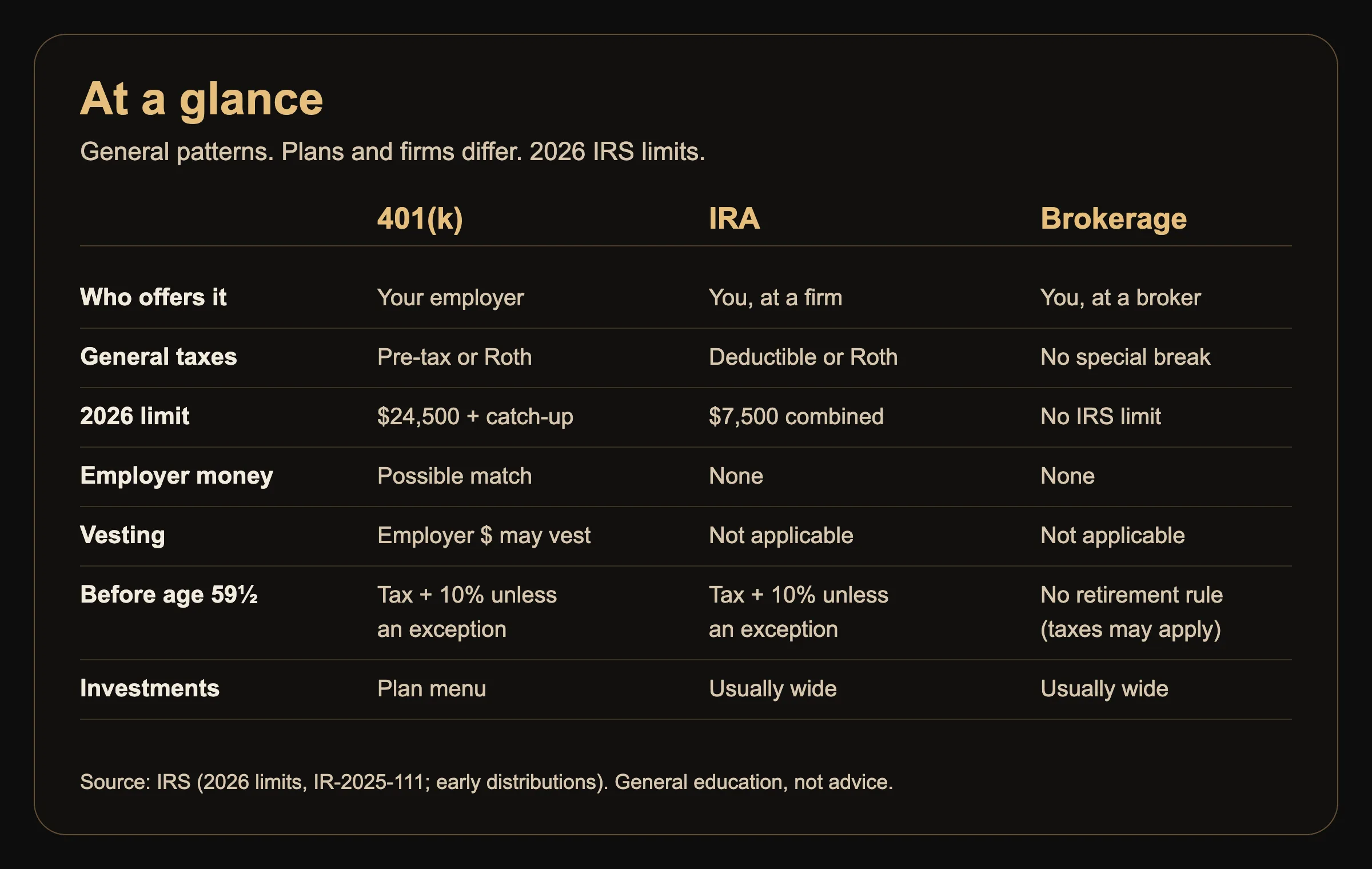
Who offers it. 401(k): employers. IRA: you open it yourself at a financial firm. Brokerage: you open it yourself at a brokerage firm.
General tax treatment. 401(k): traditional is generally pre-tax, Roth is after-tax with tax-free qualified withdrawals. IRA: traditional may be deductible, Roth isn’t deductible but qualified withdrawals are generally tax-free. Brokerage: no special treatment; income and realized gains are generally taxable.
2026 contribution limit. 401(k): $24,500 (plus catch-up if eligible). IRA: $7,500 combined across IRAs (plus $1,100 catch-up at 50+). Brokerage: no IRS contribution limit.
Employer money. 401(k): possible match, subject to vesting. IRA: no. Brokerage: no.
Access before 59½. 401(k) and IRA: early withdrawals generally face income tax plus a 10% additional tax unless an exception applies. Brokerage: no retirement-specific restriction, though taxes may apply when you sell.
Investment choices. 401(k): a menu chosen by the plan. IRA: usually wide. Brokerage: usually wide.
A quick word on HSAs
A health savings account is another container some people use. It’s tied to having a qualifying high-deductible health plan, it has its own contribution limits and rules for medical expenses, and some providers let you invest the balance. The IRS covers the details in its HSA guidance. It’s worth knowing it exists, especially if your employer offers one during open enrollment.
Three fictional people, three different setups
These examples are made up to show how the containers fit different situations. They aren’t recommendations, and none of them is "the right answer."
Andre works at a company with a 401(k). He finds out from HR that the plan offers a match and that the match vests over three years. He hadn’t enrolled because he didn’t know it existed. He now knows what the plan offers and the vesting schedule, and he’s using the plan’s materials to decide what to do next.
Tasha is a freelance video editor with no employer plan. Her income comes in irregularly. She learns that IRAs are available to people with earned income, including self-employment income, and that there are also retirement plans designed for self-employed people. She’s comparing her options with a tax professional before tax season.
Marcus already contributes to his workplace plan. He wants a separate place to save for a home studio he plans to build in a few years, and he wants to be able to access that money before retirement. He’s looking at how a regular brokerage account and a high-yield savings account differ for a shorter-term goal.
Same three containers, three different questions. That’s the point: the "right" container depends on what the money is for and what rules fit your situation.

Questions to ask before choosing
You don’t need to know every rule to make a good next move. You just need the right questions.
What is this money for, and when will I need it? Retirement money and money for a goal in a few years may belong in different places.
Does my employer offer a plan, and does it match? If so, what’s the formula and what’s the vesting schedule?
What are the fees? Plan fees, fund expense ratios and account fees all matter. The Money Map explains the main types.
What investments are available inside? A great container with a poorly understood investment inside is still a problem.
What happens if I need the money early? Read the early-withdrawal rules before you put money in, not after.
What are this year’s limits? They change. Check the IRS.
Who can answer my tax questions? Traditional vs. Roth, deductibility and income limits depend on your situation.
Common mistakes
Mixing up the container and the investment. "I have a Roth" tells you the box, not what’s inside it.
Contributing but never investing. Money can sit in cash inside a 401(k) or IRA if no investment was chosen. Check your holdings.
Not knowing about the match. Some people miss out on employer money simply because they never enrolled or never read the plan details.
Leaving a job without checking vesting. Know what’s vested before you go, and know what will happen to the account.
Forgetting old accounts. People change jobs and leave 401(k)s behind. Keep a list of every account you have and where it lives.
Assuming last year’s limits still apply. Limits often change every year.
Taking tax shortcuts from social media. A quick video can’t account for your situation. Use the IRS and a qualified professional.
The container card: save this
Screenshot this section or bookmark this page.
The account is the container. The investment is what’s inside.
401(k): through your employer, a plan menu of investments, possible match with vesting, retirement-focused rules, $24,500 employee limit in 2026.
IRA: you open it, usually wide investment choices, traditional or Roth, retirement-focused rules, $7,500 combined limit in 2026.
Brokerage: you open it, wide choices, no special tax treatment, no IRS contribution limit, flexible access.
Every container: check what’s inside, check the fees, and remember investments can lose value.

Where to go next
If you want to see what’s typically inside these containers, read What Do I Actually Own in My Investing Account? or open the Money Map. If the bigger question is whether there’s any money left over to save after bills, start with I Got Paid. Now What?, then How to Budget for Bills That Don’t Come Every Month. If your paycheck itself is confusing, Why Is My Paycheck So Much Smaller Than My Salary? walks through it, and if credit cards are part of the picture, see How to Read a Credit Card Statement Without Getting Lost. Everything money-related lives in Money & Making.
Quick answers
Is a 401(k) an investment? No. A 401(k) is an account, a container with its own rules. The investments are what you hold inside it, like the funds offered by your plan.
What’s the difference between a 401(k) and an IRA? A 401(k) is offered through an employer and may include employer contributions. An IRA is an account you open yourself. They have different contribution limits, and IRAs usually offer a wider range of investments.
What are the 2026 contribution limits? The IRS set the 2026 employee limit for 401(k)s, 403(b)s, most 457 plans and the Thrift Savings Plan at $24,500, and the IRA limit at $7,500, with catch-up contributions for eligible older savers. Limits change, so check the IRS each year.
What does vesting mean? Vesting means ownership. Money you contribute is always yours. Employer contributions may vest over a schedule set by your plan, within IRS rules.
Can I take money out of a retirement account early? Generally, withdrawals before 59½ are subject to income tax plus a 10% additional tax unless an exception applies. The rules are detailed, so check the IRS and your plan.
Why would someone have a brokerage account too? A taxable brokerage account has no IRS contribution limit and no retirement-specific withdrawal rules, which some people use for goals other than retirement. It doesn’t have the tax advantages of retirement accounts.
Is this financial or tax advice? No. It’s general educational information. For advice about your situation, talk to a qualified financial or tax professional.