Money & Making
How to Budget for Bills That Don't Come Every Month
Car registration. The annual subscription. Holiday gifts. A tire. They feel like surprises, but most of them come around every year. Here's how to find them, price them and quietly save for them one paycheck at a time.

Every month you budget for rent, the phone bill and groceries. Then a month comes along with something extra.
The car registration is due. Your renters insurance renews for the year. A software subscription you forgot about bills you annually. A friend’s wedding. Back-to-school clothes. The dentist. A tire that picked up a nail.
None of those is a monthly bill, so they never make it into a monthly budget. And because they don’t happen every month, they land like emergencies, even though most of them were completely predictable.

This guide is about those bills: the ones that come once a year, a few times a year or on no fixed schedule at all. It walks through how to find them, estimate them, spread them across your paychecks and handle the months when one shows up before you’re ready. It includes a fictional 12-month example and a worked shortfall example, because both happen.
In I Got Paid. Now What?, Step 4 of the payday routine was setting a little aside for bills that don’t come every month. This is the full version of that step.
Important: this is general educational information, not financial, legal or tax advice. Everyone’s situation is different, and all names and numbers in the examples are made up. If you’re behind on bills or dealing with debt, a nonprofit credit or housing counselor can help with your specific situation. The images of me in this article are AI-generated illustrations.
Why these bills hit so hard
There are two reasons irregular bills cause so much stress.
They’re big compared with your paycheck. A $300 car repair isn’t huge over a year. But when it lands in a single pay period that was already fully spoken for, it can knock everything else off balance.
They’re easy to forget. A monthly bill reminds you every month. An annual bill shows up once, and by the next year you’ve forgotten it ever existed.
And many households don’t have much room to absorb a surprise. In the Federal Reserve’s report on economic well-being of U.S. households in 2025, 63% of adults said they would cover a $400 emergency expense using cash or its equivalent. That means a large share of adults said they wouldn’t.

The good news: a lot of what feels like an emergency isn’t one. It’s a regular expense on a long cycle. Once you can see it coming, you can plan for it.
What counts as an irregular bill?
An irregular bill, sometimes called a non-monthly or periodic expense, is anything you pay regularly but not every month. The Consumer Financial Protection Bureau’s guide to assessing your spending recommends looking back over several months of statements so you don’t miss "less frequent expenses like insurance payments," and lists others like medical costs, school clothes, tuition, gifts, charity and vacations.
Common examples include:
Car costs. Registration, inspection, oil changes, tires, brakes, repairs, an annual or six-month insurance premium.
Insurance. Renters, homeowners or life insurance paid yearly or twice a year instead of monthly.
Annual renewals. Software, cloud storage, memberships, warehouse clubs, domain names, professional licenses.
Gifts and holidays. Birthdays, weddings, baby showers, holiday gifts, travel to see family.
School and kids. Supplies, clothes, field trips, sports fees, camps.
Health. Dental cleanings, eye exams, glasses, prescriptions, copays and deductibles.
Home. Replacing appliances, furniture, repairs, seasonal costs like heating oil or air conditioning tune-ups.
Personal. Haircuts every six weeks, clothes, a yearly trip.

Work and business. If you freelance or run a side business: annual software, equipment, conference fees, or estimated taxes, which are worth checking with the IRS or a tax professional.
Some of these are fixed and predictable, like car registration. Others vary, like repairs. Both can be planned for. The first kind gets an exact number. The second gets an estimate.
How big can these get?
Spending varies a lot by household, but national data shows how much money moves through these categories. In the Bureau of Labor Statistics’ Consumer Expenditure Survey, released October 29, 2026, average U.S. household spending in 2025 was $81,905. That included $6,470 on healthcare, $4,084 on entertainment, $2,010 on apparel and services, and $4,765 on "other vehicle expenses," a category that covers things like vehicle insurance, maintenance and repairs.
Those are averages across all households, not targets, and your numbers could be much higher or lower. But they’re a reminder that many of the categories where irregular bills live are not small.
Step 1: Find your irregular bills
You can’t plan for what you can’t see. So the first step is making a list.
Go back 12 months. Pull up your bank and card statements for the past year, if you can. A full year catches the bills that come once annually. If 12 months isn’t possible, start with what you have and add to it over time.
Scan for anything that isn’t monthly. Highlight or list every charge that only showed up once, twice or a few times. Look especially for larger amounts.
Check your email and accounts. Search your inbox for words like "renewal," "annual," "receipt" and "invoice." Check app store subscriptions on your phone.
Walk through your life. Think about your car, home, health, family, work and the year’s calendar. Birthdays, holidays, school starts, the month your car registration is due.
Write down the month each one is due. If you don’t know the exact date, the month is enough to start.
The CFPB has a free spending tracker that can help you record what you find. A notebook or a simple spreadsheet works too.
Step 2: Put a number on each one
Now estimate how much each bill will cost.
For fixed bills, use the actual amount. Car registration, insurance premiums and annual renewals usually cost about the same each time. Use last year’s amount, and add a little if it tends to go up.
For variable bills, use a realistic estimate. For things like repairs, gifts or medical costs, look at what you spent last year and adjust for what you know is coming. Record your actual spending, not what you think you "should" spend, which is the same approach the CFPB recommends for tracking spending in general.
Round up a little. Prices rise, and estimates are rarely perfect. A small cushion makes the plan easier to stick with.
When you’re done, add everything up. That’s your yearly irregular-bill total.

Step 3: Turn the yearly total into a per-paycheck amount
This is the part that makes the plan work. Instead of paying for each irregular bill out of one paycheck, you spread the cost across all your paychecks.
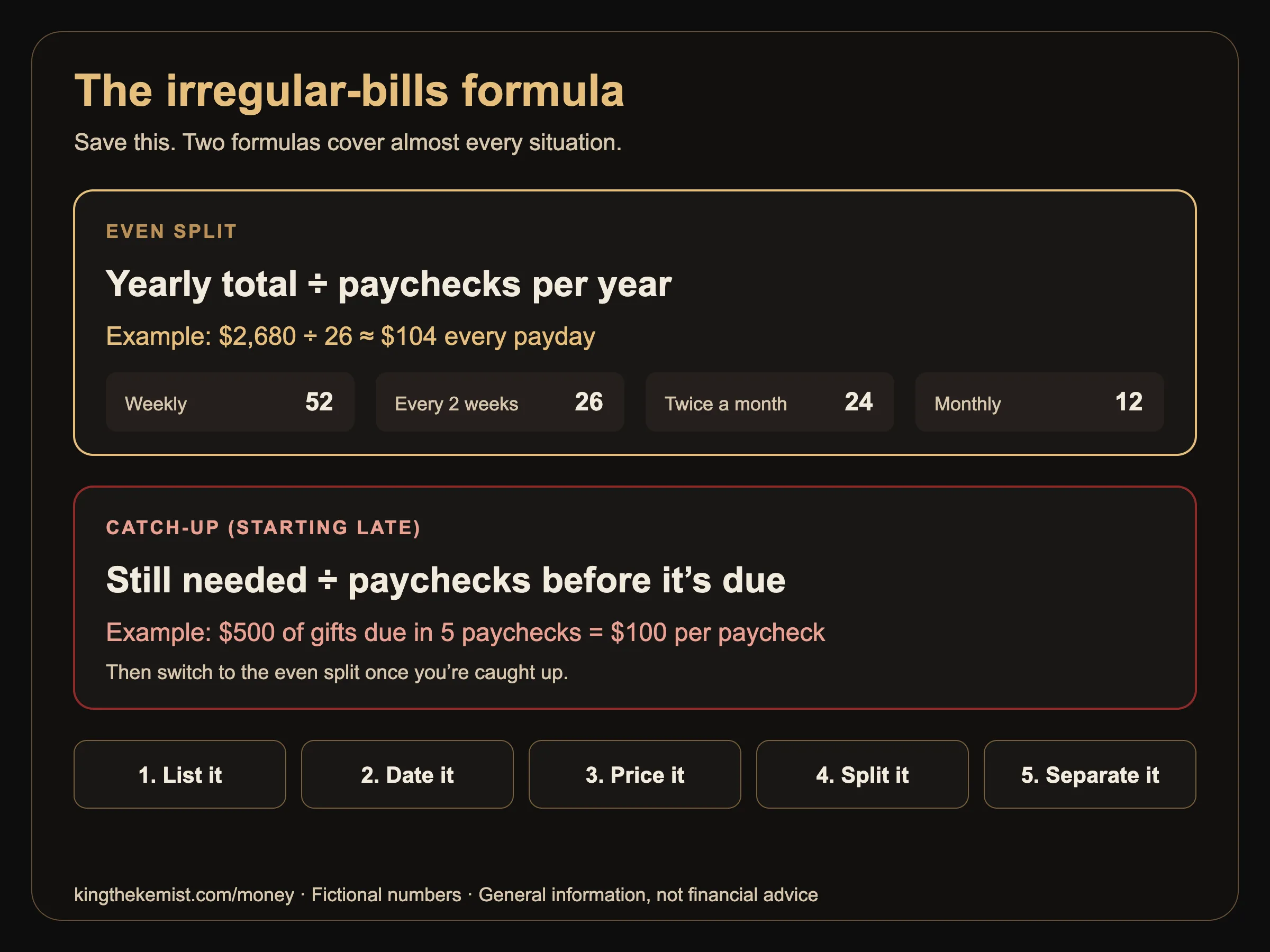
The simplest formula is:
Yearly irregular total ÷ number of paychecks in a year = amount to set aside each payday.
How many paychecks you get depends on your schedule:
Weekly: 52 paychecks a year.
Every two weeks (biweekly): 26 paychecks a year.
Twice a month (semimonthly): 24 paychecks a year.
Monthly: 12 paychecks a year.
So if your irregular bills add up to $2,680 a year, that’s about $52 a week, about $104 per biweekly paycheck, about $112 per semimonthly paycheck or about $224 a month, rounded up to the nearest dollar.
This "even split" method works best once you’re already caught up. If you’re starting from zero and a big bill is coming soon, you’ll need the catch-up method below.
Step 4: Keep the money somewhere separate
Money set aside for irregular bills works best when it doesn’t mix with everyday spending money. Otherwise it’s easy for it to quietly get spent on groceries or a night out.
People commonly do this with:
A separate savings account. Many banks let you open more than one savings account or create labeled "buckets" inside one account.
An automatic transfer on payday. If your bank or employer allows it, setting up an automatic transfer of the per-paycheck amount means you don’t have to remember.
A simple tracker. Even if all the money is in one account, a note or spreadsheet showing how much is set aside for each upcoming bill keeps it from feeling like spare cash.
This kind of fund is often called a sinking fund: money you save gradually for a specific, expected cost. It’s different from an emergency fund, which is for things you can’t predict, like a job loss. Some people keep both.

A fictional 12-month example
Here’s how this might look for a made-up person.
Andre is paid every two weeks. After going through last year’s statements, here’s Andre’s list of irregular bills and the month each one is due:
January: annual software and app renewals, $240
February: dental and eye copays, $150
March: car registration, $120
April: birthday gifts, $100
May: car maintenance (oil change and brakes), $300
June: renters insurance, paid yearly, $180
July: household replacements, $240
August: back-to-school clothes $300 and birthday gifts $100, $400 total
September: dental and eye copays, $150
October: car maintenance (tires), $300
November: nothing planned
December: holiday gifts, $500
That adds up to $2,680 for the year. Spread across 26 paychecks, it’s $2,680 ÷ 26 = about $103.08, so Andre rounds up and sets aside $104 every payday. Over a year, that’s $104 × 26 = $2,704, a little more than the total, which leaves a small cushion.
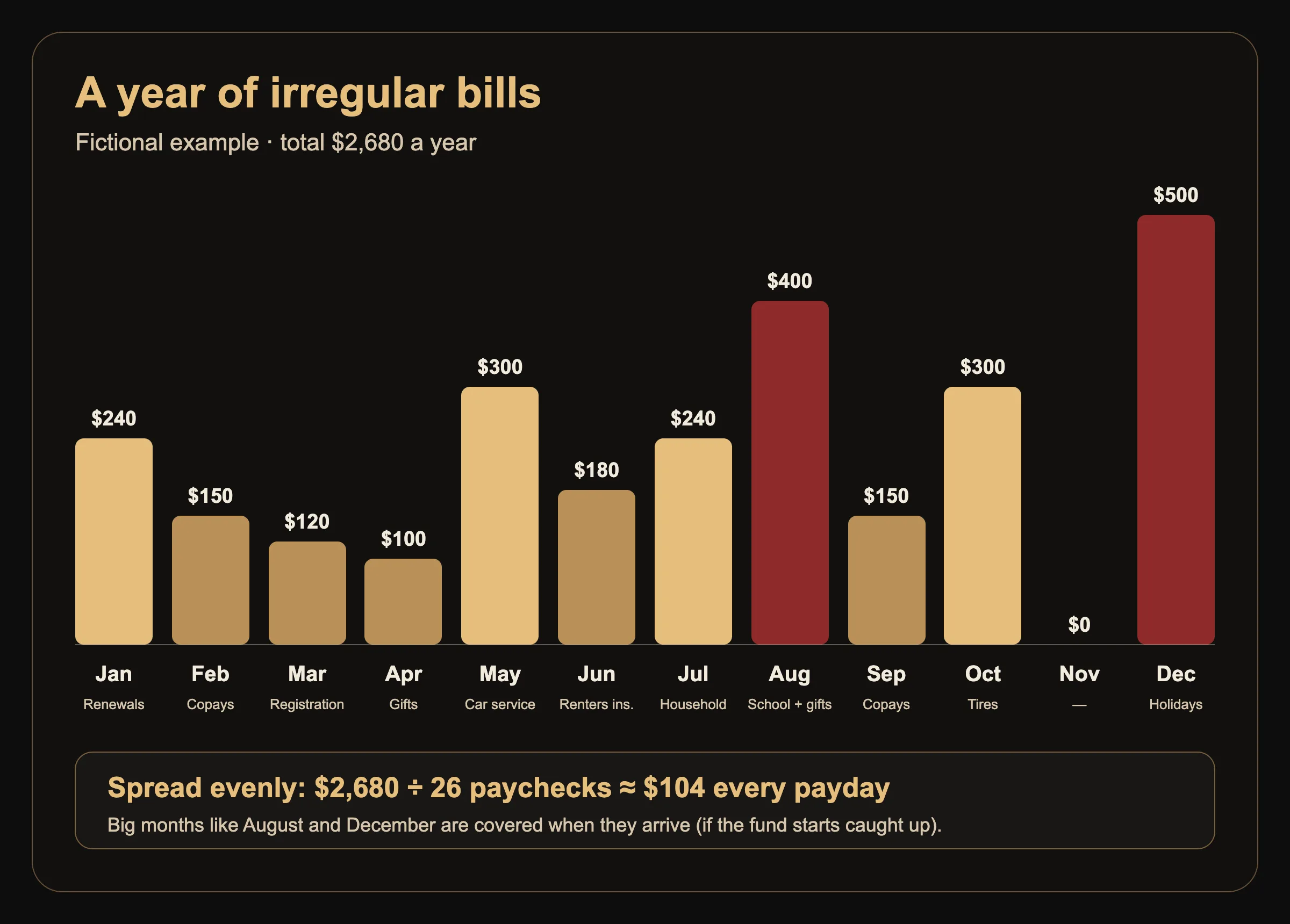
Some months, Andre’s fund grows. Other months, a bill pulls it down. Because the money builds steadily, the bigger months, like August and December, are already covered when they arrive, as long as Andre started the year with the fund caught up.
What if you’re starting from zero?
Most people don’t start the year with a full fund. Maybe you’re reading this in October, and the holidays are already close. In that case, the even split won’t save enough in time for the bills coming up soon.
The fix is the catch-up method. For each upcoming bill:
Amount still needed ÷ number of paychecks before it’s due = amount to set aside each paycheck for that bill.
Then add up the amounts for every bill coming up. Once you’ve caught up on the near-term bills, you can switch to the even yearly split.
A shortfall example
Andre is starting the fund on October 1 with nothing saved. Two bills are coming up:
Car maintenance, $300, due around October 20. Andre has 2 paychecks before then.
Holiday gifts, $500, due around December 15. Andre has 5 paychecks before then.
Using the catch-up method:
Car maintenance: $300 ÷ 2 = $150 per paycheck for the next 2 paychecks.
Holiday gifts: $500 ÷ 5 = $100 per paycheck for the next 5 paychecks.
So for the next 2 paychecks, Andre would need to set aside $150 + $100 = $250 per paycheck. After running the payday routine, Andre can realistically set aside only $120 per paycheck right now. That’s $130 short each of the next two paychecks.
That’s a normal situation, and it isn’t a sign of failure. Here’s how Andre might work through it.
Ask what’s truly due now. Andre calls the mechanic. The oil change ($80) is due now, but the tires can safely wait a few months. Andre moves the $220 tire cost to February and plans to spread it out.
Adjust the flexible bills. Andre decides on a $300 holiday gift budget instead of $500, and plans a few homemade or experience gifts.
Recalculate.
Oil change: $80 ÷ 2 = $40 per paycheck for 2 paychecks.
Holiday gifts: $300 ÷ 5 = $60 per paycheck for 5 paychecks.
Now the next 2 paychecks need $40 + $60 = $100, which fits inside the $120 Andre can spare. For the 3 paychecks after that, only the $60 gift amount is needed, leaving room to start building the rest of the fund.
Then switch to the even split. Once the holidays pass, Andre rebuilds the list for the coming year, adds the delayed tires to February and goes back to a steady amount each paycheck.

Not every shortfall works out this neatly. Here are other options people commonly use:
Pay part now, part later. Some providers allow partial payments or payment plans. Ask before the due date.
Ask about payment timing. Some insurance companies let you pay monthly or quarterly instead of annually, sometimes for a small fee. Some due dates can be moved.
Use the payday routine’s priorities. If something has to wait, the payday routine explains which bills usually come first.
Look for help if it’s more than a one-time gap. Nonprofit credit counseling and local assistance programs, which you can often reach by calling or texting 211, can help you look at the bigger picture.
Be careful with expensive borrowing. Some quick-cash options come with high fees or interest that can make the next few paychecks tighter. Read the full cost before using one.
Small habits that make it easier
Put due dates on your calendar. Add each irregular bill to your phone calendar with a reminder a few weeks before it’s due. That gives you time to check the amount and make sure the fund has enough.
Name the buckets. If your bank lets you label savings buckets, names like "Car," "Gifts" or "Annual renewals" make it harder to treat the money as spare cash.
Do a renewal check. When an annual renewal notice arrives, ask whether you still use the service. Cancelling one unused subscription lowers the yearly total for good.
Plan for the extra paychecks. If you’re paid weekly or every two weeks, a few months a year have an extra payday. Some people send part of that extra paycheck straight to the irregular-bills fund.
Keep receipts for big variable costs. Next year’s estimate is easier when you know what this year’s car repairs or medical costs actually were.
Start small if you have to. If the full per-paycheck amount doesn’t fit yet, set aside what you can. Even $10 or $20 a paycheck adds up and makes the next surprise smaller.
Common mistakes with irregular bills
Forgetting the small ones. A few $15 annual renewals don’t seem like much, but they add up. Include them.
Using last year’s numbers without checking. Insurance premiums and subscriptions often go up. Check for price increases when a renewal notice arrives.
Mixing the fund with spending money. If the money sits in your everyday checking account with no tracker, it tends to disappear.
Treating real emergencies as irregular bills. A sinking fund is for expected costs. A sudden job loss or a major medical event is what an emergency fund is for. It can help to keep them separate.
Giving up after one bad month. If a big bill drains the fund early, that’s the fund doing its job. Rebuild it and keep going.
Never updating the list. Life changes. A new car, a new pet, a new kid or a new hobby brings new irregular costs. Review the list a few times a year.
How this connects to the rest of your money
Irregular bills are one piece of a bigger picture. A few related guides:
The payday routine is where your per-paycheck set-aside happens.
How to Read a Credit Card Statement Without Getting Lost helps if irregular bills have been landing on a credit card.
Why Is My Paycheck So Much Smaller Than My Salary? explains the take-home number you’re budgeting with.
What’s the Difference Between a 401(k), IRA and Brokerage Account? covers longer-term saving, once the shorter-term bills are under control.
The Money Map explains what’s inside an investing account, and everything money-related on this site lives in Money & Making.
The irregular-bills checklist: save this
Screenshot this section or bookmark this page and come back whenever a renewal notice or new expense shows up.
1. List it. Go back 12 months of statements and write down every bill that isn’t monthly.
2. Date it. Note the month each one is due.
3. Price it. Use the actual amount for fixed bills and a realistic estimate for variable ones. Round up a little.
4. Add it up. That’s your yearly irregular total.
5. Split it. Yearly total ÷ paychecks per year = amount to set aside each payday. If you’re behind, use the catch-up method for the next few bills.
6. Separate it. Keep the money in its own account, bucket or tracker.
7. Review it. Update the list a few times a year and whenever something changes.
The formula to remember: yearly total ÷ paychecks per year. If you’re catching up: amount still needed ÷ paychecks before it’s due.
Quick answers
What is an irregular expense? It’s a cost you pay regularly but not every month, like car registration, annual insurance premiums, holiday gifts, annual renewals or car maintenance. Many feel like surprises but are actually predictable.
How do I budget for annual expenses? One common approach is to list them, estimate the yearly total, and divide by the number of paychecks you get in a year. Setting that amount aside each payday spreads the cost out so no single paycheck carries it.
What’s a sinking fund? It’s money you save gradually for a specific, expected cost, like holiday gifts or car repairs. It’s different from an emergency fund, which is for things you can’t predict.
What if a bill is due before I’ve saved enough? Use the catch-up method: divide the amount still needed by the paychecks left before it’s due. If that doesn’t fit, look for what can wait, lower flexible amounts, and ask providers about payment timing or plans before the due date.
How many paychecks do I get in a year? Weekly pay usually means 52 paychecks, every two weeks means 26, twice a month means 24 and monthly means 12.
Is this financial advice? No. This is general educational information. For advice about your own situation, talk to a qualified professional.