Money & Making
Why Is My Paycheck So Much Smaller Than My Salary?
You were offered a salary, you did the math, and then the first paycheck showed up smaller than you expected. Here's where the money goes, line by line, using a fictional pay stub.

You got the job. The offer letter said a number you were happy with. Maybe you even divided it by 12 in your head and started planning.
Then the first paycheck landed, and it was noticeably smaller.

That gap can be confusing and a little alarming, especially the first time. Did they pay you wrong? Did something get taken out by mistake? Is this just how it is?
Usually, it’s just how it is, but it helps to know exactly why. Your salary is your gross pay before anything comes out. What lands in your account is your net pay, after taxes and deductions. The difference between them is explained, line by line, on your pay stub.
This article walks through a fictional pay stub so you can read your own with more confidence. It covers the main things that come out of a paycheck, why some paychecks look different from others, how to turn a salary into a per-paycheck number and what to check every payday.
Important: this is general educational information, not tax, financial or legal advice, and it can’t calculate anyone’s actual taxes. Tax rules, rates and deductions depend on where you live, how you’re paid and your personal situation. For your own situation, use the official IRS resources linked below or talk to a qualified tax professional. The images of me in this article are AI-generated illustrations.
Gross pay vs. net pay
Two terms explain almost all of the confusion.
Gross pay is what you earn before anything is taken out. If your salary is $52,000 a year, that’s your gross annual pay. Each paycheck has its own gross amount, which is your share of that salary for the pay period, plus any overtime, bonuses or other earnings.
Net pay is what’s left after taxes and deductions. It’s the amount that actually lands in your bank account. People often call it take-home pay.
The space between those two numbers is made up of a few categories:
Taxes. Federal income tax withholding, Social Security, Medicare and, depending on where you live, state and local taxes.
Pre-tax deductions. Things like contributions to a traditional 401(k) or certain health insurance premiums, which are taken out before some taxes are calculated.
Post-tax deductions. Things taken out after taxes, like Roth 401(k) contributions in many plans, some insurance products or wage garnishments.
Once you know which bucket each line on your pay stub falls into, the gap starts to make sense.

What actually comes out: the main lines
Federal income tax withholding
In the U.S., employers usually take federal income tax out of each paycheck and send it to the IRS on your behalf. That’s called withholding. According to the IRS’s tax withholding page, how much is withheld depends on your income and the information you give your employer on Form W-4. The IRS also warns that withholding too little "can lead to a tax bill or penalty."
Withholding isn’t the same as the tax you finally owe. It’s more like a running prepayment. When you file your tax return, the total you owe for the year is compared with what was withheld, and you either get a refund or owe the difference.
Social Security and Medicare (FICA)
These two are often grouped together as FICA taxes. The IRS’s page on Social Security and Medicare withholding rates lays them out:
Social Security: 6.2% of your wages, up to an annual limit called the wage base. For 2026, the IRS lists that limit as $184,500. Once your wages for the year pass it, Social Security tax stops being withheld for the rest of that year.
Medicare: 1.45% of your wages, with no wage base limit.
Additional Medicare Tax: employers withhold an extra 0.9% on wages above $200,000 in a calendar year.
Your employer pays a matching share of Social Security and Medicare too, but that part doesn’t come out of your paycheck.

State and local taxes
Many states have an income tax, and some cities and counties do too. A few states don’t tax wages at all. Some states also have other payroll deductions, like disability insurance or paid family leave programs. Because these vary so much, check your state’s tax agency for what applies to you.
Pre-tax deductions
Some deductions come out before certain taxes are figured, which lowers the amount of pay those taxes are based on.
The most common example is a traditional 401(k). According to the IRS’s 401(k) overview, elective deferrals to a traditional 401(k) are generally not subject to income tax withholding at the time you contribute, but they are still included as wages for Social Security and Medicare taxes. So a traditional 401(k) contribution lowers your federal income tax withholding, but not your FICA taxes.
Health, dental and vision insurance premiums are often taken out pre-tax too, depending on how your employer’s plan is set up. Your benefits paperwork or HR department can tell you which of your deductions are pre-tax.
Post-tax deductions
These come out after taxes are calculated, so they don’t lower the taxes on your paycheck. Common examples include Roth 401(k) contributions, some supplemental life or disability insurance, union dues in some cases and court-ordered garnishments.
A fictional pay stub, line by line
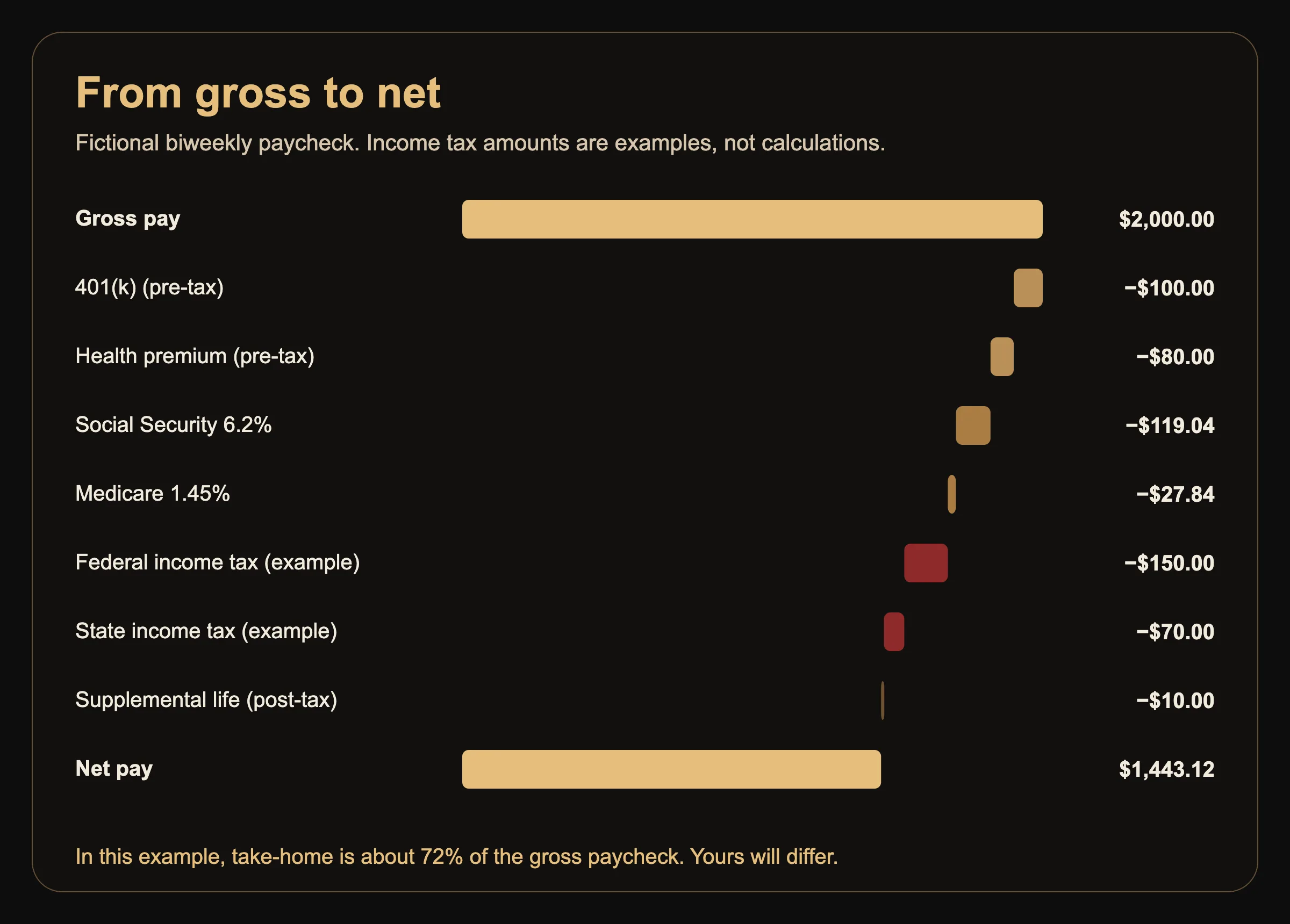
Here’s a made-up example to show how it all fits together. These numbers are hypothetical and rounded to keep the math readable. The federal and state income tax amounts are example numbers, not real calculations. Actual withholding depends on the IRS formulas, your W-4, your state and your situation.
Alex earns a salary of $52,000 a year and is paid every two weeks, which is 26 paychecks a year.
Gross pay this period: $52,000 ÷ 26 = $2,000.00
Pre-tax deductions:
Traditional 401(k), 5%: $100.00
Health insurance premium (pre-tax in this example): $80.00
Taxes:
Social Security (6.2%): $119.04
Medicare (1.45%): $27.84
Federal income tax withholding (example amount): $150.00
State income tax withholding (example amount): $70.00
Post-tax deductions:
Supplemental life insurance: $10.00
Total taken out: $556.88
Net pay: $2,000.00 − $556.88 = $1,443.12
So in this example, Alex’s take-home pay is about 72% of the gross paycheck.
A couple of details worth noticing:
Why Social Security and Medicare aren’t calculated on the full $2,000. In this example, the health premium is pre-tax for Social Security and Medicare as well, so those taxes are figured on $1,920 ($2,000 − $80). The 401(k) contribution doesn’t reduce those taxes, as the IRS explains. If your health premium is handled differently, your numbers will be too.
Why the federal number is labeled an example. Federal income tax withholding uses formulas and tables from the IRS and depends on your W-4. The $150 here is just a placeholder to show where it appears on a stub.
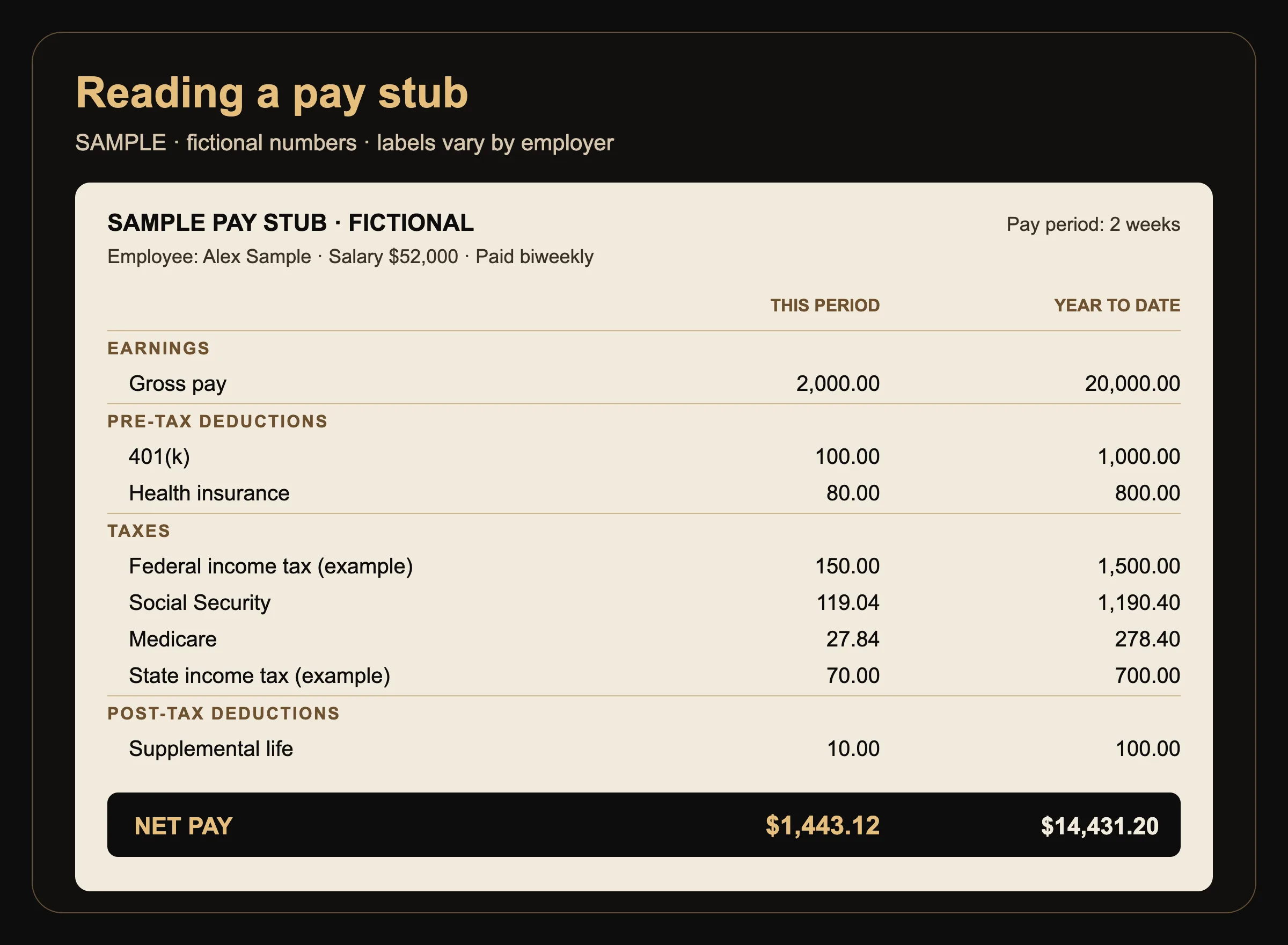
Every pay stub looks a little different, but most include the same core pieces: the pay period, gross pay, each tax and deduction, net pay and year-to-date totals.
Year-to-date (YTD) totals
Most pay stubs show two columns: this period and year-to-date. YTD is the running total since January 1.
YTD totals are useful for a few reasons:
They show your total earnings so far this year. Helpful if you’re tracking income or applying for something that asks.
They show how much tax has been withheld so far. That’s the number the IRS Tax Withholding Estimator asks for.
They help you spot errors. If YTD totals jump unexpectedly or don’t line up with what you’ve been paid, it’s worth asking about.
They explain mid-year changes. If your wages pass the Social Security wage base, the Social Security line will drop to zero for the rest of the year, which can make later paychecks slightly larger.
Why some paychecks look different
Even with the same salary, not every paycheck is identical. Common reasons:
Your first paycheck. It may cover only part of a pay period, depending on your start date. Some employers also pay on a delay, so your first check may arrive later or look smaller than a normal one.
Benefits starting. If health insurance or a 401(k) begins a month or two after you start, your take-home pay will drop when those deductions kick in.
Bonuses and supplemental pay. Bonuses are often treated as supplemental wages, and employers may use a different withholding method for them. That’s why a bonus can look like it was taxed at a different rate than your regular pay. It’s a withholding method, not necessarily what you’ll owe in the end.
Overtime or extra hours. More gross pay usually means more withholding too.
Benefits changes during open enrollment. New plan choices often start on January 1.
Hitting the Social Security wage base. For higher earners, the Social Security line stops once the annual limit is reached.
A new W-4. If you or your employer updated your W-4, your withholding will change starting with a future paycheck.

Turning a salary into a per-paycheck number
To get a rough sense of your gross pay per paycheck, divide your annual salary by the number of paychecks you get in a year.
Using a $52,000 salary as an example:
Weekly (52 paychecks): $52,000 ÷ 52 = $1,000 gross per paycheck
Every two weeks (26 paychecks): $52,000 ÷ 26 = $2,000 gross per paycheck
Twice a month (24 paychecks): $52,000 ÷ 24 = about $2,166.67 gross per paycheck
Monthly (12 paychecks): $52,000 ÷ 12 = about $4,333.33 gross per paycheck
Notice that biweekly and twice-a-month pay aren’t the same. Being paid every two weeks gives you 26 smaller checks. Being paid twice a month gives you 24 slightly larger ones. Same salary, different rhythm.
Remember that these are gross numbers. Your net pay will be lower. A simple way to estimate your own take-home percentage is to divide a recent net pay amount by the matching gross amount. If you see $1,443 net from $2,000 gross, your take-home is about 72% for that paycheck. It’s not a tax calculation, just a ratio that helps with planning.
If you’re paid by the hour, gross pay is your hours times your rate, plus any overtime. Hourly pay can change a lot from check to check, which is another reason to look at each stub.
What to check every payday
You don’t need to audit every number, but a quick look each payday can catch problems early. Here’s what to check:
Hours and pay rate. If you’re hourly, do the hours match what you worked? Is the rate right? Is overtime included if you worked it?
Gross pay. Does it match what you expected for this period?
Deductions. Are the 401(k) percentage and benefits amounts what you signed up for? Is anything new or missing?
Taxes. Did anything change suddenly without a reason, like a new W-4, a raise or a bonus?
Year-to-date totals. Do they keep adding up the way you’d expect?
If something looks off, ask your payroll or HR department. Payroll mistakes happen, and they’re usually easier to fix when they’re caught early.

For the bigger picture of planning around each paycheck, the payday routine walks through what to do once the money lands.
When to look at your W-4
Your W-4 tells your employer how to withhold federal income tax. The IRS says you can change your withholding by giving your employer a new Form W-4, and that you can’t simply ask your employer to withhold a set dollar amount without the form.
According to the IRS’s FAQs on the Form W-4, the current version doesn’t use the old "allowances" system. Only the personal information and signature steps are required. The other steps cover things like multiple jobs, dependents and other adjustments, and apply only if they fit your situation.
The IRS suggests checking your withholding:
Early in the year.
When tax law changes.
After a life change, like marriage, divorce, a new child, buying a home, retirement or a change in jobs or income.
The official tool for this is the IRS’s Tax Withholding Estimator. The IRS says it takes about 25 minutes, works for people with W-2 jobs or pensions, and uses your most recent pay stubs. It doesn’t ask for your name or Social Security number, and it can create a pre-filled W-4 you can give your employer.
This article can’t tell you how to fill out your W-4. The estimator, the IRS instructions or a tax professional can.
If you’re freelance or self-employed
If you’re paid as an independent contractor, often on a Form 1099, there’s usually no employer withholding taxes for you. The full payment lands in your account.
That can feel like a bigger paycheck, but taxes may still be due. The IRS’s page on self-employment tax explains that the self-employment tax rate is 15.3% (12.4% for Social Security and 2.9% for Medicare), that it generally applies if your net self-employment earnings were $400 or more, and that self-employed people may need to make quarterly estimated tax payments.
Many freelancers set aside a portion of each payment for taxes as soon as it arrives. How much depends on your situation, so the IRS resources or a tax professional are the right place to figure that out. If your income is irregular, the payday routine has a section on that, and a future guide will cover bills that don’t come every month.
Words you’ll see on a pay stub
Pay stubs use a lot of shorthand. A few common labels:
Pay period. The dates the paycheck covers.
Pay date. The day the money is paid.
Earnings or gross wages. What you earned before anything came out.
FIT or Fed W/H. Federal income tax withholding.
SS, OASDI or FICA-SS. Social Security tax.
Med or FICA-Med. Medicare tax.
SIT or State W/H. State income tax withholding.
401(k) or 401(k) Pre-Tax. A traditional 401(k) contribution. Roth 401(k) is usually listed separately.
Taxable wages. The amount a particular tax is calculated on, which can be lower than gross pay because of pre-tax deductions.
Net pay. What lands in your account.
Labels vary by employer and payroll provider, so if you see one you don’t recognize, your payroll or HR team can explain it.
Common paycheck mistakes and misunderstandings
Planning around gross pay. Building a budget around your salary instead of your take-home pay is one of the most common ways people get stretched. Plan around net pay.
Assuming the first paycheck is normal. A partial first period or delayed benefits can make it smaller or larger than usual. Wait for a regular paycheck before setting your plan.
Thinking a bonus was "taxed more." It may have been withheld using a different method. What you actually owe is settled when you file.
Ignoring the pay stub. Most people check only the deposit. Glancing at the stub catches missed hours, wrong rates and deductions you didn’t sign up for.
Not updating the W-4 after a big change. A second job, marriage or a new child can mean your withholding no longer fits.
Forgetting freelance taxes. If you have side income with no withholding, setting money aside as it comes in can prevent a surprise later.
Confusing pre-tax and post-tax. A traditional 401(k) lowers income tax withholding. A Roth contribution generally doesn’t lower taxes on the paycheck. Knowing which one you chose helps the stub make sense.
Five things to check on payday: save this
Bookmark this page or screenshot this section.
1. Hours and rate. Do they match what you worked and what you’re owed?
2. Gross pay. Is it what you expected for this pay period?
3. Deductions. Are your benefits and retirement contributions the amounts you chose?
4. Taxes. Did anything change, and is there a reason it did?
5. Year-to-date totals. Do they add up the way you’d expect?
Five quick checks. If anything’s off, ask payroll early.

If you’re contributing to retirement through your paycheck and want to understand where that money goes, the Money Map explains what’s inside an investing account, and a future guide will cover the difference between a 401(k), an IRA and a brokerage account. If you’re using credit cards to bridge the gap between paychecks, see how to read a credit card statement. Everything money-related on the site lives in Money & Making.
Quick answers
Why is my paycheck less than my salary divided by the number of paychecks? Your salary is gross pay. Your paycheck is net pay after federal income tax withholding, Social Security, Medicare, any state or local taxes and deductions like retirement contributions and insurance premiums.
What are Social Security and Medicare taxes on my paycheck? Together they’re often called FICA. The IRS lists the employee rates as 6.2% for Social Security, up to an annual wage base ($184,500 for 2026), and 1.45% for Medicare, with an additional 0.9% withheld on wages above $200,000.
Does a 401(k) contribution lower my taxes? According to the IRS, traditional 401(k) elective deferrals generally aren’t subject to income tax withholding when you contribute, but they’re still subject to Social Security and Medicare taxes. Roth contributions work differently.
How do I know if my withholding is right? The IRS’s Tax Withholding Estimator is the official tool for checking it. The IRS suggests reviewing it early in the year and after major life changes.
Why was my bonus taxed so much? Bonuses are often treated as supplemental wages, and employers may use a different withholding method for them. That’s withholding, not necessarily the tax you’ll owe when you file.
I’m a freelancer. Why didn’t anything come out? Independent contractors usually don’t have taxes withheld. The IRS explains that self-employed people may owe self-employment tax and may need to make quarterly estimated payments.