Alchemy & Symbols
The Emerald Tablet, Line by Line: What It Says and What It Means
Fourteen lines alchemists treated as a master key for centuries. Here's the full Emerald Tablet in Isaac Newton's translation, where it really came from, and what every line means.

The Emerald Tablet is about fourteen lines long. You can read the whole thing in under a minute.
And for roughly a thousand years, alchemists treated it like the master key to the universe. Isaac Newton, the guy who worked out gravity, sat down and translated it into English by hand. It's where "as above, so below" comes from. It's quoted on album covers, in occult books, in video games and all over Pinterest.
So what does it actually say? And what the hell does it mean?
Here's the short answer: the Emerald Tablet is a short, cryptic Hermetic text that describes how one source creates everything, how the higher and lower worlds mirror each other, and how to separate the fine from the coarse to make something perfect. Alchemists read it as instructions for making the philosopher's stone. Mystics read it as a map of the soul. Most people read it as beautiful and confusing.
I'm going to give you the whole text, using Isaac Newton's translation, and then walk through it line by line in plain English. If you haven't read What Is Alchemy? or As Above, So Below: What It Really Means, they'll give you the background. But you don't need them to follow this.
Where the Emerald Tablet comes from
Let's get the history straight first, because there's a lot of myth around this text.
It's credited to Hermes Trismegistus. "Hermes the Thrice-Great" is a legendary figure who blends the Greek god Hermes with the Egyptian god Thoth, the god of wisdom and writing. The Tablet claims his authority, but no historian thinks a real person by that name wrote it.
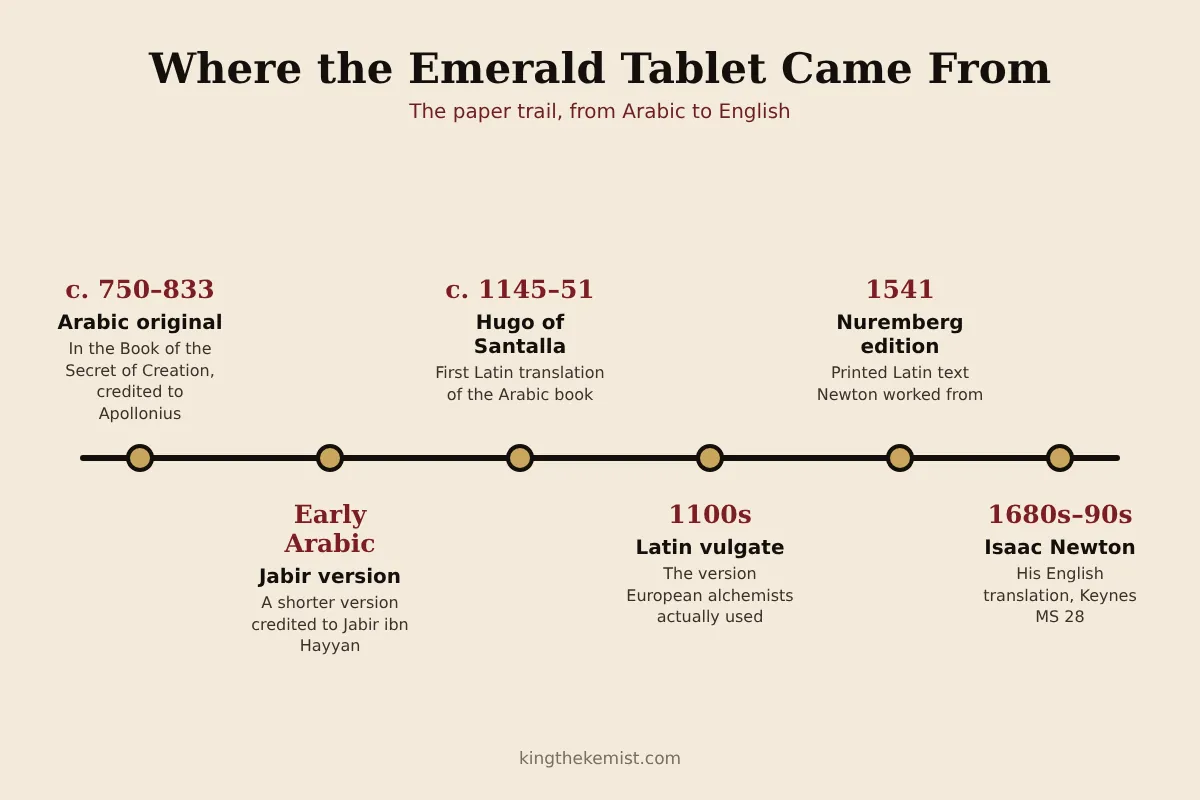
The oldest known version is Arabic, not Egyptian. It appears in the Book of the Secret of Creation (Sirr al-Khaliqa), an Arabic work compiled in the late 8th or early 9th century. Scholars' estimates run from about 750 to 833. The book presents itself as a translation of a work by Apollonius of Tyana, a first-century Greek philosopher.
It comes with a great origin story. In that book, a sage named Balinus discovers the tablet in a crypt beneath a statue of Hermes. Whether you believe that or not, it's a hell of an opening scene.
Another early Arabic version is credited to Jabir ibn Hayyan. It's shorter, with several lines missing.
It reached Europe in the 1100s. Hugo of Santalla translated the Book of the Secret of Creation into Latin around 1145 to 1151, but that version didn't spread much. A different Latin version from the first half of the 12th century, often called the "vulgate," became the one European alchemists used.
Isaac Newton translated it. His English translation, along with his own notes, survives in a manuscript at King's College, Cambridge, known as Keynes MS 28. Historian Betty Jo Teeter Dobbs dated his English translation to the late 1680s or early 1690s.
So: an Arabic text, attributed to a legendary Greco-Egyptian sage, translated into Latin in the Middle Ages and into English by the most famous scientist in history. That's the Emerald Tablet.
The full text (Isaac Newton's translation)
Here's Newton's translation, split into numbered lines the way it's usually presented. I've kept his spelling and his "&" signs. It's public domain, written more than 300 years ago.
- Tis true without lying, certain & most true.
- That which is below is like that which is above & that which is above is like that which is below to do the miracles of one only thing.
- And as all things have been & arose from one by the mediation of one: so all things have their birth from this one thing by adaptation.
- The Sun is its father, the moon its mother, the wind hath carried it in its belly, the earth is its nurse.
- The father of all perfection in the whole world is here.
- Its force or power is entire if it be converted into earth.
- Separate thou the earth from the fire, the subtle from the gross sweetly with great industry.
- It ascends from the earth to the heaven & again it descends to the earth and receives the force of things superior & inferior.
- By this means ye shall have the glory of the whole world & thereby all obscurity shall fly from you.
- Its force is above all force. For it vanquishes every subtle thing & penetrates every solid thing.
- So was the world created.
- From this are & do come admirable adaptations whereof the means is here in this.
- Hence I am called Hermes Trismegist, having the three parts of the philosophy of the whole world.
- That which I have said of the operation of the Sun is accomplished & ended.
That's it. That's the whole thing alchemists spent centuries trying to decode. Alchemy is older than the Tablet, but few texts shaped how later alchemists talked about their work more.
Line by line, in plain English
Here's how I read each line. I'll tell you what alchemists generally took it to mean, and what I take from it. These are interpretations. Nobody has the official answer key, and anybody who tells you they do is selling something.
1. "Tis true without lying, certain & most true."
The meaning: This is the opening stamp. Three ways of saying "listen up, this is real."
My take: Every great song opens with a line that makes you pay attention. This is that. It's also a little funny. When somebody tells you three times that they're not lying, you lean in. 😂
2. "That which is below is like that which is above..."
The meaning: The famous one. The higher world and the lower world mirror each other, and together they make the "miracles of one only thing." Heaven and earth, spirit and matter, the universe and the person all follow the same pattern.
My take: This is the line that became "as above, so below." I wrote a whole article on it. Short version: the small stuff and the big stuff are built the same way. Your daily habits are the small version of your life.
3. "...all things have their birth from this one thing by adaptation."
The meaning: Everything comes from one source, and it takes different forms by adapting. One thing, many shapes.
My take: One person can be a musician, a comedian, a writer and a guy who talks about money, and still be one person. That's basically my whole brand. I wrote about it in I Was Never One Thing. Different forms, one source.
4. "The Sun is its father, the moon its mother..."
The meaning: The "one thing" has parents. The Sun (in alchemy, gold, the active masculine principle) and the Moon (silver, the receptive feminine principle). The wind carries it, like a pregnancy. The earth nurses it, like a baby. It's a birth story for the philosopher's stone.
My take: Nothing great comes from one energy alone. A song needs the hard push and the soft feel. A relationship needs both people. Opposites working together make the new thing.
5. "The father of all perfection in the whole world is here."
The meaning: This one thing is the source of all perfection. Newton used "perfection" for an obscure Latin word, telesmus, that translators have argued over for centuries.
My take: Whatever you think the "one thing" is, the Tablet's saying it's the source of everything that's complete and finished. Alchemists thought it was the stone. Mystics think it's spirit. I think about it as the moment a creative work goes from almost to done.
6. "Its force or power is entire if it be converted into earth."
The meaning: The power is complete when it's made solid, grounded, brought down into physical form.
My take: This is my favorite practical line. An idea isn't worth much until you make it real. A song in your head isn't a song. A plan isn't a business. The power is "entire" when it hits the earth. Release the thing.
7. "Separate thou the earth from the fire, the subtle from the gross sweetly with great industry."
The meaning: The lab instruction. Separate the fine, light, refined part from the heavy, coarse part. Do it gently ("sweetly") but with serious effort ("great industry"). Alchemists read this as the purification stage of the work.
My take: This is editing. It's how a rough demo becomes a finished song. Keep what shines, cut what's dead weight, do it carefully, and don't be lazy about it. Same goes for your schedule, your circle and your closet. Sweetly, but with great industry.
8. "It ascends from the earth to the heaven & again it descends to the earth..."
The meaning: The substance rises and falls, like vapor in distillation going up and coming back down. Each cycle gathers the power of both the higher and lower worlds.
My take: Growth isn't a straight line up. You rise, you come back down, you rise again, and each time you carry a little more with you. If you're in a "descend" season right now, that's part of the process, not the end of it.
9. "By this means ye shall have the glory of the whole world & thereby all obscurity shall fly from you."
The meaning: Do the work right and you get the reward: glory and clarity. The darkness, confusion or "obscurity" leaves.
My take: The payoff of doing the work isn't just success. It's clarity. You finally understand what you were confused about. That's the part people don't talk about enough.
10. "Its force is above all force..."
The meaning: This power beats everything. It overcomes the subtle and penetrates the solid. Nothing is too fine or too hard for it.
My take: Consistency. Seriously. Showing up every day beats talent, beats luck, beats excuses. It gets through the hard stuff and the delicate stuff. Nothing else on this list does that.
11. "So was the world created."
The meaning: The process the Tablet just described is the same process that created the world. The alchemist in the lab is copying creation.
My take: Making something from nothing is about the closest a person gets to creation. A blank session becomes a song. A blank page becomes a book. Same move, smaller scale.

12. "From this are & do come admirable adaptations..."
The meaning: Wonderful new forms come from this process, and the method is right here in the text.
My take: Once you learn the process, you can apply it to anything. That's the point of studying patterns.
13. "Hence I am called Hermes Trismegist, having the three parts of the philosophy of the whole world."
The meaning: The author explains his title, "Thrice-Great," by claiming mastery of the three parts of universal wisdom. People have argued for centuries about what the three parts are. Some say alchemy, astrology and theurgy (divine magic). Others say body, soul and spirit.
My take: I like the body, soul and spirit reading. Take care of all three and you're doing the full work.
14. "That which I have said of the operation of the Sun is accomplished & ended."
The meaning: The "operation of the Sun," the making of gold or the perfect substance, has been fully explained. The end.
My take: Every good piece of work needs an ending that lands. This one does. "I said what I said." 😂

What the Emerald Tablet meant to alchemists
For European alchemists from the Middle Ages through Newton's time, the Tablet was close to sacred. They read it as a coded recipe for the philosopher's stone, the substance that would turn base metals into gold and maybe heal the body.
Read with that lens:
- The "one thing" is the stone or its raw material.
- The Sun and Moon are gold and silver, or sulfur and mercury.
- "Separate the earth from the fire" is purification and distillation.
- "It ascends... and descends" is repeated distillation, vapor rising and condensing.
- "Converted into earth" is making it solid, the finished stone.
Newton took it seriously enough to translate it and write commentary on it. His alchemical papers are huge, by most estimates around a million words, and the Tablet was part of that obsession.
What it means to people now
Today the Tablet lives in three main places.
Hermeticism and the occult. Groups and writers who follow Hermetic ideas treat it as a foundational text. The 1908 book The Kybalion built its "Principle of Correspondence" on line two.
Psychology and self-development. Following Carl Jung, a lot of people read alchemy, and the Tablet, as a map of inner transformation: break down, purify, integrate, become whole.
Pop culture. It shows up in fantasy novels, anime, video games, tattoos and music. Sometimes accurately. Mostly as cool-looking mystery.

Myths about the Emerald Tablet
"It's thousands of years old and came from ancient Egypt." The oldest version we can actually date is Arabic, from around the 8th or 9th century. It claims an ancient Egyptian author, but there's no evidence of an older Egyptian original.
"There's a real emerald tablet somewhere." No physical emerald tablet has ever been found. The text survives in manuscripts and books.
"It was written by Thoth the Atlantean." There's a separate 20th-century book called The Emerald Tablets of Thoth the Atlantean, published in the 1920s and 1930s by a writer named Maurice Doreal. It's a different text with a different origin and isn't the medieval Emerald Tablet. People mix them up constantly.
"It's a spell." It's a philosophical and alchemical text. Reading it out loud doesn't do anything except maybe impress your friends.
How to use the Emerald Tablet in real life
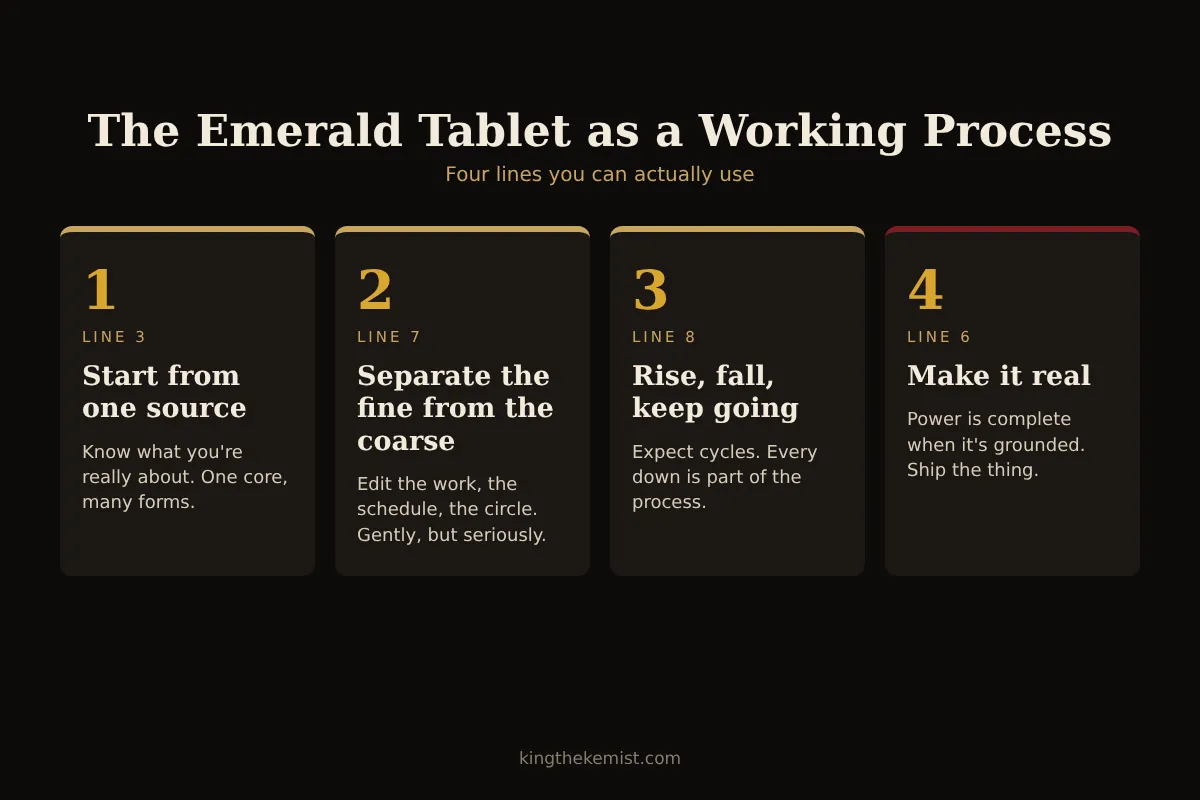
Here's my no-nonsense version, built from four lines.
- Start from one source (line 3). Know what you're actually about. One core, many forms.
- Separate the fine from the coarse (line 7). Edit your work, your schedule, your circle. Gently, but seriously.
- Rise and fall and keep going (line 8). Expect cycles. Each down is part of the process.
- Make it real (line 6). Power is complete when it's grounded. Ship the thing.
That's the Tablet as a working process. You don't need a lab, a robe or a candle. You need something you're trying to make better and the patience to work it.
Quick answers
What is the Emerald Tablet? A short, cryptic Hermetic text attributed to Hermes Trismegistus. It describes how one source creates everything and how to separate the fine from the coarse to make something perfect. Alchemists treated it as a key text for making the philosopher's stone.
How old is the Emerald Tablet? The oldest known version is Arabic, in the Book of the Secret of Creation, compiled in the late 8th or early 9th century. Scholars estimate about 750 to 833.
Who wrote the Emerald Tablet? It's attributed to Hermes Trismegistus, a legendary figure, but the real author is unknown.
Did Isaac Newton translate the Emerald Tablet? Yes. His English translation and notes survive in Keynes MS 28 at King's College, Cambridge, dated to the late 1680s or early 1690s.
Does the Emerald Tablet say "as above, so below"? Not in those exact words. Line two says that what is below is like what is above, and what is above is like what is below. "As above, so below" is the modern short version.
Is the Emerald Tablet real? The text is real and has survived in manuscripts for over a thousand years. No physical emerald tablet has ever been found.
Is the Emerald Tablet the same as The Emerald Tablets of Thoth? No. The Emerald Tablets of Thoth the Atlantean is a separate 20th-century book by Maurice Doreal.
What is the "one thing" in the Emerald Tablet? Alchemists generally read it as the philosopher's stone or its raw material. Spiritual readers see it as spirit, the soul or the divine source.
Keep going
This is part of the Alchemy & Symbols section on KTK. Read What Is Alchemy? for the history and As Above, So Below for the Tablet's most famous line. Next: The Kybalion and the 7 Hermetic Principles.
Accomplished and ended
Here's where I've landed.
Fourteen lines. A thousand years of people trying to crack them. And the most useful parts aren't the secret ones. They're the ones you can actually do: know your source, cut the dead weight, ride the cycles, and make the thing real.
That's the operation of the Sun. Go do it.
Sources
- Wikipedia: Emerald Tablet
- The Newton Project: Keynes MS 28, Newton's translation of the Tabula Smaragdina
- Newton's translation of the Emerald Tablet
- Science History Institute: Chasing the Clues in Isaac Newton's Manuscripts
- Wikipedia: The Kybalion
— King