Alchemy & Symbols
As Above, So Below: What It Really Means (and Where It Comes From)
"As above, so below" is on tattoos, album covers and half of spiritual Instagram. Here's where it really comes from, what it meant to alchemists and how to actually use it.

"As above, so below."
You've seen it. On tattoos, on T-shirts, in captions under a sunset, on half the tarot accounts on the internet. People say it like everybody already agrees on what it means.
Most people don't. And the real version is better than the caption version.
Here's the short answer: "As above, so below" means that the big picture and the small picture follow the same pattern. What happens in the heavens is mirrored on earth. What happens in the universe is mirrored in a person. What's going on inside you shows up outside you. Learn one level and you start understanding the other.
The phrase comes from the Emerald Tablet, a short, mysterious text attributed to Hermes Trismegistus that alchemists treated like scripture for centuries. Isaac Newton translated it himself. The four-word version most people know got popular much later, in the 1800s and early 1900s.
If you read What Is Alchemy?, this is the idea sitting underneath the whole thing. Here's where the phrase actually comes from, what it meant to the people who first wrote it, what it means now, and how to actually use it.

Where "as above, so below" comes from
The phrase is a paraphrase of a line from the Emerald Tablet (in Latin, the Tabula Smaragdina).
The Tablet is traditionally credited to Hermes Trismegistus, "Hermes the Thrice-Great," a legendary sage who blends the Greek god Hermes with the Egyptian god Thoth. Nobody believes a real person named Hermes Trismegistus wrote it. It's what scholars call pseudepigrapha: a text written under the name of a famous figure to give it authority.
Here's what the record actually shows:
- The oldest known version is in Arabic. It appears in the Book of the Secret of Creation (Sirr al-Khaliqa), compiled in the late 8th or early 9th century. Scholars' estimates run from about 750 to 833.
- The story attached to it is wild. In that book, a sage named Balinus finds the emerald tablet in a crypt under a statue of Hermes.
- It reached Europe in Latin in the 1100s. The most influential Latin version, the one later alchemists used, dates to the first half of the 12th century.
- Isaac Newton translated it into English. His handwritten translation survives at King's College, Cambridge, dated to the late 1680s or early 1690s.
In Newton's translation, the key line reads:
"That which is below is like that which is above & that which is above is like that which is below to do the miracles of one only thing."
That's it. That's the source. "As above, so below" is the short, catchy version of that sentence.
Who made the short version famous?
Not Hermes and not Newton.
The compressed four-word phrase was popularized in modern occult circles. The Russian-born occultist Helena Blavatsky, who co-founded the Theosophical Society in the 1870s, helped spread it. Then in 1908, a Chicago book called The Kybalion, credited to "Three Initiates" and usually attributed to the New Thought writer William Walker Atkinson, turned it into one of seven "Hermetic principles." It calls it the Principle of Correspondence and words it like this:
"As above, so below; as below, so above."
From there it went everywhere: New Age books, occult orders, astrology, tattoo shops, album covers and your cousin's Instagram bio.

What it originally meant
To the alchemists who used the Emerald Tablet, this line wasn't a vibe. It was a working theory of the universe.
They believed reality was built in layers that matched each other:
- The heavens and the earth. The seven planets they could see corresponded to the seven metals they knew. The Sun matched gold, the Moon matched silver, Saturn matched lead. What happened above was reflected below.
- The universe and the human body. This is the idea of the macrocosm (the big world) and the microcosm (the small world, meaning you). A person was seen as a miniature universe, with the same forces running through them.
- Spirit and matter. What happens in the invisible world shows up in the visible one, and the other way around.
The rest of the Tablet backs this up. In Newton's translation it goes on: "And as all things have been & arose from one by the mediation of one: so all things have their birth from this one thing by adaptation." One source, many forms. Same pattern at every level.
For an alchemist, that meant you could study the sky to understand metals, study metals to understand the soul, and work on yourself to understand the work in the flask.
What it means today
Today, people use "as above, so below" in a few different ways. Some of them are close to the original. Some are a stretch. Here's an honest breakdown.
1. Inner and outer life mirror each other. The most common modern reading: your inner world shapes your outer world, and your outer world shapes your inner world. Chaotic mind, chaotic room. Clean room, clearer head. This is the reading I find most useful.
2. Small patterns repeat at big scales. Spirals in a seashell, spirals in a hurricane, spirals in a galaxy. Branching in a tree, branching in rivers, branching in your lungs. People use the phrase to point at those repeating shapes.
3. Astrology. Astrologers use it to explain why the positions of planets might mirror events and personalities on earth. Quick reality check: astrology isn't science. I love Libra content as much as anybody, and I talk about it plenty on this site. But the phrase is a philosophy, not proof that astrology works.
4. Manifestation and the law of attraction. Some people read it as "what you think, you'll receive." That's a big modern leap. The Tablet doesn't promise you a Bentley for visualizing hard enough. I'll leave it there. 😂
5. Spiritual awakening. Others use it to mean the divine is reflected in you, and you in the divine. That's closer to the Hermetic roots, even if every tradition puts it a little differently.

How I actually use it
I'm not a mystic who sits in a cave. I'm a guy who makes music, writes, does comedy, talks about money and tries to keep his life in order. Here's how "as above, so below" actually shows up for me.
My space and my head. A messy room and a messy head tend to show up together. I'm not saying tangled cables cause bad songs. I'm saying the state of a room usually matches the state of the person in it, and cleaning one helps the other.
Habits and results. The small stuff you do daily is the "below." The life you're building is the "above." If the daily pattern is sloppy, the big picture eventually is too. If the daily pattern is tight, the big picture follows. It's the same pattern at two scales.
Music and life. Whatever's going on in an artist's life ends up in the song. Heartbreak, joy, confusion, a good week, a bad month. And a finished song can show you something about the situation you couldn't see before. Above to below, below to above. I wrote more about this in Creative Flow Is Not Something You Can Bully Into the Room.
Relationships. The way someone treats small things usually tells you how they'll treat big things. How they talk to a waiter, how they handle a late order, how they act when they're tired. Small pattern, big pattern. Pay attention to the "below." I wrote about that side of it in Emotional Maturity Is Sexy.

Patterns you can see for yourself
You don't have to take anybody's word for the idea that small and big things share shapes. Go outside and look.
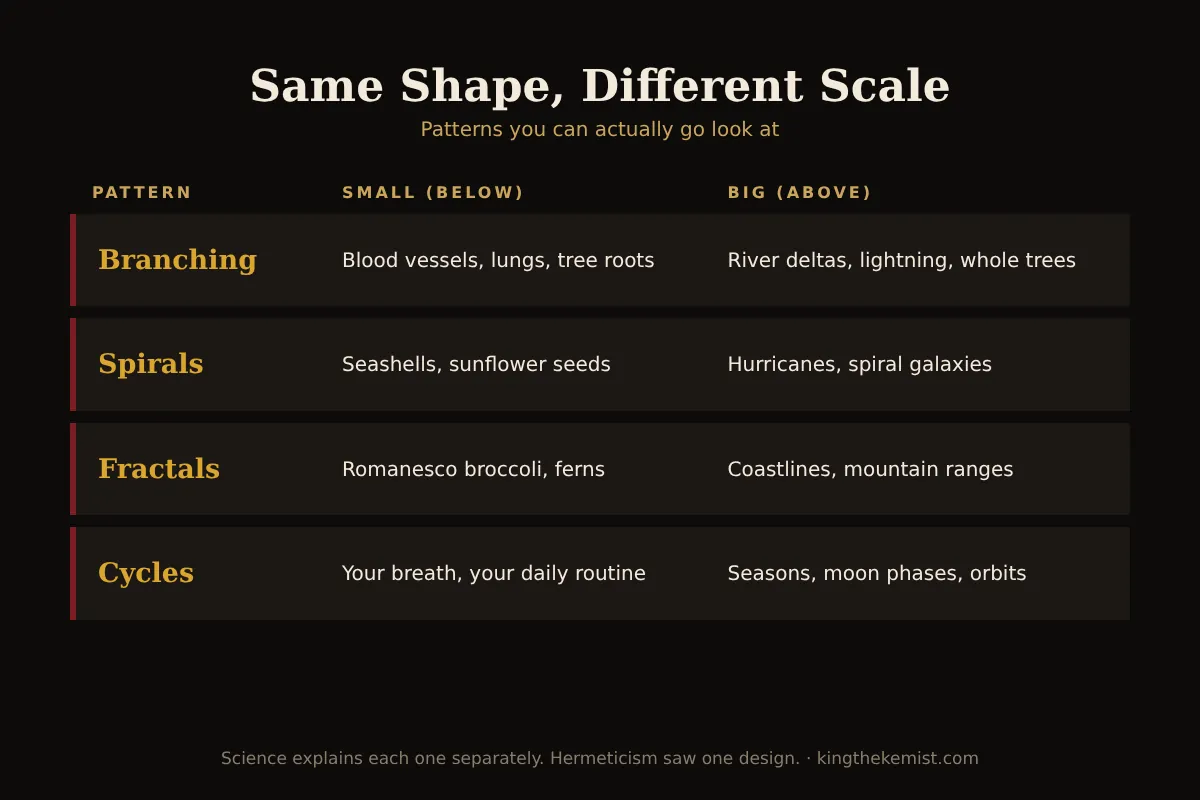
Branching. A tree's branches split again and again into smaller branches. So do its roots underground. So do rivers when they spread into a delta, so does lightning, and so do the airways and blood vessels inside your body. Same shape, wildly different scales.
Spirals. You'll find spirals in a seashell, in the seeds of a sunflower, in the shape of a hurricane seen from space and in the arms of a spiral galaxy. Different causes, same form.
Fractals. Some shapes repeat themselves when you zoom in. A coastline looks jagged from a plane and still jagged when you're standing on the rocks. Romanesco broccoli is made of little cones that are made of smaller cones. Mathematicians call these patterns fractals.
Scientists explain all of this with physics, chemistry, biology and math: how water flows, how growth works, how forces balance. That's the real explanation, and it's beautiful on its own. But you can see why people a thousand years ago, without microscopes or satellites, looked at a world full of repeating patterns and decided everything was connected by one design.
Similar ideas in other places
The Hermetic tradition isn't the only one that pictured heaven and earth mirroring each other.
The Lord's Prayer. "Thy will be done, on earth as it is in heaven." It's a different text with a different meaning, a prayer that heaven's order show up on earth. But you can hear why people connect the two.
The microcosm in Renaissance art. Leonardo da Vinci's famous drawing of a man inside a circle and a square, the Vitruvian Man, came out of an old idea that the proportions of the human body reflect the order of the larger world. The body as a small universe is an idea that ran all through Renaissance thinking.
Astrology everywhere. Ancient Babylonian, Egyptian, Greek, Indian and Chinese cultures all watched the sky and tied it to life on the ground in their own ways. "As above, so below" is the Hermetic way of saying something a lot of humans were already feeling.
I'm not saying all of these mean the same thing. They don't. I'm saying the instinct is old and it's everywhere: the big world and the small world should make sense together.
As above, so below in a song
Here's the music version, because that's where I live.
A song is a small world. It has a structure, a rhythm, a high point, a release. And the best songs are built like the life they're about.
The verses are the "below." The details. The specific street, the text message, the thing she said in the kitchen. The small, real moments.
The chorus is the "above." The big feeling that all those details add up to. The thing everybody can sing along to because everybody's felt it.
When the verses and the chorus match, when the details actually lead to the big feeling, the song works. When they don't, you can feel it, even if you can't say why. Same with a life. The daily details have to add up to the big thing you say you're about. If they don't, people can feel that too.
That's why the details in a verse matter so much. The small stuff has to carry the big stuff.
"As above, so below" and the rest of the Emerald Tablet
The phrase gets quoted alone, but it's line two of a longer text. Some other lines from Newton's translation are just as good:
- "The Sun is its father, the moon its mother." Opposites working together to make something new.
- "Separate thou the earth from the fire, the subtle from the gross sweetly with great industry." Sort what's useful from what isn't, gently but with real work. That's basically what editing a song is.
- "Its force is above all force." Whatever this "one thing" is, it's the strongest power there is.
- "So was the world created." The process in the flask and the creation of the universe follow the same pattern. As above, so below.
I'm breaking the full Tablet down line by line in its own article, because it deserves it.
What "as above, so below" is not
A few things the phrase gets dragged into that it doesn't actually say:
It's not a magic spell. It's a philosophy about patterns and connection. Saying it doesn't make anything happen.
It's not satanic. The phrase shows up in a lot of dark imagery online, including some Baphomet artwork with one hand pointing up and one pointing down. My other brand, Code of Ascension, has a full breakdown of Baphomet. But the Emerald Tablet itself is an alchemical and philosophical text, and Christian, Muslim and secular alchemists all used it.
It's not proof of anything scientific. Repeating patterns in nature are real and fascinating, but scientists explain them with physics and biology, not with the Emerald Tablet. The phrase is a lens, not a lab result.
It's not only about the sky. "Above" can mean the heavens, the big picture, the spirit, the long-term vision or your higher self. "Below" can mean the earth, the details, the body, the daily habits. The point is the relationship between them.

A simple way to put it to work
Here's an exercise to try when something feels off and you can't figure out why.
- Name the "above." What's the big-picture thing that feels wrong? Money, a relationship, a creative project, your health, your mood.
- Look at the "below." What are the small daily patterns connected to it? What do you actually do every day, not what you plan to do?
- Find the match. Where does the small pattern look like the big problem? Messy spending, messy accounts. Avoiding small conversations, a relationship that feels distant. Skipping sessions, a song that never gets finished.
- Change one small thing. Not ten. One. Then watch whether the big picture shifts.
It's not mystical. It's just noticing that your life runs on the same pattern at every scale, and that the small scale is the one you can actually touch today.

Why this phrase hits so hard
I think "as above, so below" survived 1,200 years and jumped from Arabic manuscripts to Newton's desk to tattoo parlors because it says something people feel but can't always explain: everything is connected, and you're part of it.
You're not separate from the universe, looking at it from the outside. You're a smaller version of the same thing. The same forces that make stars and storms and seasons are running through you. That can feel like a lot. It can also feel like home.
For me, it's a reminder that nothing is too small to matter. The little choices count. The daily stuff counts. The room counts. The song counts. Because the small world and the big world are built the same way.

Quick answers
What does "as above, so below" mean? It means the big picture and the small picture follow the same pattern. The heavens mirror the earth, the universe mirrors the person, and your inner life mirrors your outer life.
Where does "as above, so below" come from? It's a paraphrase of the second line of the Emerald Tablet, a Hermetic text attributed to Hermes Trismegistus. The oldest known version is Arabic, from the late 8th or early 9th century.
Is "as above, so below" in the Bible? No. It comes from the Emerald Tablet and Hermetic tradition, not the Bible. People sometimes compare it to "on earth as it is in heaven" from the Lord's Prayer, but they're different texts.
Who said "as above, so below"? The idea comes from the Emerald Tablet. The short four-word phrase was popularized in the 19th and early 20th centuries, including by Helena Blavatsky and The Kybalion (1908).
What is the full quote? In Isaac Newton's translation of the Emerald Tablet: "That which is below is like that which is above & that which is above is like that which is below to do the miracles of one only thing."
Is "as above, so below" satanic? No. It's a Hermetic and alchemical idea used by people of many faiths. It sometimes appears in dark occult artwork, but the phrase itself isn't satanic.
What does "as within, so without" mean? It's a modern extension of the same idea: your inner world and your outer world reflect each other.
What is the Principle of Correspondence? It's the name The Kybalion gives to "as above, so below," one of its seven Hermetic principles.
Keep going
This is part of the Alchemy & Symbols section on KTK. Start with What Is Alchemy? if you haven't. Next up: The Emerald Tablet, Line by Line and The Kybalion and the 7 Hermetic Principles.
The pattern is the point
Here's where I've landed.
You don't need to know exactly how the universe works to see that life runs on patterns. The way you treat your mornings shows up in your year. The way you treat people shows up in who stays. The way you treat your art shows up in the art.
As above, so below. As within, so without.
Start with the small stuff. It's the same stuff.
Sources
- Wikipedia: Emerald Tablet
- The Newton Project: Keynes MS 28, Newton's translation of the Tabula Smaragdina
- Newton's translation of the Emerald Tablet
- Wikipedia: The Kybalion
- Britannica: Alchemy
— King