Alchemy & Symbols
What Is Alchemy? The Real History, the Symbols and the Inner Work
Lead into gold is only part of the story. Alchemy was chemistry, medicine and inner transformation all at once. Here's the real history, the symbols, and why a guy named The Kemist cares.

My name is King The Kemist. So yeah, people ask me about alchemy. 😂
Usually it's some version of: "Is that like, turning lead into gold?" And the honest answer is yes, that's part of it. But if that's all you think alchemy is, you're missing the best part of the story.
Alchemy is the old art of transformation. For close to two thousand years, people in Egypt, China, India, the Islamic world and Europe tried to change matter: turn cheap metals into gold, make medicines that could cure anything, maybe even beat death. Along the way they built labs, invented equipment and discovered real chemistry. And a lot of them believed the work was happening inside them too, not just in the flask.
That last part is why the name fits me. I'm not out here melting lead in my kitchen. But taking whatever life hands you, the joy, the pain, the lessons, the rhythm, and turning it into something honest? That's the whole KTK idea. I wrote about it in I Was Never One Thing. This is the history behind the word.
Here's what alchemy actually was, where it came from, what the symbols mean, whether anybody ever pulled it off, and how the idea still works in real life.
The short answer
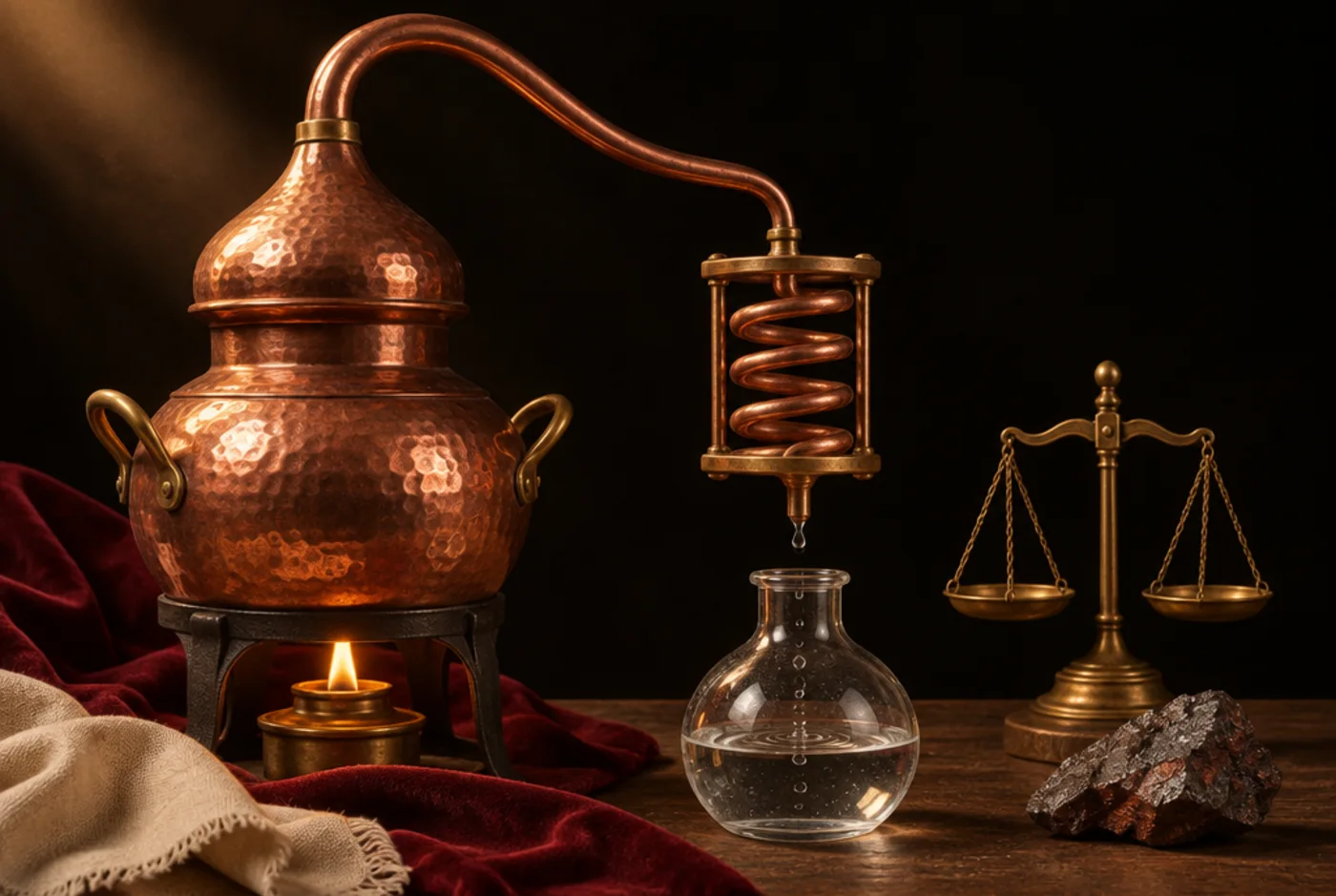
Britannica describes alchemy as a form of speculative thought that tried to turn base metals into silver or gold and to find a cure for disease and a way to extend life. The key idea underneath all of it was transmutation: change. Change in metals, change in the body, and for some alchemists, change in the soul.
So when someone asks "what is alchemy," the most accurate one-line answer is:
Alchemy was the pre-modern science, craft and philosophy of transformation.
It wasn't one thing. It was chemistry before chemistry, medicine before modern medicine, and a spiritual practice all mixed together, depending on who was doing it and where.
Where the word comes from
Nobody knows for sure, and anybody who tells you otherwise is guessing.
Here's what the record shows. The English word comes from Medieval Latin alkimia, which came from the Arabic al-kimiya, which came from a Greek word. According to the Online Etymology Dictionary, the Greek form shows up around 300 CE in a decree of the Roman emperor Diocletian. Past that, the origin is uncertain.
One popular theory ties it to an old name for Egypt. Plutarch used Khemia, glossed as "land of black earth," for the dark, fertile soil along the Nile. Another theory points to a Greek word related to pouring or casting metal. The etymology dictionary says the word seems to have elements of both, and Britannica says the origin of the root "chem" is uncertain.
What's not uncertain: "alchemy" and "chemistry" come from the same root. When you say the word chemistry, you're saying alchemy without the "al."
And yes, I'm aware that a guy who spells his name "Kemist" is having a good time with that. 😂
Alchemy started in more than one place
Most people picture alchemy as a European thing: old men with long beards in castle towers. That's one chapter. It's not the start.
Hellenistic Egypt. Britannica traces Western alchemy to roughly 300 BC to AD 300, centered in Greek-speaking Egypt. The earliest alchemist it considers authentic is Zosimos of Panopolis, who wrote about color changes, distillation and "spirits." Zosimos described a substance called "the tincture" or "the powder" that could cause transformation. That idea traveled into Arabic as elixir and into Latin as the philosopher's stone.
China. Chinese alchemy may be even older than the Western tradition. Its focus was the search for physical immortality through elixirs, and it later became tied to Taoism. Britannica notes it faded partly because elixirs poisoned people. Imagine finding out your immortality potion was the thing killing you. That's a hell of a plot twist.
India. Hints show up in the Vedas, but Indian alchemy developed mainly through Tantrism from about 1100 to 1300. Medicine was the main concern. Gold-making was a side quest.
The Islamic world. Scholars in Baghdad and beyond took Greek alchemy, tested it, expanded it and wrote it down. The name Jabir ibn Hayyan is attached to a large collection of these writings. Britannica calls the Persian physician ar-Razi (about 850 to 924) the high point of Arabic alchemy.
Europe. Arabic texts were translated into Latin in the Middle Ages, and alchemy spread through Europe. That's where you get the famous names: Nicolas Flamel, a Paris scribe and bookseller whom later legend turned into the alchemist who completed the Great Work (the writings behind that legend showed up about two centuries after he died), and Paracelsus, who changed the whole direction of the field.
What were alchemists actually trying to do?
Three big goals show up again and again.
1. Turn base metals into gold. This one is called chrysopoeia. The logic went like this: metals grow and mature in the earth, gold is the most "perfect" metal, so with the right process you could speed up nature and perfect a lesser metal.
2. Find the philosopher's stone. This was the substance that would make transmutation possible. It wasn't really pictured as a rock. Britannica quotes the alchemists' own phrase for it: "a stone which is not a stone." Some texts described it as a powder, a tincture or a red substance.
3. Make the elixir of life. A universal medicine. Cure every disease, extend life, maybe end death. This goal was strongest in China, but it ran through Western alchemy too.
There was a fourth goal for a lot of practitioners, and it's the one that still matters most to me:
4. Transform the person doing the work. For many alchemists, purifying a metal and purifying yourself were the same project. The lab work was also a spiritual discipline. You couldn't make gold if you were still lead.
The building blocks: elements, principles and metals
Alchemists had their own way of explaining what everything is made of. You'll see these ideas in the symbols on old drawings, on tattoos, on album covers and all over Pinterest.
The four elements. Earth, water, air and fire, inherited from ancient Greek philosophy. Everything was thought to be a mix of these in different amounts.
The three principles. Paracelsus, who lived from 1493 to 1541, added his own system, often called the tria prima. According to a University of Illinois history of chemistry exhibit, he said every substance had three principles:
- Salt: the solid part, what stays.
- Sulfur: the flammable, "fatty" part, what burns.
- Mercury: the vaporous, fluid part, what flows and rises.
These weren't the salt in your shaker or the mercury in an old thermometer. They were qualities. Body, soul and spirit, if you want the spiritual reading.
The seven metals and their planets. Ancient people knew seven metals and seven moving lights in the sky, and alchemists paired them up.

| Metal | Planet | Symbol |
|---|---|---|
| Gold | Sun | ☉ |
| Silver | Moon | ☾ |
| Mercury | Mercury | ☿ |
| Copper | Venus | ♀ |
| Iron | Mars | ♂ |
| Tin | Jupiter | ♃ |
| Lead | Saturn | ♄ |
That's why the symbol for copper is the same as the symbol for Venus, and the symbol for iron is the same as the symbol for Mars. When people talk about turning lead into gold, they're also talking about going from Saturn, the heavy, slow, restrictive one, to the Sun.
The Great Work: four colors, four stages
The full alchemical process was called the Magnum Opus, the Great Work. It was usually described as a series of color changes, because that's literally what alchemists watched happen in their flasks.
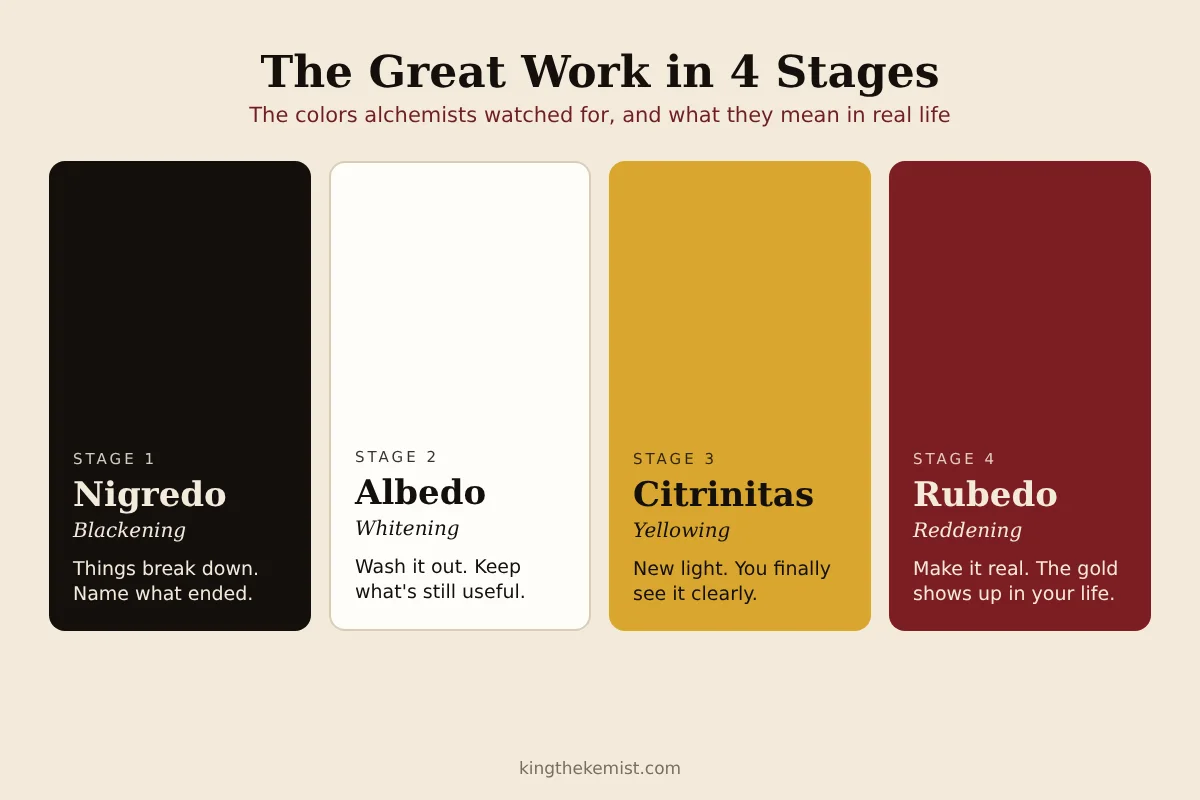
- Nigredo, the blackening. Everything breaks down. Decay, burning, rot, darkness. The raw material has to be destroyed before it can become something else.
- Albedo, the whitening. Washing and purifying. What's left after the breakdown gets cleaned up.
- Citrinitas, the yellowing. The dawn. In some texts this stage stands for a new inner light, the moment the "solar" light shows up and you don't need borrowed light anymore.
- Rubedo, the reddening. Completion. The philosopher's stone, the gold, the finished work.
Not every alchemist used all four. Some texts list three stages, some list more, and the order and meaning shifted over time. But black, white, yellow and red is the version most people recognize today.
Read that list again and tell me it doesn't sound like every breakup, career change or rebuild you've ever been through. That's not an accident, and we'll get to why.
So did alchemy work?
Depends what you mean by "work."
Gold-making didn't work. Not the way alchemists hoped. No one turned a pot of lead into a bar of gold with fire, acids and patience. We know why now: changing one element into another means changing the number of protons in the nucleus of an atom. You can't do that with a furnace. That takes nuclear physics.
But the lab work was real, and it built chemistry. Britannica points out that Europe didn't even have a separate word for the science of matter. Learning alchemy was learning chemistry. Alchemists developed distillation equipment and techniques, and over about three centuries they discovered the mineral acids. By the late 1500s, Britannica says, alchemists "began to move en masse into pharmacy." Paracelsus pushed the field toward medicine. Instead of chasing gold, he wanted chemistry to make better medicines.
Even Isaac Newton was in it. The guy who gave us the laws of motion and gravity spent years on alchemy. According to the Science History Institute, his alchemical manuscripts run to about a million words. Indiana University's Chymistry of Isaac Newton project has been putting them online. Newton spent years trying to decode alchemical texts full of code names and metaphors, comparing authors to triangulate what they meant.
And then modern physics actually did it. Here's the part that makes me laugh. In 1980, researchers at Lawrence Berkeley National Laboratory, with Nobel winner Glenn Seaborg as senior author, used a particle accelerator to turn bismuth, which sits right next to lead on the periodic table, into tiny amounts of gold. According to Scientific American, Seaborg said making gold that way "would cost more than one quadrillion dollars per ounce," at a time when gold sold for about $560 an ounce.

Then in May 2025, CERN's ALICE experiment reported that near-miss collisions between lead nuclei in the Large Hadron Collider were turning lead into gold. When a lead nucleus, with 82 protons, loses three protons, it becomes gold, with 79. CERN says up to about 89,000 gold nuclei per second were being made at the ALICE collision point. Across the LHC's second run, from 2015 to 2018, the four major experiments produced about 86 billion gold nuclei. Total weight: 29 picograms. That's 0.000000000029 grams, and each nucleus lasted only a tiny fraction of a second.

So the alchemists were right that lead could become gold. They were just about 2,000 years and a 27-kilometer particle collider early. 😂
The inner alchemy: why it still matters
Here's the part of alchemy that never died.
In the 20th century, the Swiss psychiatrist Carl Jung studied alchemical texts and decided alchemists weren't only describing chemistry. He believed they were also projecting their own inner process onto the work. He wrote about it in Psychology and Alchemy and later books. In Jung's reading, the stages of the Great Work map onto stages of personal growth: the nigredo is facing your shadow, the albedo is working with what you find, and the rubedo is becoming whole.
You don't have to buy everything Jung said to see why that clicks. Every real transformation in a person's life goes through some version of:
- Something breaks.
- You sit in the mess.
- You clean up what's left.
- You finally see clearly.
- You build something new and make it real.
That's the Great Work. And it's why "alchemy" shows up everywhere now: in self-development, in music, in therapy language, in tattoos, in brand names. People don't use the word because they want to make gold. They use it because they want to believe they can turn what hurt them into something worth something.
I believe that too.

Why a guy named The Kemist cares about this
I picked this name on purpose. I was never one thing. I make music. I write. I do comedy. I talk about money, Libra shit, friendship and whatever else is on my mind. People kept telling me to pick one lane.
Alchemy gave me a better way to think about it. An alchemist doesn't pick one ingredient. He takes everything on the table, the heavy stuff and the light stuff, and works it until it becomes something new.
That's what music can do. A bad week can become a hook. A conversation can become a verse. A memory can become a beat. I wrote about how that feels in Creative Flow Is Not Something You Can Bully Into the Room, and about the chills a song can give you in That Chill Down Your Spine Has a Name: Frisson.
It's also why I'm not interested in the version of alchemy that's all secret handshakes and gatekeeping. The best alchemists wrote things down. They shared notes, argued, tested and passed it on. So that's what this section of the site is going to be: the history, the symbols and the ideas, in plain English, with my take on top.
How to use the Great Work in real life
You don't need a lab. You need a situation that's heavy and a willingness to work it. Here's how to use the four stages as a check-in when something in your life is falling apart or changing.
Nigredo: name what's breaking down. Don't rush past it. What actually ended? What's not working anymore? Write it down plainly. Most people try to skip straight to gold and wonder why nothing changes.
Albedo: clean it up. What's left that's still useful? What lesson, what skill, what relationship survived? Throw out the rest. This is the honest part, and it's usually the uncomfortable part.
Citrinitas: look for the new light. What do you see now that you couldn't see before? A new idea, a better boundary, a different direction. This is the "oh, that's what that was about" moment.
Rubedo: make it real. Gold that stays in the flask doesn't count. Release the song. Send the email. Start the thing. Leave the situation. Transformation isn't finished until it shows up in your actual life.
Try it on a creative project, a money reset or a relationship. It's simple, and it works because it doesn't let you skip steps.
Common myths about alchemy
"Alchemy was just fake science." Not really. It was the science people had. Alchemists did real experiments, invented real equipment and discovered real substances. The theory was wrong in a lot of places. The work was real.
"Alchemy was only about gold." Gold was one goal. Medicine, long life and spiritual transformation mattered just as much, and in China and India they mattered more.
"Alchemy was evil or satanic." Plenty of alchemists were devout Christians, Muslims or Taoists. Isaac Newton was deeply religious. Alchemy borrowed religious and mystical language, but it wasn't devil worship.
"Nobody believes in it anymore." People still practice spiritual alchemy, study Hermetic philosophy and use alchemical symbols today. And physicists have made gold from other elements. Just not enough to pay rent.
Quick answers
What is alchemy in simple words? Alchemy was the old practice of trying to transform things: cheap metals into gold, sickness into health, and an ordinary person into a better, wiser one. It was an early mix of chemistry, medicine and philosophy.
Is alchemy real? Alchemy was a real historical practice. Its goal of turning lead into gold with heat and chemicals didn't work, but modern particle accelerators have turned lead and bismuth into tiny amounts of gold.
Where did alchemy come from? Western alchemy traces to Greek-speaking Egypt around 300 BC to AD 300. China and India had their own separate traditions. The Islamic world expanded it, and Europe picked it up from Arabic texts.
What is the philosopher's stone? It was the legendary substance that would let an alchemist turn base metals into gold and possibly make an elixir of life. Alchemists described it as "a stone which is not a stone."
What are the stages of alchemy? The best-known version has four color stages: nigredo (black), albedo (white), citrinitas (yellow) and rubedo (red). They represent breaking down, purifying, awakening and completing.
Did Isaac Newton practice alchemy? Yes. His alchemical manuscripts run to about a million words, and Indiana University's Chymistry of Isaac Newton project is putting them online.
What's the difference between alchemy and chemistry? Chemistry grew out of alchemy. Alchemy mixed experiments with spiritual and symbolic ideas. Chemistry kept the experiments and the testing and dropped the rest.
What is spiritual alchemy? It's the idea that the stages of the Great Work describe personal transformation: facing what's broken, cleaning it up, gaining insight and becoming whole. Carl Jung popularized this reading in the 20th century.
Keep going
This is the start of the Alchemy & Symbols section on KTK. Keep reading: As Above, So Below: What It Really Means, The Emerald Tablet, Line by Line and The Kybalion and the 7 Hermetic Principles.
If you want the symbol side of this from a different angle, my other brand, Code of Ascension, breaks down the ouroboros, the snake eating its own tail, and Baphomet, where you'll see the alchemical phrase solve et coagula on the arms.

The real gold
Here's where I've landed.
Most of us aren't going to make gold in a lab. But everybody has lead. The bad year. The heartbreak. The job that drained you. The version of you that didn't work anymore.
Alchemy says that's not the end. That's the raw material.
So don't throw it away. Work it.
Sources
- Britannica: Alchemy
- Online Etymology Dictionary: Alchemy
- Science History Institute: Chasing the Clues in Isaac Newton's Manuscripts
- University of Illinois: From Alchemy to Chemistry, Paracelsus
- Scientific American: Fact or Fiction? Lead Can Be Turned into Gold
- CERN ALICE: ALICE detects the transformation of lead into gold at the LHC
— King