Alchemy & Symbols
The Kybalion and the 7 Hermetic Principles, Explained
Mentalism, correspondence, vibration and the rest. Here's what The Kybalion really is, who wrote it, what the seven principles mean, and how to use the good parts without getting played.

If you've spent any time in spiritual corners of the internet, you've seen the seven Hermetic principles. Mentalism. Correspondence. Vibration. Polarity. Rhythm. Cause and Effect. Gender. They show up in TikTok videos, manifestation books, tattoo ideas and posts that start with "the ancients knew."
Almost all of that comes from one book: The Kybalion.
Here's the part a lot of people skip. The Kybalion isn't an ancient Egyptian scroll. It was published in Chicago in 1908. That doesn't make it worthless. Some of its ideas are genuinely useful, and I think a few of them are dead-on about how life works. But you should know what you're reading before you build your whole worldview on it.
So here's the real story: what The Kybalion is, who probably wrote it, what the seven principles actually say, what's truly Hermetic and what's 1900s self-help, and how to use the good parts without getting played.
This is the fourth piece in the Alchemy & Symbols series. If you missed them, start with What Is Alchemy?, As Above, So Below and The Emerald Tablet, Line by Line.

What is The Kybalion?
The Kybalion: A Study of the Hermetic Philosophy of Ancient Egypt and Greece was published in 1908 by the Yogi Publication Society in Chicago. The author is listed as "Three Initiates." No names.
The book presents itself as an explanation of a secret collection of ancient Hermetic sayings, also called "the Kybalion," handed down from teacher to student. It quotes those sayings, then explains them. Its core is a list of seven principles that it claims are the foundation of the whole Hermetic tradition.
The writing is clear, confident and easy to follow, which is a big reason it took off. The real ancient Hermetic texts are dense, strange and poetic. The Kybalion reads like a lecture. You can see why people picked it up.
Who wrote it?
Most researchers attribute The Kybalion mainly to William Walker Atkinson (1862–1932), an American lawyer turned writer. Atkinson was a major voice in the New Thought movement, a late-1800s and early-1900s American philosophy built on the idea that your thoughts shape your health, success and reality. He wrote a huge number of books, many under pen names. One of the best known was "Yogi Ramacharaka," and the Yogi Publication Society that published The Kybalion was tied to him.
Whether two other people helped write it is still debated. What's clear is that the book came out of New Thought culture, not out of an ancient temple.
The famous opening lines
The Kybalion has some quotable lines. My two favorites:
"The lips of wisdom are closed, except to the ears of Understanding."
"When the ears of the student are ready to hear, then cometh the lips to fill them with Wisdom."
That second one echoes the old saying "when the student is ready, the teacher will appear," which has no clear single origin. Which, honestly, is true about a lot of things. You can hear the same advice ten times, and then on the eleventh time you're finally ready for it.

The 7 Hermetic principles, explained
Here's each principle the way The Kybalion states it, what it means in plain English, and my take on how it holds up.
1. The Principle of Mentalism
The line: "The All is Mind; the Universe is Mental."
What it means: Everything that exists comes from one universal Mind, which the book calls "The All." The universe is a mental creation of that Mind. And because your mind is part of it, your thoughts have creative power.
My take: This is the one that does the most heavy lifting in manifestation culture. I believe your mindset shapes your life in a real way. How you think affects what you notice, what you try, what you quit on and how you treat people. That's practical and true. Where I tap the brakes is when it turns into "think it hard enough and it'll fall in your lap." Thoughts point the way. Work gets you there.
2. The Principle of Correspondence
The line: "As above, so below; as below, so above."
What it means: The patterns on one level of reality match the patterns on other levels. The universe and the person, the spiritual and the physical, the big and the small all mirror each other.
My take: This is the most legit Hermetic principle in the book, because it comes straight from the Emerald Tablet. I wrote a whole piece on it. Short version: study the small stuff, because it shows you the big stuff.
3. The Principle of Vibration
The line: "Nothing rests; everything moves; everything vibrates."
What it means: Everything is in motion, from matter to energy to thought. The differences between things are differences in their rate of vibration.
My take: As a music person, I get the appeal. Sound literally is vibration, and some songs do hit your body differently. I talked about that in Why Music Gives You Chills. But a lot of "high vibe, low vibe" talk dresses up a feeling in science words. Atoms move, sure. That doesn't mean physics proves your ex had "low vibrations." 😂 Use it as a metaphor for energy and mood. Don't use it as a lab result.

4. The Principle of Polarity
The line: "Everything is Dual; everything has poles; everything has its pair of opposites."
What it means: Opposites are really two ends of the same thing, different only in degree. Hot and cold are both temperature. Love and hate are both strong feeling. The book argues you can move yourself along the scale, shifting from one pole toward the other.
My take: This one is useful. Fear and excitement feel almost the same in your body. The difference is the story you tell about it. Reframing a nervous feeling as "I'm amped" can be enough to move you along that line. Libras, we know all about living between two poles. 😂
5. The Principle of Rhythm
The line: "Everything flows, out and in; everything has its tides."
What it means: Everything swings like a pendulum. Rise and fall, good season and bad season, momentum and rest. The book says you can't stop the swing, but you can learn not to get dragged by it.
My take: This is maybe the most comforting one. A bad stretch isn't permanent, and neither is a great one. Knowing that keeps you humble when it's going well and keeps you going when it isn't.

6. The Principle of Cause and Effect
The line: "Every Cause has its Effect; every Effect has its Cause."
What it means: Nothing happens by pure chance. "Chance" is just a name for causes we don't see. The book says most people are carried along by causes outside them, and the goal is to become a cause instead of only an effect.
My take: Love this one for discipline. You can't control everything, but you can control your inputs. What you practice, who you're around, what you consume, what you build. Be the domino that starts the line, not the one waiting to get knocked over.
7. The Principle of Gender
The line: "Gender is in everything; everything has its Masculine and Feminine Principles."
What it means: The book uses "gender" for two forces it says exist in all creation: an active, projecting energy it calls masculine and a receptive, generating energy it calls feminine. It says gender is bigger than sex: physical sex is just how the principle shows up on the physical plane, and it claims the same principle works on the mental and spiritual planes too.
My take: Strip the labels and the idea is simple. Creation needs both pushing and receiving. Acting and listening. Writing and editing. People get weird about this principle because of the words, but the core point holds up fine in a studio.

Mental transmutation: the book's big claim
Underneath all seven principles is one promise The Kybalion keeps coming back to. It calls it mental transmutation.
In alchemy, transmutation meant turning one metal into another, lead into gold. The Kybalion takes that word and points it inward. Its argument goes like this: if the universe is mental (Mentalism), and opposites are just two ends of the same scale (Polarity), then a trained mind can change one mental state into another. Fear into courage. Doubt into confidence. Hate into love. The book treats this as the real "Great Work" that alchemists were talking about in code.
This is where The Kybalion is at its most New Thought. The idea that the true gold is inner change isn't brand new. Plenty of writers read alchemy that way, and Carl Jung later built a whole psychological reading of alchemy around inner transformation. But The Kybalion packages it as a skill you can practice, which is very 1900s America.
Here's how I'd translate it into something you can actually do:
- Name the state. "I'm anxious." "I'm jealous." "I'm stuck." You can't move what you won't look at.
- Find the other pole. What's the opposite end of that same line? Anxious and excited. Jealous and inspired. Stuck and ready.
- Take one step along the line. Not a leap. One step. Make the call. Write the first verse. Text your friend back.
That's mental transmutation without the robe. It isn't magic. It's attention plus a choice. And it works better than sitting in the bad end of the line waiting for the universe to rescue you.
What The Kybalion gets right about making things
I keep coming back to how well a few of these principles describe creative work.
Rhythm is the creative cycle. Ideas come in waves. Some weeks everything you touch works, and some weeks nothing does. If you know the tide goes back out and comes back in, you stop treating a dry week like the end of your career. I wrote about this in Creative Flow.
Polarity is contrast, and contrast is half of art. Loud parts hit harder after quiet parts. A joke lands harder after a serious setup. A chorus feels bigger because the verse held back.
Cause and Effect is the reps. The song you write today is caused by the hundred you wrote before it. Talent is real, but output is caused by practice.
Gender, in the book's sense, is the push and the pull of making something. You put the idea out, then you receive it back and listen to what it needs. Write, then edit. Play, then listen back.
You don't have to believe a single word about The All to find that useful. It's just a good map of how making things feels.
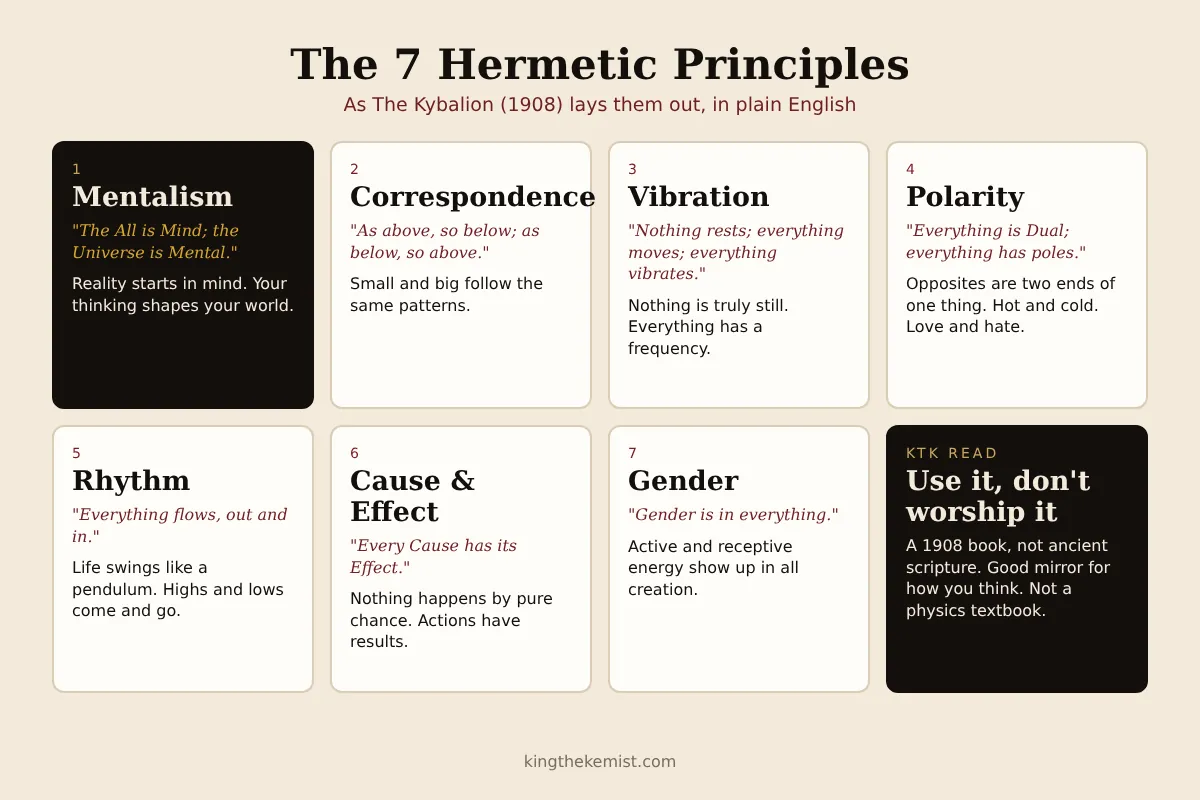
Here's the full list in one place
Is The Kybalion actually ancient Hermeticism?
Short answer: partly, but mostly no.
The real Hermetic tradition is built on texts like the Corpus Hermeticum, a group of Greek writings attributed to Hermes Trismegistus, generally dated to roughly the first few centuries AD. Marsilio Ficino translated them into Latin in the 1460s, and they had a huge influence on Renaissance thinkers. Add the Emerald Tablet, the oldest surviving version of which is Arabic and dates to roughly 750 to 833, and you've got the core of the tradition.
Those texts are about knowing God, the nature of the soul, how the cosmos is ordered and how a person gets back to the divine. They're mystical and full of dialogues and visions.
The Kybalion is something else. Scholar Nicholas E. Chapel, who has written about the book in detail, argues that it's too tied to early-1900s New Thought to stand for historical Hermeticism. In his reading, a few principles do have real Hermetic roots, especially mentalism, correspondence and a gendered polarity of creation. Others, like vibration, come from more modern ideas. Chapel traces the vibration idea back to the 18th-century English philosopher David Hartley, not ancient Egypt.
So The Kybalion is best understood as a 1908 American self-development book that borrows Hermetic language and a few Hermetic ideas, then organizes them around New Thought's belief in the power of the mind.

Why The Kybalion is still everywhere
If it's not ancient, why is it so popular?
It's simple. Seven principles, each with a one-line maxim. That's easy to remember and easy to share. The ancient texts don't fit on an Instagram slide.
It's empowering. Its core message is that your mind has power over your life. People want to hear that, especially when life feels out of control.
It feeds the Law of Attraction. New Thought ideas passed through a lot of later self-help, and the Law of Attraction became a mainstream phrase after the 2006 book and film The Secret. When people talk about "vibrating higher," they're usually standing on The Kybalion's shoulders whether they know it or not.
It sounds ancient. The "Egypt and Greece" subtitle and the anonymous "Three Initiates" give it mystique. That framing does a lot of work.
Common myths about The Kybalion
"It's thousands of years old." It was published in 1908.
"The seven principles are the original laws of Hermes." The ancient texts don't lay out a list of seven principles like this. The list is the book's own system.
"Science has proven the Principle of Vibration." Physics says particles and fields move and oscillate. That's not the same as proving that your thoughts have a vibration that attracts things. Be careful when someone uses "quantum" to sell you something.
"The Kybalion and the Emerald Tablet are the same thing." No. The Emerald Tablet is a short medieval Arabic text that The Kybalion quotes. I broke it down line by line in The Emerald Tablet, Line by Line.
"The Principle of Gender is about men and women." Not only. The book treats physical sex as one expression of Gender on the physical plane, but says the principle is broader and works on the mental and spiritual planes too.

How I'd actually use the seven principles
You don't have to believe the universe is literally a thought to get value out of this. Here's how I'd use each one as a practical lens:
- Mentalism: Check your thinking before you blame your situation. Is the story you're telling yourself helping you?
- Correspondence: Look at your small habits. They're a preview of your whole life.
- Vibration: Notice what changes your energy. Music, people, places, food, sleep. Use more of what lifts you.
- Polarity: When you feel the bad end of something, look for the other end of the same line. Fear can become focus. Anger can become drive.
- Rhythm: Don't panic in the low tide. Don't get cocky in the high tide.
- Cause and Effect: Pick one cause you control and start it today.
- Gender: Balance doing with receiving. Push, then listen. Write, then edit.
That's a solid framework for a life. You don't need to pretend it's 5,000 years old for it to work. Good ideas can come from a 1908 Chicago publisher. Good songs can come from a basement.
Quick answers
What is The Kybalion? A 1908 book, published in Chicago by "Three Initiates," that presents seven principles it calls the core of Hermetic philosophy.
Who wrote The Kybalion? It's usually attributed mainly to William Walker Atkinson, a New Thought writer. Whether others helped is debated.
What are the 7 Hermetic principles? Mentalism, Correspondence, Vibration, Polarity, Rhythm, Cause and Effect, and Gender.
Is The Kybalion ancient? No. It borrows from ancient Hermetic ideas, but the book and its seven-principle system date to 1908.
Is The Kybalion real Hermeticism? Partly. Scholars like Nicholas E. Chapel see real Hermetic roots in some principles, but argue the book is mainly a product of early-1900s New Thought.
What does "the All is Mind" mean? It's the Principle of Mentalism: the idea that the universe is a mental creation of one universal Mind.
Is The Kybalion the same as the Law of Attraction? Not exactly, but both come out of New Thought, and modern Law of Attraction teaching borrows heavily from Kybalion-style ideas.
Where does "when the student is ready, the teacher will appear" come from? Its exact origin is unclear. The Kybalion has a version of the idea: "When the ears of the student are ready to hear, then cometh the lips to fill them with Wisdom."
The bottom line
The Kybalion is a great door and a bad cage.
As a door, it's an easy way into some big ideas: patterns repeat, everything moves in cycles, opposites are connected, your mind matters and you can choose to be a cause in your own life.
As a cage, it becomes a reason to stop thinking, to believe anything with "vibration" in it, or to think a 1908 self-help book is ancient secret law.
Read it. Use what works. Know where it came from. That's how you handle any teacher.
Sources
- Wikipedia: The Kybalion
- The Kybalion (1908), full text at Sacred Texts
- Wikipedia: William Walker Atkinson
- Wikipedia: Corpus Hermeticum
- Wikipedia: Emerald Tablet
- Wikipedia: New Thought
— King